Why Some Animal Records Refuse To Fall
Wild animals don’t read record books, but evolution, physics, and ecology make some species so specialized that their superlatives are hard to beat. From speed to size to lifespan, certain champions sit on thrones built by millions of years of adaptation—and those records have held for decades because the limits of muscle, bone, drag, buoyancy, and metabolism don’t change quickly. If you love tricky trivia, learning why a record stands is just as important as memorizing the headline number.
Below is a tour of wild animal records that still stand, along with quick explanations, neat examples you can remember for quizzes, and practical tips to avoid common trick questions.
The Speed League
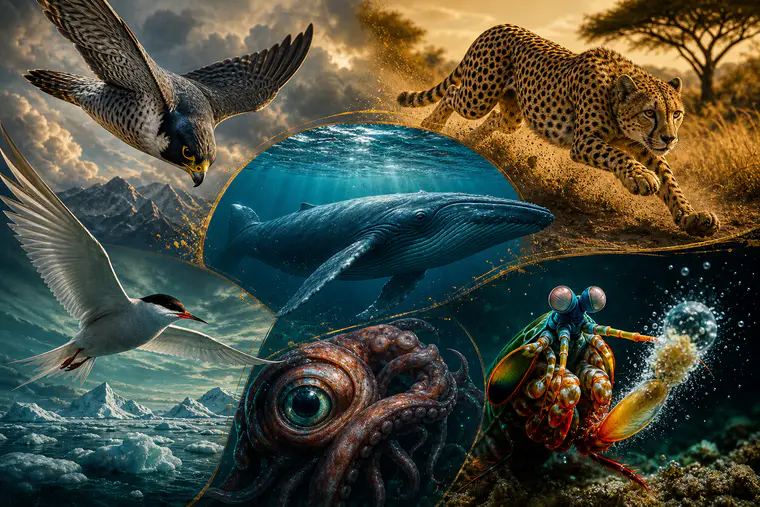
Fastest animal on Earth (overall): Peregrine falcon
- The peregrine’s high-speed stoop (dive) tops 200 mph. Gravity assists the dive, while stiff, narrow wings and a teardrop body reduce drag. Special baffles in the nostrils prevent lung damage at extreme airflow. That’s why no flapping flier can match a streamlined missile in a dive.
- Quiz tip: If the wording says “fastest animal,” not “fastest runner” or “fastest swimmer,” the answer is peregrine falcon—because diving flight counts.
Fastest land animal: Cheetah
- Cheetahs can hit freeway speeds (60–70 mph) in just a few seconds with explosive acceleration, long flexible spines, semi-retractable claws, and oversized nasal passages for airflow. Sprint distance is short; overheating is the limiting factor. Nothing else on land has the cheetah’s combination of traction and spring-loaded backbone.
- Watch for trick phrasing: “fastest over long distance” would not be cheetah—it fades quickly.
Fastest fish: Sailfish (with a caveat)
- Sailfish are often listed near the top with burst speeds reported around highway pace. Their spearlike bills and retractable dorsal “sail” streamline the body. Some sources argue for marlins, but the key idea is that hydrodynamics plus power translate to brief, blistering sprints—not marathon speed.
- Trivia-safe approach: If the options are “sailfish vs. cheetah vs. peregrine,” fastest overall is peregrine; on land, cheetah; in water, sailfish.
Titans of Size
Heaviest animal ever: Blue whale
- No dinosaur, no land giant compares. Adult blue whales can exceed 150 tons. Water’s buoyancy lets their frame grow without crushing their own weight, a hard limit for land animals. Their diet—tiny krill in vast numbers—powers a giant engine with a finely tuned filter-feeding system.
- Memorable fact: A blue whale’s heart is roughly the size of a small motorcycle, pumping tons of blood through a body as long as a basketball court.
Tallest land animal: Giraffe
- Giraffes stand around 16–19 feet tall thanks to elongated neck vertebrae (not extra ones—most mammals, including us, have seven). Their record height stands because a taller neck would make pumping blood to the brain dangerously difficult; giraffes already hold the crown for the highest blood pressure among animals.
Largest reptile: Saltwater crocodile
- Massive males can exceed 20 feet. Their size record endures because crocs have a semi-aquatic lifestyle that supports bulk while staying efficient predators. Evolution didn’t need them to be bigger.
Largest bird by weight: Ostrich
- Ostriches are ground-dwelling sprinters with powerful legs and a massive body compared to other living birds. Flightlessness removes the size limits that kneecap airborne species.
Powerhouse Performers
Strongest bite (measured): Saltwater crocodile
- Tests on big crocs have recorded bite forces exceeding 3,000 pounds of force. Their skulls are built like living bear traps. Among mammals, hippos and big cats have formidable bites, but crocs remain the heavyweight champs.
Strongest for body weight: Horned dung beetle
- The horned dung beetle has lifted or pulled over a thousand times its body mass in tests. That’s like a person hoisting several fully loaded cars. Insects often dominate relative-strength metrics because small bodies handle stress differently than large ones—surface area and cross-sectional scaling work in their favor.
Fastest strike: Mantis shrimp
- Some mantis shrimp swing their raptorial “clubs” so fast the water around them briefly vaporizes (a cavitation bubble). The blow can crack aquarium glass. They store energy with a biological spring-and-latch system, reaching accelerations greater than a bullet leaving a handgun relative to their size.
Masters of Sound and Sight
Loudest animal: Sperm whale (caveats apply)
- Sperm whales produce sonar clicks so intense that measurements near the source rank among the loudest biological sounds recorded. Loudness in water differs from air, and units can be confusing, but as a rule-of-thumb for quizzes, “sperm whale” is the accepted answer.
- Related curiosity: Pistol shrimp can generate an explosive snap that stuns prey; blue whales sing lower but carry farther.
Biggest eyes: Colossal squid
- Dinner-plate eyes help these deep-sea hunters detect faint silhouettes of prey (and predators) in near-blackness. Big eyes gather scarce photons; at depth, that can be the difference between a meal and becoming one.
Survivors And Extreme Travelers
Toughest all-around survivor: Tardigrade
- These tiny “water bears” endure extreme cold, heat, radiation, and even the vacuum of space by curling into a dessicated cryptobiotic state. They can slow their metabolism to a whisper and wait years for water to return. Their record stands because no large animal can pause life this completely without damage.
Deepest-diving mammal: Cuvier’s beaked whale
- Tagging studies have recorded dives approaching 3,000 meters and lasting over three hours. Specialized lungs collapse safely under pressure, and oxygen is banked in blood and muscle. Sperm whales also dive deep, but Cuvier’s beaked whale holds the edge for absolute depth and marathon duration.
Highest recorded bird flight: Rüppell’s griffon vulture
- Confirmed at airline-cruising altitudes, this vulture’s high blood-oxygen affinity and huge wings let it ride violent mountain updrafts. Bar-headed geese also cross the Himalayas, but Rüppell’s holds the record for altitude reached.
Longest migration: Arctic tern
- Arctic terns zigzag from polar summer to polar summer, completing globe-spanning circuits on the order of tens of thousands of miles each year. They see more daylight than any other animal. The strategy works so well that the record keeps standing—evolution has optimized them for endless summer.
Life Cycles And Longevity
Longest gestation among land mammals: African elephant
- About 22 months. Elephant calves are born neurologically advanced, which requires long prenatal brain development. A longer pregnancy is the evolutionary price for a walking, thinking heavyweight infant.
Largest egg (living land animal): Ostrich
- Ostrich eggs are the biggest regularly laid by any living land animal. They’re thick-shelled to withstand the weight of a brooding parent and resilient against predators.
Oldest known individual animal (verified age): Ocean quahog clam
- A particular quahog nicknamed “Ming” was dated to over five centuries. Clams lay down annual growth rings, letting scientists verify age like dendrochronology for trees.
Longest-lived vertebrate (best evidence): Greenland shark
- Radiocarbon dating of eye lens proteins suggests lifespans of several centuries. Cold waters, slow growth, and low metabolic rates help these sharks age at glacial speed.
Venom, Poison, And Defense
- Most venomous snake (by lab potency): Inland taipan. Its venom is extraordinarily toxic in small doses, though the snake is shy and bites are rare.
- Most toxic vertebrate (contact poison): Golden poison dart frog. Alkaloids in its skin can be lethal; Indigenous peoples historically tipped darts with this toxin. Captive-bred frogs fed non-toxic diets don’t develop the same chemical arsenal, a reminder that environment matters.
- Pain you won’t forget: Bullet ant and some stingrays rank high on pain indices, but “most venomous” and “most painful” are not the same record—watch those labels in quizzes.
Why These Records Still Stand
- Physics sets ceilings. Drag scales with speed; bones and tendons have finite tensile strength; air is less buoyant than water. That’s why the fastest overall (peregrine, using gravity) differs from the fastest level-flier, runner, or swimmer.
- Ecology sets trade-offs. Animals optimize for survival, not records. Cheetahs trade endurance for acceleration; blue whales trade agility for filter-feeding efficiency.
- Measurement matters. “Fastest,” “loudest,” and “most venomous” depend on how you measure. Responsible trivia accepts the consensus record and ignores one-off, poorly measured claims.
Quick-Reference Cheat Sheet
- Fastest overall: Peregrine falcon (dive)
- Fastest land: Cheetah
- Fastest fish: Sailfish (debatable with marlins, but sailfish is the safe pick)
- Heaviest ever: Blue whale
- Tallest land: Giraffe
- Strongest bite: Saltwater crocodile
- Strongest for size: Horned dung beetle
- Fastest strike: Mantis shrimp
- Loudest animal: Sperm whale (underwater)
- Biggest eyes: Colossal squid
- Deepest-diving mammal: Cuvier’s beaked whale
- Highest flight: Rüppell’s griffon vulture
- Longest migration: Arctic tern
- Longest gestation (land mammal): African elephant
- Largest egg (living land animal): Ostrich
- Oldest verified individual (animal): Ocean quahog clam
- Longest-lived vertebrate (evidence-based): Greenland shark
Smart Study Tips For Animal-Record Trivia
- Sort by habitat. Memorize “sky, land, sea” champions together: peregrine–cheetah–sailfish.
- Watch the wording. “Fastest animal” vs. “fastest runner” changes the answer. So does “nonstop” vs. “total migration distance.”
- Pair a record with a mechanism. Remember the adaptation: mantis shrimp’s spring-and-latch, peregrine’s nostril baffles, giraffe’s blood pressure, beaked whale’s collapsible lungs. Mechanisms make facts stick and help you eliminate wrong options.
- Use number anchors sparingly. You don’t need exact miles per hour; knowing “peregrine > cheetah > sailfish in their domains” wins most questions.
- Expect curveballs. A quiz might ask “largest egg by a living animal” (whale shark embryos are enormous but not laid externally) or “oldest vertebrate” (Greenland shark) rather than “oldest animal” (clam). Read carefully.
Classroom And Pub-Quiz Examples
- Example 1: Which animal has recorded the deepest dive among mammals? Correct: Cuvier’s beaked whale. Reasoning: specialized lungs, oxygen storage, pressure tolerance.
- Example 2: What bird sees the most daylight in a year? Correct: Arctic tern. Reasoning: pole-to-pole migration tracks endless summer.
- Example 3: A question asks “largest bird.” Clarify if they mean “by weight” (ostrich) or “by wingspan” (wandering albatross). If not specified, most setters mean “by weight.”
- Example 4: “Most venomous snake” gets asked constantly. The lab-potency champ is inland taipan, but the most dangerous to humans in practice is another debate entirely (habitat, temper, antivenom access).
Fun Connections To Remember
- Physics pairs: Drag vs. speed (peregrine’s dive beats cheetah’s sprint); buoyancy vs. size (blue whale vs. land mammals).
- Sense and survival: Colossal squid eyes for faint light; sperm whale clicks for hunting in blackness; vulture hemoglobin for thin air.
- Energy budgets: Cheetah’s overheating vs. elephant’s long prenatal brain-build; terns trading energy for endless summer.
Frequently Asked Questions
Are these numbers exact?
Not always. Field measurements vary by method and conditions. For most quizzes you only need the accepted champion, not a precise number.
Why isn’t the cheetah the “fastest animal” overall?
Because peregrine falcons in a dive reach much higher speeds thanks to gravity-assisted stoops and ultra-streamlined bodies. “Fastest animal” without context defaults to the peregrine.
What’s the difference between “venomous” and “poisonous” in trivia?
Venom is injected (fangs, stingers); poison is absorbed or ingested (skin, tissues). Inland taipan = venomous; golden poison dart frog = poisonous.
Could these records ever be broken?
Yes—especially as tracking tech improves (tiny GPS tags, better tags for deep divers). But physical and ecological limits mean many crowns—blue whale’s mass, cheetah’s sprint niche, peregrine’s dive—are likely to remain safe for a long time.
Approved member comments will appear here.