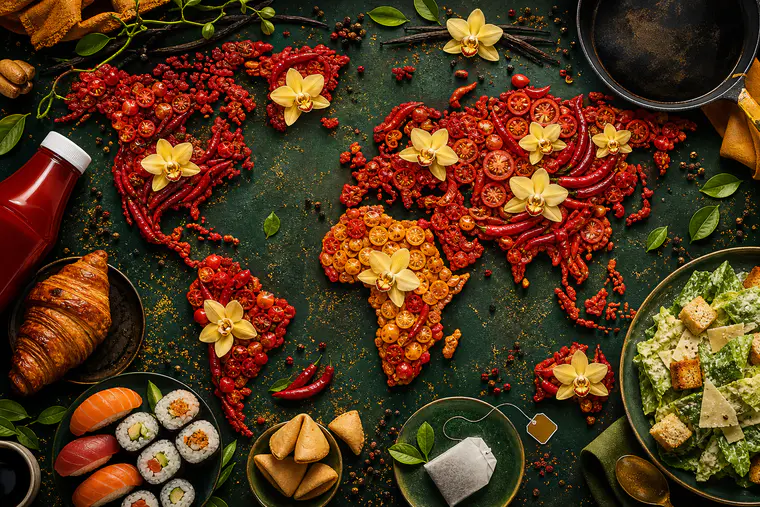
Why so many favorite foods have surprising backstories
If you’ve ever wondered why a “French” fry may be Belgian, or how a classic salad linked to Italy was actually born in Mexico, here’s the short answer: everyday foods are travelers. Recipes and kitchen habits migrate with people, trade routes, and technology. What we call “authentic” today often began as a clever adaptation somewhere else. The unexpected origins below don’t aim to spoil anyone’s comfort food—they add context you can bring to your next trivia night or dinner table conversation.
Sauces and condiments that took the long way around
Ketchup started as a fermented fish sauce
Modern ketchup is an American pantry staple, but the word traces to Hokkien Chinese terms like “kê-tsiap,” a centuries-old fermented fish sauce from the South China Sea region. European traders encountered it, brought versions home, and experimented with local ingredients. Tomato-based ketchup only became standard much later, as cooks in Britain and the United States adapted the idea to include tomatoes, vinegar, sugar, and spices. The bottle you squeeze today is the end point of a long chain of reinterpretations.
Worcestershire sauce was a happy accident
The umami-packed sauce associated with steak and Bloody Marys emerged in 19th‑century England, reportedly after chemists in the city of Worcester tried to reproduce flavors from abroad. A batch left to mature in barrels developed a deep complexity. Whether or not every detail of the origin tale is precise, the key takeaway is that the sauce’s signature depth comes from fermented, aged components layered over time.
Dishes whose birthplaces defy the label
Caesar salad: created in Mexico near the U.S. border
Despite the Roman name and frequent association with Italy, the best‑known origin story places Caesar salad in Tijuana in the early 1920s, credited to restaurateur Caesar Cardini. Cross‑border dining and Prohibition‑era travel helped the dish spread quickly to American audiences. If you’re quizzed on “Which country first served Caesar salad?” Mexico is a strong, widely cited answer.
Fortune cookies: California meets Japan, served in Chinese restaurants
The fold‑and‑fortune concept resembles Japanese confections that include small slips of paper, and the modern cookie was popularized in early 20th‑century California. After World War II, as Chinese restaurants expanded in the United States, fortune cookies became a standard end‑of‑meal treat in those establishments—even though they aren’t a traditional dessert in China. The cookie’s story is a reminder that cuisine is as much about diaspora communities as it is about old-country traditions.
Croissant: Austrian roots, Parisian icon
The flaky, buttery croissant is a French breakfast classic, yet its ancestor is the Austrian kipferl, a crescent‑shaped pastry. Bakers in Paris refined the technique with laminated dough, creating the airy layers people love today. Romantic legends tie the crescent shape to battles with the Ottoman Empire, but those tales are better viewed as folklore than as documented history.
Chicken tikka masala: a British‑South Asian creation
Variations of this creamy, tomato‑forward dish are commonly linked to South Asian chefs cooking in the United Kingdom in the latter half of the 20th century. It grew from the interplay between South Asian culinary traditions and local British preferences. While there isn’t a single agreed‑upon birthplace or date, the dish demonstrates how immigrant cooks tune recipes for new audiences, and how those new dishes can circle back into global menus.
General Tso’s chicken: Chinese American, not a mainland staple
Sweet, tangy, and crispy, General Tso’s chicken developed in North America. It’s not a common everyday dish in most of China. Like many Chinese American favorites, it uses familiar techniques—deep‑frying, balancing sweet and sour—tailored to local tastes, with a name that nods to Chinese history.
Ingredients that circled the globe
Chilies fired up Asia only after the 16th century
Many people assume chilies are native to India or Thailand because they are so integral to the cuisines. In fact, chili peppers originated in the Americas. They traveled to Asia after trans‑Atlantic contact, accelerated by trade networks including Portuguese routes. Within a few generations, chilies became essential across South and Southeast Asia.
Tomatoes and potatoes: New World ingredients, Old World icons
- Tomatoes, now central to Italian sauces and salads, came from the Americas. European cooks gradually embraced them, and Italy turned them into classics across centuries.
- Potatoes, also American in origin, became a European staple and eventually a foundation of global comfort foods—from gnocchi to pierogi to mashed potatoes.
Vanilla’s global leap hinged on a pollination breakthrough
Vanilla orchids are native to Mexico, where Indigenous communities cultivated them and where a specific bee naturally pollinates the flowers. In the 19th century, Edmond Albius on Réunion Island discovered a reliable hand‑pollination technique. That single innovation made large‑scale vanilla cultivation possible far from the plant’s original home.
Drinks and drinking habits with unexpected histories
Tea bags were a practical packaging idea
The tea bag, often credited to an American tea merchant who sent samples in small bags in the early 1900s, wasn’t originally meant to be brewed as-is. Customers tried steeping the entire pouch, found it convenient, and a new habit took hold. Over time, materials improved and the practice spread widely.
Coffee’s path: from the Horn of Africa to the world
Coffee plants are linked to Ethiopia, with early cultivation and trade through Yemen. Coffeehouses blossomed around the eastern Mediterranean and then Europe, becoming places for conversation and commerce long before today’s cafés. Espresso, pour‑over, and cold brew are modern chapters in a much older story of preparation methods transforming social life.
India Pale Ale tells a shipping story
The high‑hopped beers known as IPAs were refined in England to suit export markets, including long shipments to warmer climates. Extra hops and suitable strength helped beer travel better. While the simplified “invented for India” line doesn’t capture every nuance, the style’s reputation is tied to global trade and logistics, not just a single recipe moment.
Kitchen traditions that came from design, safety, and language shifts
Why the U.S. refrigerates eggs and many European countries don’t
In the United States, commercial eggs are typically washed to reduce surface contamination, which also removes a natural protective layer. Refrigeration then becomes the standard for safety and freshness. In many European countries, eggs are handled differently, and unrefrigerated display is common. The divergence is about supply‑chain practices rather than right vs. wrong.
“Entrée” means something different in the U.S.
In American restaurants, the entrée is the main course. In many other places, “entrée” can still imply an entry dish—what Americans might call an appetizer. The word’s journey is a linguistic clue to how dining customs evolve separately across regions.
Mise en place: not just chef talk, but a productivity tool
Mise en place—having ingredients prepared and organized before cooking—grew out of professional French kitchens. Home cooks adopted the practice because it works. For trivia lovers, it’s a reminder that kitchen traditions often begin as workflow solutions before they become “rules.”
Cast‑iron skillets, from ancient tech to modern heirlooms
Cast iron has a long history, with widespread use in Asia and Europe well before industrial mass production. In the United States, companies popularized affordable cast‑iron cookware in the late 19th and early 20th centuries. Its durability and heat retention made it a cross‑generational favorite that feels timeless, even though its widespread domestic adoption has a traceable industrial story.
Pressure cookers: centuries of science in a countertop pot
The underlying idea dates to early experiments with sealed vessels and steam pressure. Domestic pressure cookers came much later, bringing laboratory principles into home kitchens. Today’s stovetop and electric versions are descendants of that same concept: raise pressure to raise boiling point and cook faster.
Myths, debates, and what to say at trivia night
Origin stories are often messy, and that’s okay. When you share a fact, frame it accurately: some answers are “best evidence” rather than absolute. Here’s a quick guide for common stumpers.
- Potato chips: A popular U.S. tale credits a New York State chef in the 1800s, but similar thin‑sliced fried potatoes appear in earlier European cookbooks. Safe framing: the dish was popularized in 19th‑century America, with earlier precedents.
- French fries: Belgium and France both claim an early role. Safe framing: the exact birthplace is debated in the Low Countries/France region.
- Pizza Margherita: The story of a royal‑inspired pie with tricolor toppings is charming but not ironclad. Safe framing: Naples shaped modern pizza; the tricolor tale is contested.
- Carbonara: Competing theories connect it to Rome, coal workers, or wartime ingredients. Safe framing: a mid‑20th‑century Roman dish with multiple plausible origin paths.
- Mayonnaise: You’ll hear both French and Spanish claims (often the city of Mahón on Menorca). Safe framing: a European sauce with debated beginnings.
- Martini: Several towns and brands lay claim. Safe framing: its exact origin remains unclear; American bars played a major role in the cocktail’s rise.
When in doubt, it’s fair to say, “The best‑documented version is X, but there are competing stories.” You’re not dodging—you’re being precise.
How to turn food origins into a great trivia round
Pick a theme that travels
Build a quiz around a single ingredient’s journey. Example: “Chili peppers around the world.” Ask where they began (the Americas), which cuisines adopted them later (Indian, Thai, Korean, Sichuan, and more), and how they transformed regional dishes.
Use map questions with time windows
Instead of “Where was dish X invented?” try “Which region helped popularize this dish in the 19th century?” That wording rewards historical understanding and avoids trap answers when origins are murky.
Write either/or items that encourage nuance
- Was the Caesar salad first served in Mexico or Italy? (Mexico.)
- Are fortune cookies traditional in China or popularized in the U.S.? (Popularized in the U.S., with Japanese influences.)
- Did croissants originate in France or Austria? (Austrian roots; perfected in France.)
Tie kitchen tools to the science that shaped them
Ask why pressure cookers save time (higher pressure raises the boiling point), or why cast iron holds heat. These questions connect history to everyday usefulness.
Practical takeaways you can use tonight
- Read menus with curiosity: A “foreign‑sounding” dish might be a local adaptation. That’s part of the fun.
- When you hear a tidy origin myth, look for the trade route behind it. Spices, migration, and technology leave fingerprints on your plate.
- For trivia, phrase questions to reflect what’s well documented. Reward context, not just memorized dates.
- In the kitchen, consider mise en place and tool choice as historical solutions: they evolved because they solved real problems.
Frequently Asked Questions
Are fortune cookies Chinese or Japanese?
The modern restaurant fortune cookie is strongly associated with Chinese restaurants in the United States, but it has clear links to Japanese confections and took shape in early 20th‑century California.
Did Italy always cook with tomatoes and chilies?
No. Both tomatoes and chilies originated in the Americas and reached Europe and Asia after trans‑Atlantic contact. Italian and many Asian cuisines embraced them over time and made them essential.
Is the croissant truly French?
The croissant’s direct ancestor is the Austrian kipferl. French bakers developed the laminated, ultra‑flaky version that became iconic worldwide.
Why does the U.S. call the main course an “entrée”?
American usage evolved so that “entrée” refers to the main course, while in many other places it still hints at an introductory dish. It’s a linguistic shift rather than a universal rule.
Approved member comments will appear here.