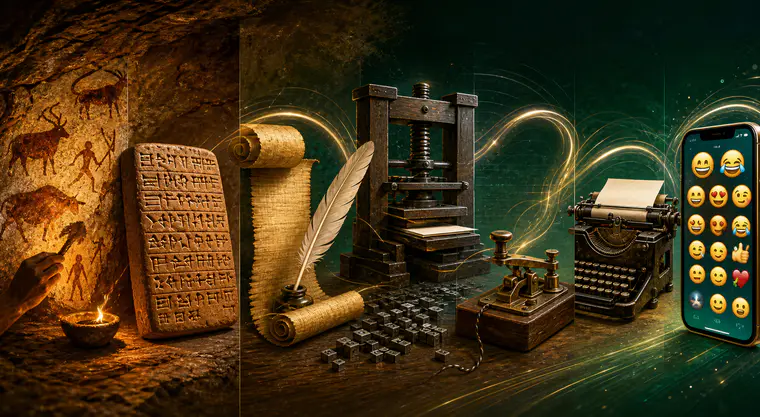
The Short Answer: We Learned by Turning Sounds and Ideas into Sharable Signs
If you’re here for the bottom line, it’s this: humans learned to communicate beyond speech by inventing external signs—marks, gestures, and eventually standardized symbols—that let ideas travel farther than a voice can carry and last longer than a memory. Each leap, from tally marks and pictures to alphabets, printing, and emojis, compressed meaning into efficient, widely understood codes. The fun twist for trivia lovers is that every stage left behind clues in the symbols we still use today, from the ampersand’s origins to why emojis don’t look the same on every phone.
Why Communication Needed More Than Voices
From memory to marks
Spoken language is powerful but ephemeral. Early humans began offloading memory to the environment: notches on bones to count, pigments on stone to tell stories, and portable tokens to track goods. These weren’t full writing systems yet, but they turned private knowledge into public, inspectable records.
The problem symbols solve
- Distance: Your voice fades; marks endure.
- Time: A scribed symbol can outlive its author.
- Scale: Larger groups need shared rules to coordinate.
Over time, the most useful marks stabilized into conventional signs: if everyone agrees that a certain squiggle means “five sheep,” trade and taxes get a lot simpler.
When Pictures Became Writing
Cuneiform, hieroglyphs, and the rebus trick
Around the fourth millennium BCE in Mesopotamia, Sumerian administrators pressed wedge-shaped signs into clay tablets—a system we now call cuneiform. Egyptian hieroglyphs emerged roughly around the same era on the Nile, combining pictures with sound values. A key insight driving these early scripts is the rebus principle: a picture can represent a sound (bee + leaf to suggest the word “belief,” for example). That idea lets a small set of signs build many words, unlocking abstract expression.
Multiple inventions, different solutions
- Mesopotamia: clay, commerce, and adaptable signs.
- Egypt: richly pictorial signs used in religious and monumental contexts.
- China: oracle-bone inscriptions by the late second millennium BCE, evolving into one of the world’s longest continuously used writing traditions.
- The Americas: Maya writing, a sophisticated logo-syllabic system used for history and astronomy.
These systems weren’t linear steps toward a single “best” script. They were locally optimized solutions to local needs—materials, languages, and institutions shaped what “worked.”
The Alphabet: Compression for Speed and Spread
From Phoenician traders to Greek vowels
Merchants along the Mediterranean used a set of signs for consonants—the Phoenician script—by the first millennium BCE. Greeks adapted it by adding letters for vowel sounds, which made reading and writing clearer and faster. Latin, derived from Greek via Etruscan, spread with the Roman world. Elsewhere, Brahmi scripts emerged in South Asia and diversified into writing systems used today for languages like Hindi and Tamil.
Lowercase letters, spaces, and the look of the page
- Uppercase and lowercase: In the manuscript era, scribes developed more rounded, faster-to-write letterforms; printers later sorted large capitals in the “upper case” drawer and small letters in the “lower case,” giving us the names we still use.
- Word spaces: Ancient scripts often ran letters together. Widespread spacing between words, adopted more consistently in medieval Europe, made silent reading easier and faster.
- The ampersand: “&” began as a stylized ligature of the Latin word “et” (and). It was so common it eventually became treated as a letter in some alphabets for teaching children.
The alphabet’s strength is efficiency: a few dozen symbols can represent thousands of words, producing a compact technology for copying, teaching, and spreading ideas.
Punctuation: Instructions for the Reader
Marks that guide breath, tone, and logic
Punctuation marks gradually taught readers how to pace and parse text.
- The period began as a dot signaling a pause; over time, different placements distinguished full stops from shorter breaks.
- The question mark likely evolved from a curving mark indicating a rising intonation.
- The exclamation point emphasized surprise or emphasis, originally combining a point with an elevated “i”.
- The paragraph mark (¶), or pilcrow, once introduced new sections before the now-familiar indented paragraph took over.
Symbols born from scribes and merchants
- The @ sign existed long before email. It appeared in mercantile and scribal contexts as shorthand for “at the rate of” or as a ligatured form from Latin.
- The # sign has a story that passes through weight measures (“lb.” for pound), printing, and telephony before the modern hashtag era. The shape’s history is older than the social media use you know now.
These marks—far from decorative—are tools. They compress stage directions for tone and logic into tiny, reusable signals.
Print: Mass Communication Becomes Routine
Standard pages, standard voices
With metal movable type in 15th‑century Europe, printing amplified communication. Consistency of letters and spacing standardized what texts looked like; printers’ choices shaped how readers expected information to be organized. Indexes, title pages, italics, and roman typefaces became widely legible conventions.
Over the centuries, dictionaries, spelling guides, and stylebooks emerged—not to freeze language, but to coordinate it. Coordinated rules reduce friction and help strangers understand one another at scale, whether in law codes, newspapers, or school primers.
Wires, Waves, and Screens: The Age of Shortcuts
Telegraph, telephone, radio, and codewords
The electric telegraph in the 19th century made speed and brevity essential. Morse code compressed letters to dots and dashes, with shorter patterns for frequent letters. Operators and hobbyists used numerical codes—like “73” for best regards and “88” for love and kisses—to save time. You can hear an echo of this culture in the way we use acronyms and abbreviations online.
The telephone lent itself to spontaneous speech, while radio and television broadcast one-to-many messages that relied on standardized language and timing. Each technology rebalanced the trade-offs between richness (tone, image, gesture) and economy (speed, cost per symbol).
Email, texting, and the return of tone markers
With keyboards back in our hands, we rediscovered an old problem: plain text strips away facial expression and tone. So writers got creative. ALL CAPS for shouting, repeated letters for emphasis (“sooo”), and brackets to signal stage directions [like this]. The famous sideways smiley :-) and :‑( popularized by early computer communities in the 1980s were quick hacks that worked.
Emojis: Pictures That Travel as Code
From pager art to a global standard
In the late 1990s, mobile services in Japan included tiny pictographs—early emojis—so users could add emotion and context in limited character spaces. Emojis crossed borders as smartphone makers added support and as the Unicode Consortium encoded them for consistent handling across platforms. Once a character is standardized in Unicode, any device that supports that version can display it, even though the visual design varies by vendor.
Why an emoji looks different on your phone
An emoji like the “grinning face” is defined abstractly in the standard, but each platform draws its own version, explaining small differences in expression or color. That’s why a message can feel slightly different depending on the sender’s and receiver’s devices. Skin-tone modifiers and gender variations are encoded as sequences—combinations of characters that your phone renders as a single image—illustrating how modern symbols still rely on compositional rules.
Are emojis a language?
They’re a flexible set of symbols, but not a full language on their own. You can’t easily express complex grammar or precise logic with emojis alone; instead, they function like gestures and intonation—supplements to text that add mood, context, or play. The broader point is familiar: we keep inventing little marks that carry just enough extra meaning to smooth the rough edges of written conversation.
A Practical Lens: Communication Is Compression + Convention
Across millennia, the same forces recur:
- Compression: We continually seek shorter, faster ways to package meaning.
- Convention: Symbols work only if communities agree on what they mean.
- Context: The medium (clay, parchment, type, screen) nudges what counts as “clear” or “efficient.”
Understanding this helps you read the present. Emojis aren’t a fad; they’re another iteration in a very long series of meaning-saving shortcuts.
Conversation-Ready Trivia You Can Use
- The alphabet is a code: A few dozen symbols map to thousands of words, making copying and teaching efficient.
- Uppercase/lowercase got their names from typesetters’ drawers: capitals in the upper case, small letters in the lower.
- & is a squished “et”: A Latin word turned into a durable symbol—and once taught as if it were the alphabet’s 27th character in some primers.
- Spaces between words were not a given: Ancient manuscripts often ran letters together; medieval scribes pushed spacing that made silent reading easier.
- Morse had its own emojis—sort of: Short numeric and letter codes for sentiments (“73” for regards) prefigure today’s “BRB” and “LOL.”
- The @ sign predates email: It appeared in mercantile and scribal contexts before being repurposed for addresses and tags.
- Not every hand gesture is universal: The thumbs‑up emoji can be read as positive in many places but may feel curt or even rude in certain contexts. As with language, local conventions matter.
- Emoji flags are built from letters: Many are rendered from pairs of regional indicator characters corresponding to country codes, not single picture files.
- QWERTY’s layout is often explained by typewriter mechanics: Early designs spread out commonly paired letters to reduce jams, a story that lingers even as the medium changed.
Reading Old Symbols—and New Ones—More Clearly
Ask three quick questions
- What was the medium? Clay favors wedges; phones favor tiny, colorful glyphs. The tool shapes the sign.
- Who needed it? Administrators, merchants, and priests often drove early writing; today, texters and platform designers shape emoji trends.
- What got standardized? Look for the rulebook—scribal habits, printing houses, dictionaries, or digital standards like Unicode. That’s where shared meaning hardens.
Try this on your next message
- Replace a vague adjective with a specific symbol sequence that’s widely understood. “I’m excited” can become “I’m excited 😄🎉” when tone matters more than detail.
- When clarity beats brevity, add a word instead of another icon. “Meeting moved to 3 PM” is clearer than a time emoji alone.
- Remember audience: if you’re texting across cultures or generations, prefer plainer language with sparing emoji for tone.
What This Journey Suggests About the Future
If history is a guide, we’ll keep layering lightweight signals onto language. New marks won’t replace words; they’ll braid with them. Animated reactions, generative visuals, and even subtle haptic cues could function like punctuation and emojis do now—small, quick additives that steer how text is felt as much as what it says. The enduring pattern is practical: we invent signs that save effort without losing meaning, then we standardize the ones that spread.
Strong Takeaway
From the first notches to the newest emoji pack, humans have learned to communicate by turning fleeting thoughts into durable, shareable signs—and by agreeing on rules for using them. That’s the trivia-friendly secret: today’s tiny icons carry the same ancient impulse as a clay wedge or a scribe’s flourish. Once you see that continuity, you can read—and write—across the centuries with more confidence and a few great stories to tell.
Frequently Asked Questions
What’s the oldest known writing system?
Scholars generally point to early cuneiform in Mesopotamia, appearing in the late fourth millennium BCE, and Egyptian hieroglyphs from roughly the same era. Other scripts, like early Chinese inscriptions and Maya writing, developed independently in different places and times.
Are emojis a real language?
Emojis are a helpful symbol set but not a full language with robust grammar. They work best alongside words, adding tone, emotion, or context—much like gestures or intonation in speech.
Why do emojis look different on different phones?
Emoji characters are standardized as abstract code points, but each platform draws its own artwork. The underlying “meaning” is shared, yet the design style can vary, nudging how a message feels.
Who invented the alphabet?
There wasn’t a single inventor. Consonantal scripts used by Phoenician speakers influenced the Greek adaptation that added vowels; Latin and many modern European alphabets descend from that lineage, while other regions followed different script families like Brahmi in South Asia.
Approved member comments will appear here.