Why surprising first jobs make great trivia (and what they teach us)
If you’re hunting for memorable quiz fodder—or a reminder that careers rarely follow straight lines—this guide is for you. History’s most recognizable names often worked ordinary, even odd, jobs before anyone knew them. Those early gigs didn’t just pay the bills; they sharpened habits, exposed them to new ideas, and sometimes delivered the exact skills that later set them apart. Below you’ll find concise, scannable snapshots of unexpected first jobs held by major icons, plus practical ways to turn these facts into strong quiz questions and conversation starters.
Use this list to build themed rounds (science, politics, arts), write tiebreakers that hinge on a single quirky detail, or inspire friends who feel stuck at a so‑called “detour” job. The real takeaway: detours can be the path.
Scientists and inventors who started off the beaten path
Albert Einstein — Patent clerk
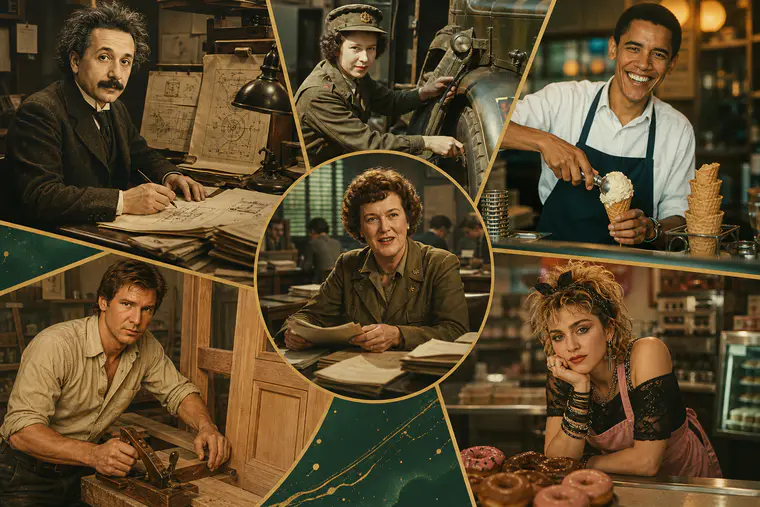
In 1902, long before the Nobel Prize and household-name status, Einstein worked as a technical expert at the Swiss Patent Office in Bern. Evaluating applications for electromagnetic devices demanded clear, practical thinking about how things really work. During his patent-office years, he published several papers—1905 is often called his “annus mirabilis”—that transformed physics. The quiet routine of close reading and problem-spotting turns out to be an underrated training ground for theory.
Michael Faraday — Bookbinder’s apprentice
Faraday, one of the pioneers of electromagnetism and electrochemistry, began by binding books and reading voraciously. That hands-on craft and self-education led him to public lectures, then to the lab of Humphry Davy. The bridge from trade skill to scientific discovery is a trivia-ready reminder that curiosity plus access to information can be catalytic.
Angela Merkel — Quantum chemist
Before becoming Germany’s chancellor, Merkel worked as a research scientist in quantum chemistry. The lab culture of careful measurement and peer review shaped a matter-of-fact, data-forward leadership style people later recognized on the world stage. It’s a powerful example of technical training crossing into public life.
Margaret Thatcher — Research chemist (myth-busting included)
Well before 10 Downing Street, Thatcher had a stint as a research chemist. A quick caveat that’s worth turning into a quiz misdirect: despite a persistent rumor, she did not “invent soft-serve ice cream.” The true story—early lab work followed by a pivot to law and then politics—makes the point that early-career experiments are common, even among future heads of government.
Leaders whose first jobs were wonderfully ordinary
Queen Elizabeth II — Wartime mechanic and driver
In 1945, the future monarch joined the Auxiliary Territorial Service, training as a driver and mechanic. Maintaining vehicles under wartime pressure gave her a ground-level sense of service and logistics. It’s one of those facts that sounds like a trick question but isn’t—perfect for a high-difficulty trivia clue.
Abraham Lincoln — Village postmaster
Years before the presidency, Lincoln served as postmaster of New Salem, Illinois, in the 1830s. The job put him in daily contact with nearly everyone—a front-row seat to local concerns and a steady stream of newspapers. Access to information and neighbors shaped both his reading habits and reputation for reliability.
Barack Obama — Ice cream scooper
As a teenager in Honolulu, Obama worked at Baskin-Robbins. He has spoken about how the repetitive work and sticky hands weren’t glamorous—but first jobs rarely are. For trivia writers, this one plays beautifully as a “Which U.S. president once did X?” stumper.
Pope Francis (Jorge Bergoglio) — Bouncer and chemical technician
Long before the papacy, Francis has said he worked as a nightclub bouncer and also as a chemical technician. Those experiences—face-to-face with people at their most human, and methodical work in a lab—underscore his later emphasis on dignity in everyday labor.
Artists and entertainers who clocked in like the rest of us
Harrison Ford — Carpenter
Before Star Wars and Indiana Jones, Ford was a self-taught carpenter in Hollywood. The craft kept him afloat financially and, crucially, put him in rooms with filmmakers who later hired him. It’s a clean illustration of how a side skill can become a networking engine.
Madonna — Donut shop employee
Before pop superstardom, Madonna reportedly lasted only a short time at a Dunkin’ Donuts in New York City. Service work in a new city was part of a scrappy climb that included dance classes, demos, and club gigs. Short tenure or not, it’s an all-time great one-liner for music rounds.
Brad Pitt — Giant chicken mascot
One of Pitt’s early Los Angeles jobs was dressing in a chicken suit to hand out flyers for a fast-food chain. It’s the kind of detail that sticks in a player’s brain and makes for a perfect visual clue.
Whoopi Goldberg — Mortuary cosmetologist
Before EGOT status, Goldberg worked doing cosmetology for the deceased. The job required emotional steadiness and technical skill—qualities that later read as poise on stage and screen.
Steve Buscemi — Firefighter
Buscemi served as a New York City firefighter (Engine 55) before acting took off, and he later returned to volunteer alongside former colleagues after the September 11 attacks. That backstory adds gravity to a face audiences know mostly from character roles.
Johnny Cash — Air Force radio intercept operator
Before the Man in Black, Cash served in the U.S. Air Force in Germany, working as a Morse code intercept operator. Long hours of focused listening and pattern recognition are a poet’s version of ear training.
Elvis Presley — Truck driver
Elvis worked as a truck driver for Crown Electric in Memphis before his recording career began. The detail fits neatly into questions that ask players to match everyday jobs with future legends.
Ozzy Osbourne — Slaughterhouse worker
Long before fronting Black Sabbath, Osbourne held tough, gritty jobs, including working in a slaughterhouse in Birmingham, England. It’s a stark contrast to the theatrics of heavy metal—and a great misdirection when quizzers assume “record store clerk.”
Writers and storytellers who drew from day jobs
J.K. Rowling — Bilingual secretary and teacher
Rowling worked as a researcher and bilingual secretary at Amnesty International in London, and later taught English abroad. Exposure to human-rights casework and cross-cultural classrooms shaped a careful observer who layered big themes into popular fiction.
Stephen King — Janitor and laundry worker
Before bestseller lists, King worked a string of jobs, including janitorial work and in an industrial laundry. Those settings—and the feeling of scraping by—echo across his early short stories and novels. Trivia angle: ask teams to identify the writer from a list of blue-collar jobs.
Agatha Christie — Pharmacy dispenser
During World War I, Christie served as a dispenser, learning the properties and dosages of common medicines and poisons. That practical knowledge threads through her detective fiction with unusual precision.
Walt Disney — Ambulance driver and commercial artist
After World War I, Disney drove ambulances for the Red Cross in France and later worked as a commercial artist. A sketcher’s eye and a knack for visual storytelling were there from the start, even if the medium—animation—came later.
Maya Angelou — Streetcar conductor
As a teenager in San Francisco, Angelou worked as a streetcar conductor. The discipline and public-facing nature of the job foreshadowed the commanding presence of her performances and readings.
Vincent van Gogh — Lay preacher and missionary
Before painting full-time, Van Gogh served as a lay preacher and missionary, notably in the Borinage region. The empathy and intensity of that period echo in the emotional force of his later canvases.
Patterns you can use to craft stronger quiz questions
When you look across these stories, certain themes pop:
- Hands-on, service-heavy jobs train observation and empathy (postmaster, driver, streetcar conductor, firefighter).
- Repetitive routine builds patience for long projects (ice cream scooping, laundry, assembly-line or clerical tasks).
- Technical apprenticeships translate surprisingly well to leadership (chemist to chancellor, mechanic to monarch-in-waiting).
- Short, scrappy gigs can open crucial networks (carpentry in Hollywood, commercial art in a studio town).
- Early exposure to real-world constraints turbocharges creativity later (patent office, pharmacy counter).
Turn those patterns into formats that play well under time pressure:
- “Match the icon to their first job” with one plausible decoy per clue.
- “Which one of these jobs did this person NOT do?” to test depth of knowledge.
- “Order these early jobs chronologically” to make tiebreakers fair and skill-based.
Quick-hit trivia you can use tonight
- Which future physicist reviewed electromagnetic inventions at a patent office? Albert Einstein.
- Which future monarch trained as a wartime driver and mechanic? Queen Elizabeth II.
- Who wore a chicken suit to hand out flyers before winning an Oscar? Brad Pitt.
- Which novelist learned about poisons while working as a dispenser? Agatha Christie.
- Which future U.S. president scooped ice cream in Honolulu as a teen? Barack Obama.
- Who was a self-taught carpenter before landing career-defining roles? Harrison Ford.
- Which rock legend drove a truck in Memphis? Elvis Presley.
- Who served as a New York City firefighter before becoming a beloved character actor? Steve Buscemi.
How to turn this into a memorable themed round
Pick a lane. Choose “Leaders,” “Page to Stage,” or “From Lab Coat to Spotlight.” Keeping a tight theme makes recall cleaner for players.
Layer difficulty. Start with widely known pairings (Einstein—patent clerk), then escalate to lesser-known ones (Van Gogh—lay preacher, Merkel—chemist). Aim for a 3-3-3 split across easy, medium, hard questions in a 9‑question round.
Write with precision. Use job titles as they were known at the time (e.g., “Auxiliary Territorial Service driver” rather than a vague “mechanic”). When a famous myth exists, acknowledge it and turn it into a clever decoy, not a false claim.
Reward educated guesses. Well-constructed choices let players reason: a chemist background fits a methodical leader; a bookbinder’s apprentice fits a scientist who loved reading.
A few more gems worth knowing
- John Wayne worked as a studio prop man after a football injury ended his college career.
- Margaret Thatcher’s chemist period is real; the soft-serve myth is not.
- Rowling’s Amnesty International stint explains why her early drafts pay attention to bureaucratic detail.
- Cash’s intercept work in Germany hints at the rhythm and restraint in his music.
The strong takeaway
The throughline isn’t that greatness lurks in a specific job. It’s that habits formed in the margins—precision, empathy, stamina, curiosity—compound over time. For quiz hosts, these stories are gold because they’re counterintuitive yet verifiable. For everyone else, they’re a reminder that the title on your badge today says little about what you might create next.
Frequently Asked Questions
What counts as an “unexpected” first job?
A role that doesn’t obviously connect to someone’s later fame. A patent clerk becoming a physicist or a monarch serving as a mechanic surprises because it breaks our assumptions about linear careers.
Are some of these stories myths?
A few famous anecdotes get exaggerated over time. When in doubt, phrase clues carefully (e.g., Thatcher was a research chemist, but not an inventor of soft-serve). Avoid repeating claims you can’t verify.
How do I adjust difficulty for different audiences?
For casual nights, use iconic pairings (Elvis—truck driver). For seasoned trivia fans, ask for specifics (Einstein’s city, Lincoln’s exact role, or which military branch Johnny Cash served in).
Can I build a whole quiz around this theme?
Absolutely. Mix categories (science, politics, arts), balance global figures, and include one myth-busting question to keep teams on their toes. Close with a chronology tiebreaker that orders three jobs or milestones.
Approved member comments will appear here.