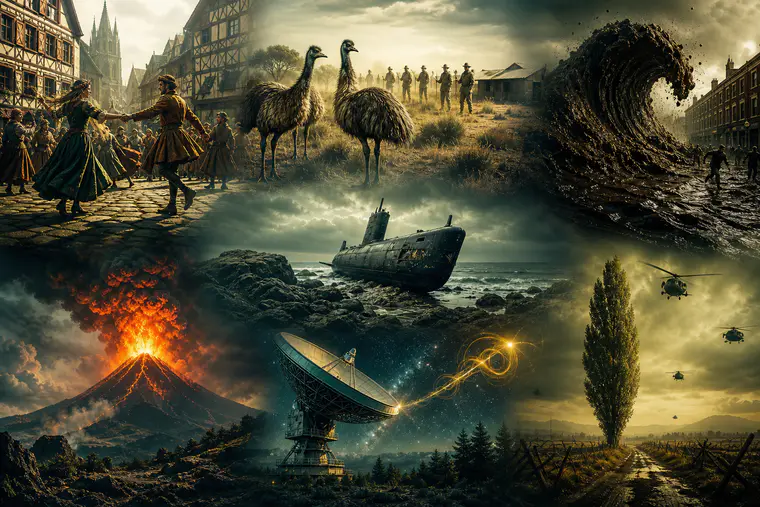
Why these stories sound fake — and how we know they are real
If you love trivia, you have probably heard a few jaw-droppers that seem too wild to be true. Good news: many of the most outlandish tales are backed by dates, places, and contemporary records. This guide gives you 15 strange-but-true historical events you can confidently share at your next quiz night or friendly debate. For each entry, you will get what happened, when and where it occurred, and why historians think it unfolded the way it did.
Use these to surprise your audience, but also to model how careful trivia players separate folklore from fact.
How to use this list for better trivia
- Lead with the date and place. It instantly grounds a bizarre claim.
- Offer one clear sentence that explains why it matters.
- Avoid overconfident causes when evidence is thin; say what scholars think, not what you wish were true.
- Keep a 10-second quiz hook ready for each item.
15 historical events that sound completely made up — but happened
1. The Dancing Plague of 1518
In the summer of 1518, residents of Strasbourg, then part of the Holy Roman Empire, began dancing involuntarily in the streets. The episode grew to dozens, then hundreds, over weeks. Local authorities even hired musicians, believing more dancing would cure the affliction.
No single cause has been proven. Hypotheses include mass psychogenic illness under stress and, less likely, ergot poisoning. What is well documented are the dates, the city, and the civic responses recorded by chroniclers.
Quiz hook: An actual dance craze with no music, Strasbourg, 1518.
2. Australia’s Great Emu War (1932)
After emu populations damaged crops in Western Australia, a short-lived military culling operation in late 1932 used soldiers with machine guns to reduce numbers. The birds scattered, proved hard to target, and the operation was widely mocked as a failure. The nickname Emu War stuck.
It was not a declared war, but the involvement of military personnel and equipment makes the label hard to resist.
Quiz hook: The side with feathers outmaneuvered the one with machine guns.
3. The Cadaver Synod (897)
Pope Stephen VI put his deceased predecessor, Pope Formosus, on trial in Rome. The corpse was propped on a throne, a deacon answered the charges, and the dead pontiff was declared guilty. The verdict was later annulled, but the spectacle is described by multiple medieval sources and remains one of the most macabre episodes in papal history.
Quiz hook: A papal trial with a defendant who could not object.
4. Defenestration that helped start a war (1618)
In Prague, Protestant nobles threw two imperial officials and their secretary out of a castle window during a political crisis. Tradition holds they survived by landing in a dung heap below. The incident escalated quickly and helped ignite the Thirty Years’ War, one of Europe’s most devastating conflicts.
Quiz hook: Three men out a window, decades of war to follow.
5. The Tunguska airburst over Siberia (1908)
On the morning of 30 June 1908, a powerful explosion flattened vast swaths of taiga near the Tunguska River in remote Siberia. No impact crater has been confirmed; the leading explanation is an airburst of a small asteroid or comet fragment. Trees were leveled for miles around, but few human casualties were reported due to the area’s sparse population.
Quiz hook: The largest modern cosmic bang that left no obvious crater.
6. Operation Mincemeat: a spy ruse with a corpse (1943)
During World War II, British intelligence dressed a corpse as a Royal Marine officer, planted misleading documents about Allied invasion plans, and released the body off the coast of Spain. The false papers suggested Greece and Sardinia were targets, helping to divert Axis attention from the real objective, Sicily. It is one of history’s most famous deception operations.
Quiz hook: The briefcase that moved armies without firing a shot.
7. The volcano that made a year feel like winter (1815–1816)
Mount Tambora in present-day Indonesia erupted spectacularly in April 1815, injecting ash and gases high into the atmosphere. The following year, 1816, is remembered in parts of North America and Europe as the Year Without a Summer. Cold snaps and crop failures were widely reported. The gloomy season even colors literary lore, with a stormy Swiss summer linked to the circle that produced Mary Shelley’s Frankenstein.
Quiz hook: One volcano, global weather weirdness the next year.
8. A plan to build an aircraft carrier from reinforced ice (1942–1943)
In World War II, British planners studied Project Habakkuk: a massive aircraft carrier made from pykrete, a mixture of ice and wood pulp that is stronger and slower to melt than plain ice. A small prototype was tested on a Canadian lake. The full-scale ship never left the drawing board, but the memos, models, and materials are part of the historical record.
Quiz hook: The unsinkable carrier concept made of frozen sawdust.
9. The Wow! signal: 72 seconds of radio mystery (1977)
On 15 August 1977, a radio telescope in Ohio picked up a strong, narrowband signal from space. A volunteer astronomer wrote Wow! in the margin of the printout, and the name stuck. The signal has not been reliably repeated, and its origin remains unknown. It is one of the most famous one-off detections in the search for extraterrestrial intelligence.
Quiz hook: A mysterious space ping that lasted just over a minute.
10. Boston’s wave of molasses (1919)
On 15 January 1919, a large storage tank burst in Boston’s North End, sending a fast-moving wave of molasses through city streets. Buildings were damaged, rail lines were twisted, and 21 people died. Lawsuits followed, and the disaster prompted greater attention to industrial safety and construction standards.
Quiz hook: A flood so sticky that rescue efforts bogged down.
11. The Battle of Los Angeles false alarm (1942)
In the tense months after the Pearl Harbor attack, searchlights and anti-aircraft guns lit up the sky over Los Angeles on the night of 24–25 February 1942. Hundreds of shells were fired at what turned out to be a false alarm. No enemy aircraft were recovered. Nervous operators, poor visibility, and misidentification likely combined to trigger the barrage.
Quiz hook: A furious night of anti-aircraft fire with nothing to hit.
12. A Soviet submarine beached on Swedish rocks (1981)
A Whiskey-class Soviet submarine, later nicknamed Whiskey on the Rocks, ran aground near Sweden’s Karlskrona archipelago in October 1981. The incident sparked a tense standoff in neutral Sweden’s waters. After inspections and negotiations, the submarine was eventually refloated and left under escort. The episode fed Cold War anxieties and maritime lore alike.
Quiz hook: Not a spy novel scene — an actual sub stuck in plain sight.
13. The Kentucky meat shower (1876)
On a March afternoon in 1876 near Olympia Springs, Kentucky, flakes of what looked like raw meat fell over a small area. Samples were sent for examination; contemporary accounts suggested animal tissue. The leading natural explanation is that vultures, startled in flight, regurgitated their meals, which then fell as odd-looking pieces. Whatever the cause, newspapers eagerly documented the bizarre rain.
Quiz hook: The day the sky served mystery meat.
14. The exploding whale of Oregon (1970)
When a dead whale washed ashore near Florence, Oregon, highway officials used dynamite to dispose of the massive carcass on 12 November 1970. The blast showered the area with chunks of blubber, damaging property and creating a lasting cautionary tale. A local TV report turned the fiasco into a legend replayed for decades.
Quiz hook: A cleanup plan that went off with unintended consequences.
15. Operation Paul Bunyan: cutting a tree with an army (1976)
After a deadly clash in the Korean Demilitarized Zone, United States and South Korean forces returned days later with a carefully choreographed show of overwhelming force to cut down a poplar tree that had obstructed a line of sight. Chainsaws did the work while large numbers of troops, vehicles, and aircraft stood by. The tree fell; no shots were fired.
Quiz hook: The most heavily guarded lumberjack job in history.
What these tales teach us
These episodes are fun to share because they are both entertaining and well attested. They also model good trivia habits:
- Extraordinary claims can be true, but they need ordinary anchors — names, dates, documents.
- Causes are complex. It is fine to say scholars disagree or that multiple factors likely played a role.
- The practical payoff is memorability. A precise date or vivid image (a molasses wave, a grounded submarine) helps you retell a story accurately months later.
Quick reference: dates and places at a glance
- Dancing Plague: Strasbourg, 1518
- Great Emu War: Western Australia, 1932
- Cadaver Synod: Rome, 897
- Defenestration of Prague: Prague, 1618
- Tunguska event: Siberia, 1908
- Operation Mincemeat: Mediterranean theater, 1943
- Tambora and the Year Without a Summer: Indonesia eruption 1815; global effects 1816
- Project Habakkuk: UK and Canada, 1942–1943
- Wow! signal: Ohio, USA, 1977
- Boston Molasses Flood: Boston, USA, 1919
- Battle of Los Angeles: Los Angeles, USA, 1942
- Whiskey on the Rocks: Sweden, 1981
- Kentucky meat shower: Kentucky, USA, 1876
- Exploding whale: Oregon, USA, 1970
- Operation Paul Bunyan: Korean DMZ, 1976
The strong takeaway
When a story sounds made up, do not dismiss it — date it, place it, and check what the best sources actually say. That habit turns trivia into knowledge you can trust and share.
Frequently Asked Questions
Are any of these events hoaxes or urban legends?
No. Every event listed here appears in credible historical records, newspapers, or official documents. In a few cases the causes are debated, but the events themselves are well attested.
Why avoid neat single-cause explanations?
History is rarely tidy. For example, the Dancing Plague likely involved social stress and psychology; the Tunguska blast is consistent with a cosmic airburst, but details are still studied. Saying what is most likely — and what remains uncertain — keeps your facts honest.
What makes a good trivia version of these stories?
Lead with a date and a vivid image, then give a one-line takeaway. Example: Boston, 1919 — a molasses tank burst and a sticky wave killed 21 people, prompting new safety scrutiny.
Can I use these in a quiz without extra research?
Yes, if you stick to the core facts provided here. If you want to add colorful details or numbers, verify them with a reputable source first, because embellishments are where errors usually creep in.
Approved member comments will appear here.