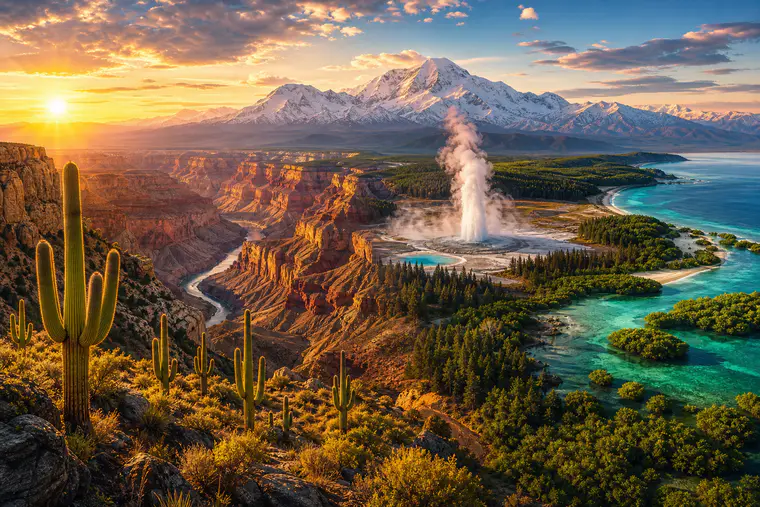
Why America’s national parks are so interesting
If you’ve ever wondered why the U.S. national parks inspire such strong feelings—and make such great quiz material—the short answer is range. Within a single system you’ll find the continent’s loftiest peak and one of its lowest basins, temperate rainforests and cactus gardens, living volcanoes and million‑year rock records, plus stories of Indigenous cultures, scientific discovery, and changing ideas about conservation. That blend of natural extremes and human history is the heart of national parks fun facts: each park protects something distinctive, and those distinctions add up to a bottomless trove of trivia.
This guide assembles evergreen, responsibly sourced facts you can use in conversation, study, or your next quiz night. When you’re ready to test yourself, try our National Parks Quiz (and share it with a park‑loving friend) at the end.
What “national park” actually means
The United States has many types of federally protected places, and that variety is part of the fun:
- National parks: Large natural areas set aside to preserve outstanding scenery, geology, ecosystems, and recreation. They’re managed by the National Park Service (NPS), which was established in 1916 to care for parks and monuments “unimpaired for the enjoyment of future generations.”
- National monuments: Protected for their historic, cultural, or scientific importance. They can be designated by Congress or by the President under the Antiquities Act. Some later become national parks; others remain monuments.
- Preserves, seashores, lakeshores, historic sites, and more: The NPS manages many designations beyond “park.” In Alaska, several units are “national park and preserve,” reflecting different rules for activities such as hunting and subsistence use.
One quick tip for trivia: a site’s title often hints at what’s special about it. “Canyonlands,” “Petrified Forest,” “Mammoth Cave,” and “Dry Tortugas” don’t hide the lede.
Natural extremes that make great national parks fun facts
America’s parks are full of superlatives that are stable over time—perfect for your memory bank.
Heights, depths, and sizes
- Denali National Park and Preserve in Alaska contains Denali (formerly Mount McKinley), the highest peak in North America at 20,310 feet above sea level.
- Death Valley National Park in California and Nevada includes Badwater Basin, a salt flat that sits well below sea level and is among the lowest points on the continent.
- Wrangell–St. Elias National Park and Preserve, also in Alaska, is commonly cited as the largest U.S. national park by land area, dwarfing many states.
- By contrast, Gateway Arch National Park in Missouri protects a small but culturally significant site—the stainless‑steel arch and surrounding grounds on the Mississippi Riverfront—illustrating that “national park” can encompass landmarks as well as vast wilderness.
Fire, ice, and ancient stone
- Hawai‘i Volcanoes National Park protects Kīlauea and Mauna Loa, two of the world’s most studied volcanoes; eruptions there have helped scientists better understand how shield volcanoes grow.
- Mount Rainier National Park in Washington contains the most glacial ice on any single peak in the contiguous United States, feeding rivers that supply millions of people downstream.
- Grand Canyon National Park reveals a cross‑section of deep time. Rock layers at the canyon’s bottom are more than a billion years old, while the youngest rim strata are far newer—an open textbook of Earth history.
Forest giants and desert specialists
- Sequoia National Park in California shelters the General Sherman Tree, widely recognized as the largest tree on Earth by wood volume.
- Redwood National and State Parks in northern California protect groves of coast redwoods, among the tallest trees on the planet.
- Saguaro National Park in Arizona protects the iconic saguaro cactus, a species native to the Sonoran Desert that can live for many decades and grow into towering, many‑armed silhouettes.
Caves and underwater worlds
- Mammoth Cave National Park in Kentucky contains the longest known cave system on Earth, with hundreds of miles of mapped passageways and more discovered over time.
- Dry Tortugas National Park in Florida is mostly open water and coral reef. Its remote islands host seabird colonies and the massive 19th‑century Fort Jefferson.
- Biscayne National Park, also in Florida, protects mangrove shorelines, clear shallows, and the northern Florida Keys, making it a national park that is primarily marine.
Wildlife surprises (and how to watch responsibly)
If you enjoy wildlife trivia, the national parks deliver across different habitats.
- The Everglades are famous as a place where American crocodiles and American alligators live in overlapping ranges—a rare combination in the wild.
- Yellowstone protects one of the largest intact temperate‑zone ecosystems on the planet and is home to free‑ranging bison, elk, wolves, and grizzly bears. Its geysers and hot springs—part of an immense ancient caldera—add yet another layer of uniqueness.
- Channel Islands National Park off California preserves isolated habitats where several species evolved in place; it’s known for endemism (species found nowhere else).
- The Great Smoky Mountains host exceptionally rich plant and animal diversity for a temperate forest, thanks to complex terrain and moisture.
Responsible viewing is part of the story. The NPS typically advises keeping at least 25 yards (roughly 23 meters) from most wildlife and at least 100 yards (about 91 meters) from bears and wolves. Individual parks may set stricter rules, so always check local guidance before you go.
People, culture, and the “park idea”
National parks preserve human stories alongside natural wonders.
- Yellowstone (established in 1872) is often called the world’s first national park. The “park idea” that grew from it—protecting places for public benefit—has influenced conservation worldwide.
- The name Denali comes from a Koyukon Athabascan word often translated as “the high one,” reflecting Alaska Native connections that long predate written records. Across the system, many park names and interpretation programs now emphasize Indigenous stewardship and place‑based knowledge.
- Mesa Verde National Park in Colorado preserves remarkable cliff dwellings built by the Ancestral Pueblo people. Its stonework and setting make it one of the most striking archaeological parks in the United States.
- Hot Springs National Park in Arkansas traces its federal protection back to 1832, when Congress set aside the hot springs and surrounding land—decades before the NPS existed—highlighting early American interest in public health, recreation, and natural resources.
How to turn park knowledge into quiz power
Trivia rewards sticky facts and vivid details. Here are study approaches that work well with national park topics:
- Link a park to a single, high‑contrast image: geysers for Yellowstone, hoodoos for Bryce Canyon, mangroves for Biscayne. Strong mental pictures cue recall quickly.
- Pair superlatives with place names: “Highest peak—Denali”; “Longest cave—Mammoth Cave”; “Lowest point—Badwater Basin.”
- Use names as clues to geography: “Glacier Bay” and “Kenai Fjords” signal Alaska; “Dry Tortugas” hints at Florida and sea turtles.
- Note unusual combinations: a national park that’s mostly water (Biscayne), a park that protects living volcanoes (Hawai‘i Volcanoes), or a park famous for fossilized wood (Petrified Forest).
Try these warm‑ups, then challenge yourself in our National Parks Quiz at the end.
Sample Q&A you can memorize
- Which park contains North America’s highest peak? Denali National Park and Preserve.
- Where is the longest known cave system? Mammoth Cave National Park in Kentucky.
- Which park includes one of the lowest places in North America? Death Valley National Park (Badwater Basin).
- Which park is best known for living, study‑ready shield volcanoes? Hawai‘i Volcanoes National Park.
- Which park protects the largest single tree by volume? Sequoia National Park (the General Sherman Tree).
- Which park is primarily marine, with mangroves, clear bays, and the northern Florida Keys? Biscayne National Park.
Visiting tips that add context to your facts
Being on the ground makes trivia come alive. A few timeless principles will keep your plans solid and your knowledge accurate:
- Check the official NPS website for operating hours, weather alerts, road or trail closures, and safety notices. Conditions can change quickly, especially in mountain, desert, or coastal parks.
- Understand elevations and distances. A “short” alpine hike can feel very different than a flat coastal walk. In desert parks, bring and drink more water than you think you’ll need.
- Respect archaeological sites and living landscapes. Many parks protect places of ongoing cultural importance; stay on paths, leave artifacts undisturbed, and learn before you go.
- Practice Leave No Trace principles—pack out your trash, store food properly around wildlife, and keep to durable surfaces to protect fragile soils and vegetation.
A few more evergreen, quiz‑worthy nuggets
- Not all national parks are in the 50 states. The National Park of American Samoa lies south of the equator and protects rare tropical rainforest, coral reefs, and traditional village lands under cooperative agreements.
- Some parks are best explored by boat. Voyageurs in Minnesota is famous for interconnected lakes and island campsites, while Dry Tortugas and Isle Royale are reachable mainly by boat or seaplane.
- Lava, ice, wind, and water all shape parks differently. That’s why arches dominate Arches National Park, hoodoos crowd Bryce Canyon, and glacial valleys carve Yosemite.
Your next step: put your knowledge to the test
You now have a framework for understanding why these places are endlessly interesting: diverse designations, natural extremes, deep time, wildlife, and layered human stories. Turn that understanding into recall—and bragging rights—by taking our National Parks Quiz. It’s a quick, fun way to see which facts stuck and which ones to study next.
Take the National Parks Quiz here: /quizzes/national-parks
Frequently Asked Questions
How many U.S. national parks are there?
The exact number can change when Congress creates a new park or when designations shift. It’s safe to say there are more than 60 today. For the most current list, check the National Park Service website.
What’s the difference between a national park and a national monument?
Both are managed to protect important resources, but parks are usually created by Congress to preserve large natural areas, while monuments can be designated for cultural, historic, or scientific features and may be established by Congress or by the President. Some monuments later become parks.
When is the best time to visit a national park?
It truly depends on the park and your goals. Alpine areas have short, snow‑free summers; deserts are pleasant in cooler months but dangerously hot in midsummer; coastal and rainforest parks can be rainy year‑round. Always check seasonal conditions and closures before you go.
Are pets allowed in national parks?
Policies vary. Many parks allow leashed pets in campgrounds, paved areas, and some roads but restrict them on trails or in backcountry to protect wildlife and people. Review each park’s rules before visiting, and never leave pets in hot cars.
Approved member comments will appear here.