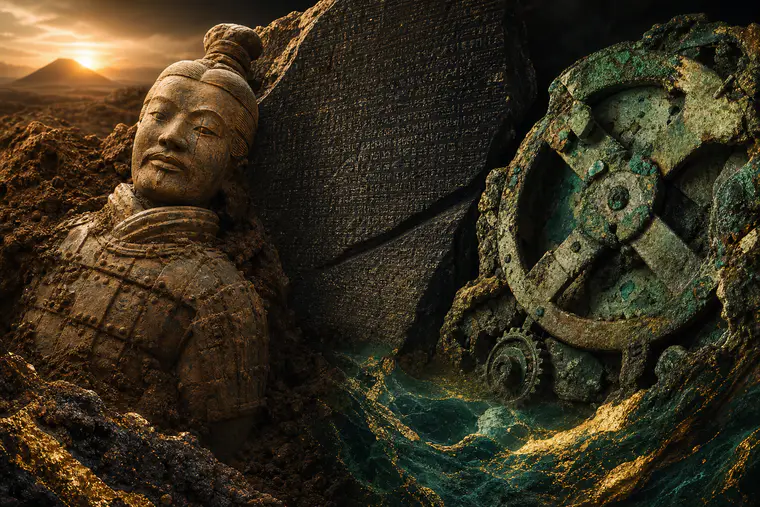
You’re here because you love those quiz-night moments when a single buried clue unlocks a whole story. The underlying question is simple: which long-lost discoveries really matter, and how can you remember them fast under pressure? This guide highlights real finds that lay hidden for centuries (or millennia), explains why they survived, and gives you practical hooks to recall who found what, where, and why it changed history.
Why discoveries stay lost—and then suddenly change everything
Things vanish beneath ash, sand, mud, peat, and the seafloor. They also disappear into paperwork—an unremarkable field becomes famous only when a farmer, diver, or archaeologist looks closer. When rediscovered, these objects and sites don’t just add trivia; they rewrite timelines, resurrect languages, and correct myths with material facts.
Preservation is rarely luck alone. Dry caves can protect scrolls; volcanic ash can freeze a town in time; oxygen-poor bogs can mummify bodies and wood; and shipwrecks can entomb bronze and marble far from air and light. Understanding the “why” behind preservation turns a jumble of names into patterns you can recognize in a question.
How they’re found: chance, patience, and better tech
Serendipity still rules
- A well dig uncovers an army of clay soldiers.
- A sponge diver spots ancient bronze on a steep seabed.
- A metal detector beeps in a farm field—and a kingdom’s artistry emerges.
So does persistence
Years of methodical excavation or archival sleuthing can pay off. Sometimes the best “shovel” is a researcher’s notebook that points to a promising mound, cave, or parish boundary.
Tools that see the unseen
Modern archaeologists use remote sensing—ground-penetrating radar, magnetometry, drones, and LiDAR—to map buried structures without disturbing them. Underwater, rebreathers, robotics, and careful conservation let teams work deeper and longer while preserving context.
Ten unforgettable finds, decoded for trivia players
Below are globally recognized discoveries that were hidden for centuries. Each entry gives you a crisp memory angle: Where, When (discovered), Who (if helpful), and Why it matters.
Rosetta Stone (Egypt)
- Where: Found at Rashid (Rosetta) in the Nile Delta.
- When: 1799, during Napoleon’s Egyptian campaign.
- Why it matters: The decree on this granodiorite stela appears in hieroglyphic, Demotic, and Ancient Greek. That trilingual “key” enabled Jean‑François Champollion to decipher hieroglyphs in the 1820s, turning silent walls into readable history. Memory hook: three scripts, one stone, opens Egypt’s language.
Dead Sea Scrolls (Judean Desert)
- Where: Caves near Qumran by the Dead Sea.
- When: First discovered in 1947 by local Bedouin; subsequent scholarly excavations followed.
- Why it matters: These parchment and papyrus texts, many over two thousand years old, include the earliest surviving copies of numerous Hebrew Bible books and other writings. Dry caves preserved ink and leather that would have decayed elsewhere. Memory hook: desert caves + ancient scriptures = oldest biblical manuscripts.
Terracotta Army (China)
- Where: Near Xi’an, in Shaanxi Province.
- When: 1974, by farmers digging a well.
- Why it matters: Thousands of life‑size clay soldiers, horses, and chariots guard the mausoleum of China’s first emperor, Qin Shi Huang. The discovery illuminated imperial power, mass production methods, and funerary beliefs. Memory hook: well-digging farmers, a buried army, first emperor.
Sutton Hoo Ship Burial (England)
- Where: Suffolk, eastern England.
- When: 1939, on the eve of World War II.
- Why it matters: A royal Anglo‑Saxon ship burial with a famed helmet and exquisite metalwork. It shattered the idea of a “dark” early medieval England by revealing elite artistry and international connections. Memory hook: ship in a mound; treasure that brightens the “Dark Ages.”
Antikythera Mechanism (Greece)
- Where: Off the island of Antikythera, from a Roman‑era shipwreck.
- When: Recovered in 1901 after sponge divers first found the wreck in 1900.
- Why it matters: This corroded bronze device, packed with interlocking gears, predicted celestial movements and eclipses—an ancient analog computer from around the 2nd century BCE. Modern imaging revealed its breathtaking complexity. Memory hook: gears + Greece + shipwreck = astronomy machine.
Pompeii and Herculaneum (Italy)
- Where: Near Naples, beneath Vesuvius’s ash.
- When: Systematic rediscovery and excavation began in the 18th century.
- Why it matters: The AD 79 eruption sealed streets, houses, frescoes, and food remains, preserving a cross‑section of Roman daily life. Ash created a time capsule, letting historians study everything from graffiti to gardens. Memory hook: volcano ash = Roman city snapshot.
Vindolanda Tablets (Britain)
- Where: A fort near Hadrian’s Wall, northern England.
- When: Unearthed from the 1970s onward.
- Why it matters: Thin wooden postcards of inked correspondence reveal shopping lists, birthday party invites, and troop logistics from Roman Britain. Waterlogged, oxygen‑poor layers preserved the wood and ink. Memory hook: ancient “postcards” from the edge of empire.
Oseberg Ship Burial (Norway)
- Where: A burial mound at Oseberg Farm, Vestfold.
- When: 1904 excavation.
- Why it matters: One of the best‑preserved Viking ships, interred in the early 9th century with rich grave goods. Clay and turf sealed the timbers, informing shipbuilding, art, and ritual practice. Memory hook: Viking ship in a mound; elegance preserved by mud.
Staffordshire Hoard (England)
- Where: A field near Lichfield, Staffordshire.
- When: 2009, first pieces found by a metal detectorist.
- Why it matters: The largest known hoard of Anglo‑Saxon gold and silver metalwork, dominated by sword fittings. It reframed our picture of warfare, craftsmanship, and wealth in early medieval England. Memory hook: detector beep to treasure heap; warrior bling not coins.
Göbekli Tepe (Turkey)
- Where: A hilltop in southeastern Turkey.
- When: Identified mid‑20th century; major excavations began in 1990s.
- Why it matters: Monumental stone enclosures with T‑shaped pillars dating to the 10th millennium BCE challenge assumptions about when complex ritual spaces emerged—long before cities and metal. The site appears to have been deliberately backfilled in antiquity, which aided preservation. Memory hook: oldest big stones before towns; buried on purpose.
Patterns that win quiz points
Most questions don’t ask for excavation trench numbers; they ask for the one link that unlocks the chain. Train your brain to notice patterns in wording.
- “Ship burial” often signals Sutton Hoo (England) or Oseberg (Norway).
- “Trilingual decree” or “key to hieroglyphs” points to the Rosetta Stone.
- “Caves by the Dead Sea” or “Qumran” means the Dead Sea Scrolls.
- “Life‑size clay soldiers” shouts the Terracotta Army.
- “Ancient analog computer” or “gears in a wreck” cues the Antikythera Mechanism.
- “Ash‑preserved Roman city” is Pompeii or Herculaneum.
- “Wooden ink letters from Roman Britain” are the Vindolanda tablets.
- “Massive early medieval gold find in a field” steers you to the Staffordshire Hoard.
- “Stone enclosures older than cities” leans toward Göbekli Tepe.
How to remember fast: the 3W+I rule
For each major discovery, lock in four anchors:
- Where: country or region.
- When: year or broad period of rediscovery.
- Who: a memorable finder or group (farmer, diver, archaeologist).
- Impact: one crisp reason it mattered (deciphered writing, redefined an era, revealed technology).
Example: Terracotta Army → Where: China (Xi’an). When: 1974. Who: farmers. Impact: changed understanding of Qin‑era power and production.
Writing brief “flash cards” or a one‑line mnemonic for each entry cements these anchors. On game night, even partial recall—“Greek gears in a wreck”—often suffices.
What makes some materials last for centuries?
- Stone and fired clay handle time well—stelae, statues, pottery, and terracotta figures often outlast wood and cloth.
- Metals corrode but survive, especially gold, which resists chemical attack. Iron tools and weapons may rust away unless sealed.
- Organic materials (papyrus, parchment, wood, textiles) demand special conditions: extreme dryness (desert caves), waterlogging with little oxygen (bogs, wells), or sudden burial (ash, mudflows) to endure.
Knowing the material points you toward the environment that likely preserved it—and toward likely examples.
Responsible curiosity: a quick note
If you’re tempted to explore with a metal detector or to collect artifacts, laws and ethics matter. In many places, you must get the landowner’s permission, follow local, state, and national regulations, and report significant finds to authorities or heritage bodies. When in doubt, consult official guidance in your area and act conservatively to protect sites for future study.
Quick-fire mini list: other buried wonders worth knowing
- Bog bodies in northern Europe: naturally mummified individuals preserved by peat bog chemistry.
- The Uluburun shipwreck (Turkey): a Late Bronze Age cargo time capsule, famous for its mixed Mediterranean trade goods.
- The Cave of the Warriors (Huaquerones) and other Andean burials: textiles and mummies preserved in desert conditions.
- The Riace Bronzes (Italy): two monumental Greek statues recovered from the sea, remarkable for their survival and artistry.
Use these as backup answers or tiebreaker flexes—they’re distinctive and not as overused in quiz sets.
Strong takeaway: learn the context, not just the headline
What separates a guess from a banker? Context. If you can attach a discovery to a place, a rediscovery date, a finder profile, and a clear historical impact, you’ll recognize it even when a question is rephrased or disguised. History may get buried, but patterns don’t—they repeat in clues just as reliably as they do in the ground.
Frequently Asked Questions
How do archaeologists figure out the age of a discovery?
They combine methods. Relative dating (stratigraphy) reads soil layers; absolute methods include radiocarbon dating for organic remains and dendrochronology for wood. Inscriptions, coin types, and pottery styles also provide chronological anchors.
Why are desert caves and bogs so good at preserving things?
Desert caves offer dryness that slows decay, protecting fragile materials like papyrus and parchment. Bogs are waterlogged and low in oxygen; that chemistry can “tan” skin and protect wood while inhibiting the microbes that usually break them down.
Are metal detectors a good way to make historic finds?
They can locate metallic objects, but responsible use is crucial. Always check laws and permissions where you live, avoid protected sites, and report significant finds to the proper authorities or heritage programs. The goal is to preserve context, not just collect objects.
What’s the single best memory trick for these topics?
Tie each discovery to a four‑part capsule: Where + When + Who + Impact. One short sentence—“Farmers near Xi’an found a clay army in 1974 that redefined Qin power”—beats a list of disconnected facts every time.
Approved member comments will appear here.