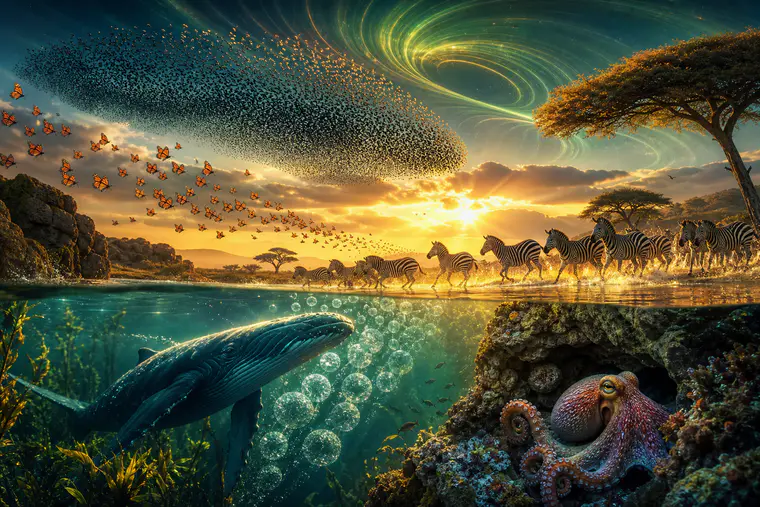
Why some animal behaviors still defy complete explanation
If you’ve ever wondered why whales sing, how birds know where to migrate, or what those zebra stripes are really for, you’re in good company. Scientists can describe many of these behaviors in detail and even test parts of the “how,” yet the full picture—the exact mechanisms, the evolutionary trade-offs, and the exceptions that prove the rule—often remains incomplete. That’s not a failure of science; it’s a sign we’re asking rich questions about complex, living systems that change across habitats and time.
This guide gives you clear, trivia-ready snapshots of nature’s biggest behavior puzzles, separating what we know from what is still under active study. Use it to win debates, add nuance to classroom discussions, and appreciate how discovery actually unfolds.
A quick cheat sheet: what’s known vs. unknown
- Magnetoreception: many species seem to sense Earth’s magnetic field; the exact biological sensor(s) and how brains read the signal remain under investigation.
- Whale song: highly structured and culturally evolving; its full set of functions across species and situations is not fully settled.
- Zebra stripes: strong evidence for biting-fly deterrence in sunny habitats; other roles may also matter.
- Cat purring: produced by laryngeal muscles and neural pacing; its full purpose—from communication to possible self-healing—is debated.
- Octopus “dreaming”: sleep phases with dramatic skin-pattern changes are documented; what, if anything, is being “replayed” is unknown.
- Monarch migration: compass systems are mapped in broad strokes; how naïve generations complete an intercontinental route is still being refined.
- Starling murmurations: local interaction rules explain the swirls; the birds’ real-time sensory thresholds and decision rules are still modeled.
- Shark navigation: homing over oceanic distances suggests magnetic maps; how multiple senses are integrated remains a live question.
- Mantis shrimp vision: spectacular receptor diversity exists; how they trade color precision for speed or reliability is an evolving story.
- Mass whale strandings: multiple plausible causes; most specific events lack a single, definitive trigger.
The animals that read the planet: magnetoreception
From homing pigeons to sea turtles and salmon, many migrants act as if they carry a planet-scale map. The leading ideas fall into two broad camps:
- Magnetite-based sensing: microscopic magnetic crystals embedded in tissues could tug on receptors as a compass needle would.
- Light-dependent chemistry: special proteins in the eye (notably cryptochromes) may undergo magnetic-field–sensitive reactions, providing a directional cue that depends on light and wavelength.
Both ideas have experimental support in labs and partial support in the field, but neither fully explains why performance varies by species, age, weather, and even geomagnetic noise. The unsolved part is not “do animals sense magnetism?” but rather “which sensor is used, when, and how is that info fused with smell, landmarks, sun position, and wind?”
Trivia angle: Some birds seem to lose orientation when exposed to certain wavelengths of light, hinting that the magnetic compass may be a visual sense as much as a “sixth sense.”
Why whales sing: love songs, long-distance messages, or both?
Humpback, blue, and other baleen whales produce powerful, patterned sounds that travel astonishing distances underwater. In humpbacks, singing is primarily a male behavior and songs can change across seasons and even spread through populations—hallmarks of cultural transmission.
What’s unsettled is the complete function set. Courtship and mate attraction likely play major roles, but songs may also help males space themselves, coordinate movements, or probe the environment. Because whales often sing in contexts that are hard to observe directly (deep water, long ranges, changing groups), scientists piece together clues from acoustics, movement tags, and population studies. The emerging picture is a multi-purpose communication system rather than a single-purpose serenade.
Trivia angle: Whale songs can be so low in frequency that they are felt as much as heard, allowing communication over tens to hundreds of miles under the right ocean conditions.
The zebra’s suit: stripes against what?
Zebra stripes have been framed as camouflage, air conditioning, social name-tags, and anti-predator dazzle. The evidence most consistently supported today is deterrence of biting flies (like tsetse and horseflies). Field tests using striped vs. solid coats show fewer landings on striped surfaces, and high-stripe species live in regions where such pests are intense.
Still, “one explanation to rule them all” may be too simple. Thermoregulation could matter on windless, sun-baked days; stripe patterns might also help individuals recognize herd mates at close range. The likely answer is a bundle of benefits whose weight shifts with climate, predators, and parasites.
Trivia angle: Black-and-white may be the point—the stark contrast scrambles the polarized light cues many insects use when they close in for a landing.
The quiet riddle: why cats purr
Most domestic cats purr during contentment, but also during stress or recovery—think vet visits and nursing. The physical mechanism involves rhythmic activation of laryngeal muscles driven by a neural oscillator, producing vibrations often measured around 25–150 Hz.
The unsettled piece is purpose. Communication (“I’m safe, you’re safe”), self-soothing, and solicitation (“keep petting me, human”) are all plausible. There’s even a hypothesis that those frequencies encourage tissue repair, though that idea is not a settled medical claim. For now, purring reads as a flexible, low-energy signal with multiple payoffs depending on context.
Trivia angle: Big cats such as lions roar but do not purr continuously like house cats; anatomy and airflow trade-offs likely separate the two vocal styles.
The octopus that might be dreaming
Octopuses have sleep states that include calm periods and active bursts when skin patterns flash rapidly—the same chromatic vocabulary they use while hunting or hiding. Some scientists suggest this could be memory “replay” or a form of internal rehearsal. Others caution that we should not map human dreams onto cephalopod sleep too quickly. The best we can say: octopus sleep is complex, cyclic, and still being decoded.
How to watch like a scientist: If you see an octopus in a documentary flipping through zebra, mottled rock, and white-flash patterns while otherwise still, you’re likely looking at an active sleep phase—an irresistible, but not yet proven, invitation to imagine dreams.
Navigation without a map app: monarch migration
Each fall, monarch butterflies from across eastern North America converge on mountain forests in central Mexico. No single butterfly makes a round trip; the generation that returns north in spring is not the one that left. Experiments indicate monarchs use a sun compass (correcting for time of day) and may also reference magnetic cues and odor landscapes.
What’s incomplete is the developmental program that steers a naïve insect to the exact right mountain slope at the right time, and how local microclimate and forest structure cue arrival and dormancy. Habitat changes on the route add additional complexity, making this one of the grand, ongoing stories in migration science.
Trivia angle: On cool mornings, monarchs cluster by the thousands on the same branches, waiting for just the right temperature and light to take flight in brilliant bursts.
Sky ballet: starling murmurations
Even if you know that each starling tracks only nearby neighbors, it’s still magic to watch those living clouds ripple. Computer models built on local rules—match speed, avoid collisions, tend toward group center—reproduce many features. High-speed recordings suggest birds respond to a fixed number of neighbors rather than a fixed distance.
What we lack is a definitive, species-wide rulebook for every condition—gusts, predators, twilight—plus a map of exactly which sensory channels (vision, peripheral motion, even sound) dominate in each context. The humble takeaway: exquisite group patterns can arise from simple rules plus fast reactions.
Try it yourself: Look up videos of murmuration flocks and focus on one bird. You’ll see it never knows the whole picture, just a snippet—yet the group produces art.
The ocean’s homing experts: shark navigation
Sharks routinely cross basins and return to specific nurseries or reefs. Researchers have shown that some species orient predictably when exposed to magnetic fields mimicking locations along their routes—evidence for a magnetic map sense. But sharks also rely on smell, currents, temperature fronts, and perhaps social cues.
The persistent question is integration: how does a shark’s brain weight a weak magnetic hint against a strong scent plume, or switch to celestial or wave cues when clouds or turbulence spoil one channel? The answer will likely involve flexible, context-dependent weighting—an elegant computation performed by a fish.
Trivia angle: Some coastal sharks appear to “smell home” when close to shore but switch to broadscale cues offshore, a two-mode navigation system.
Too many colors, or just the right ones? The mantis shrimp paradox
Mantis shrimps boast a dozen or more types of photoreceptors—far beyond our three. Yet in certain lab tasks they don’t discriminate fine hue differences as precisely as humans do. One interpretation is that mantis shrimps trade fine-tuned comparison for speed and categorical recognition: instead of comparing wavelengths like a spectrometer, they read each receptor’s “channel” as a quick label—good enough for signaling, hunting, and spotting reef mates.
Unsolved details include how neural circuits compress that rich input and how polarization sensitivity and ultraviolet channels fit into the animal’s ecological priorities.
Trivia angle: Some mantis shrimps can detect circularly polarized light, a visual signal invisible to us without instruments.
The mystery of mass whale strandings
From pilot whales to beaked whales, mass strandings haunt coastlines. Proposed causes include navigational errors in gently sloping, shallow bays, illness in a pod leader that others follow, sudden predators or threats, noisy disturbances that disrupt echolocation, and geomagnetic anomalies. Often, more than one factor could be at play.
What keeps the mystery alive is the rarity and complexity of events. Each coastline has different acoustics, tides, and human activity, and necropsies may be incomplete. Responsible take: we have a menu of plausible triggers, but most individual cases lack a single, proven cause.
How to think like a nature detective
You don’t need a lab to appreciate these mysteries. Borrow the scientist’s mindset:
- Watch for context. A behavior’s meaning often flips with time of day, season, or audience.
- Prefer bundles to silver bullets. Multiple partial explanations can all be true at once.
- Separate mechanism from function. “How is it done?” and “why is it useful?” are different questions.
- Embrace uncertainty. Today’s open question is tomorrow’s great discovery story.
Quick-fire curios you can use in conversation
- Birds may “see” magnetic fields only under certain light colors—imagine a compass that works best at dusk.
- Zebra stripes can confuse the landing systems of biting flies; the same pattern is easier, not harder, for lions to see at a distance.
- Cat purr frequencies overlap with those used in some therapeutic devices, but that overlap doesn’t prove a medical effect.
- Starling flocks likely have no leader; order emerges from neighbors copying neighbors with split-second timing.
The strong takeaway
The world’s most captivating animal behaviors sit at the edge of our understanding not because they’re unknowable, but because biology is layered. Genes, bodies, senses, learning, culture, weather, and chance all braid together. The joy for a trivia lover—or any curious reader—is that “we don’t fully know” can be the most accurate and interesting answer in the room, especially when you can add, “but here’s the best evidence so far, and here’s why scientists are still testing it.”
Frequently Asked Questions
Are these mysteries unsolved because scientists haven’t looked hard enough?
No. Many are “partially solved.” We have strong evidence for pieces of the puzzle (for example, that magnetic fields affect bird orientation). The remaining gaps involve exactly which sensors are used when, how signals are combined, and how behaviors vary across species and environments.
Do new technologies finally settle these debates?
They help—satellite tags, biologgers, high-speed cameras, and machine learning all reveal details we couldn’t see before. But new tools often uncover new layers of complexity. Think of them as sharper lenses, not magic wands.
What counts as a good explanation in animal behavior?
Two ingredients: mechanism (how the body and brain produce the behavior) and function (how the behavior helps survival or reproduction). A mature explanation usually links both, with evidence that holds across contexts and species—or explains the exceptions.
Why do different sources give different answers?
Context. A result from one habitat, season, or species may not generalize. Also, multiple hypotheses can be partly true at once. Good summaries say what’s known, what’s tentative, and where consensus is forming.
Approved member comments will appear here.