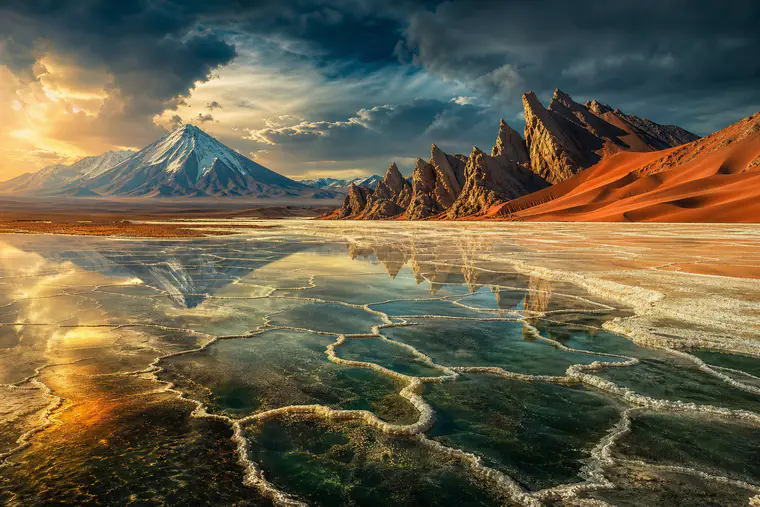
If you’ve ever wondered where to find Earth’s most alien-looking scenery without leaving the planet, start with the places that break records. Extremes of heat, cold, dryness, salt, altitude, depth, and size reshape landscapes into forms that look straight out of a sci‑fi set—yet each spot also tells a clear story about how our planet works. Below, you’ll find record holders paired with practical context you can use for better trivia, smarter trip planning, or simply deeper curiosity.
How this list helps you spot “otherworldly” Earth
- Focus on confirmed, long-standing records or widely accepted scientific superlatives.
- For each place, you’ll see what record it holds and why it looks extraterrestrial.
- When access involves hazards, you’ll get a gentle heads-up so you can research current rules and safety guidance locally before you go.
Places of fire and extreme heat
Lut Desert (Dasht-e Lut), Iran — Among the highest land-surface temperatures on Earth
This vast salt-and-sand desert has repeatedly topped global charts for the highest land-surface temperatures measured by satellite, exceeding 70°C (158°F) in some years. Wind-sculpted ridges called yardangs rise like ruined city blocks, casting knife-edged shadows across a copper-and-charcoal plain. From a distance, the scene can look like the lava-scarred lowlands of a volcanic moon.
Why it looks extraterrestrial: The color palette is minimal, shapes are geometric, and life is sparse—conditions planetary scientists use as real-world analogs for Mars and Mercury surface processes.
Know before you go: Independent travel in remote deserts is risky. If you visit, go with experienced local guides and heed official permits and seasonal heat advisories.
Death Valley, California, USA — Record-setting air heat and North America’s lowest point
Death Valley is famous for some of the highest air temperatures ever reliably reported on Earth and for Badwater Basin, a salt flat at about 282 feet (86 meters) below sea level. Polygonal salt crusts sprawl to the horizon, and salt-encrusted shorelines glint under a white sky. The simple geometry and extreme light feel unearthly in person and in photos.
Why it looks extraterrestrial: The basin’s glaring flats and bare, folded badlands mirror features seen in images of Mars and the Moon, though carved by Earth’s unique combination of heat and water—or the lack of it.
Know before you go: Summer heat is dangerous. Winter and shoulder seasons are friendlier, but always carry more water than you think you need and check National Park Service updates.
Dallol, Danakil Depression, Ethiopia — Scalding, acidic hydrothermal terraces below sea level
Set in one of the lowest, hottest regions on land, Dallol’s hydrothermal field forms neon terraces stained yellow, green, and orange by sulfur and iron minerals. Pools here can be extremely acidic, and delicate mineral crusts disguise scalding fluids just beneath the surface.
Record angle: The broader Danakil area has been noted for some of the highest average annual temperatures recorded for an inhabited place and sits well below sea level. It’s also a prime example of a rifting landscape where a new ocean may someday form.
Why it looks extraterrestrial: The color gradients and fizzing pools look like chemical laboratories in the open air—an easy mental leap to the kind of hydrothermal chemistry scientists study as potential habitats on early Mars or the icy moons.
Safety note: Many zones are off-limits without permits. Toxic gases and unstable crusts make unguided exploration a bad idea.
Places of salt, soda, and other chemical extremes
Salar de Uyuni, Bolivia — The world’s largest salt flat
Covering more than ten thousand square kilometers in the Bolivian Altiplano, Salar de Uyuni is so flat and bright that satellites use it to calibrate sensors. After rains, a thin film of water turns the surface into a seamless mirror. The sky doubles; horizons vanish.
Why it looks extraterrestrial: The scale and reflectivity erase familiar cues of depth. It’s easy to imagine you’ve stepped onto a reflective exoplanetary salt pan.
Trivia nugget: The salar formed from ancient lakes that evaporated, leaving behind a thick halite crust and polygon patterns as it dries and contracts.
Dead Sea, Israel/Jordan/West Bank — The lowest land elevation on Earth’s surface
The Dead Sea’s shoreline sits around 430 meters (over 1,400 feet) below mean sea level, Earth’s lowest exposed land. Its hypersaline water keeps swimmers unusually buoyant, and salt-encrusted formations fringe the coast like coral made of frost.
Why it looks extraterrestrial: The stark basin, steep desert walls, and white salt shelves look like a crater lake on a parched world. The chemistry is extreme enough that fish and aquatic plants cannot thrive.
Lake Natron, Tanzania — A soda lake that paints itself red
Fed mainly by mineral-rich hot springs, Lake Natron is highly alkaline and often turns shades of crimson and pink as microorganisms bloom. From the air, the lake looks like a watercolor palette dripped across a lunar plain.
Record angle: Natron is one of Earth’s best-known soda lakes—a category defined by high pH and carbonate chemistry. It’s also critical breeding habitat for lesser flamingos, which thrive where few other birds can.
Myth-buster: Photos of “petrified” animals at Natron became famous online. Those birds died from other causes; minerals later coated them. The lake’s chemistry is harsh, but it doesn’t instantly turn wildlife to stone.
Places of cold, height, and polar extremes
East Antarctic Plateau — The coldest surface conditions measured on Earth
Satellites have detected winter surface temperatures on the plateau that plunge below −90°C (−130°F) in localized hollows. At ground stations, Vostok holds the record for the lowest directly measured air temperature. Under clear skies and fierce katabatic winds, the ice surface can appear perfectly featureless—like a blank canvas stretching to a frozen horizon.
Why it looks extraterrestrial: With no trees, little texture, and air so dry it squeaks, the plateau resembles images of high-latitude terrains on Mars.
McMurdo Dry Valleys, Antarctica — The driest polar desert
Shielded from snowfall by surrounding mountains and scoured by relentless winds, the Dry Valleys are so parched that exposed mummified seals can persist for centuries. Rusty, iron-rich “Blood Falls” pours from Taylor Glacier into Lake Bonney, staining the ice a surreal red.
Record angle: They are the driest places on the coldest continent—polar desert squared—and a favorite Mars-analog test bed for robots and microbial studies.
Lake Baikal, Russia — Deepest and among the oldest freshwater lakes
Slicing into Siberia along a rift zone, Baikal is the deepest freshwater lake on Earth and holds an enormous volume of crystal-clear water. Winter ice forms intricate pressure ridges; summer reveals turquoise shelves and dramatic cliffs.
Why it looks extraterrestrial: The combination of abyssal depth, ancient age, and unique endemic life creates an ecosystem unlike anywhere else. The glassy ice sheets and blue fractures feel almost alien to walk across.
Volcanoes, lava lakes, and mountains that rewrite scale
Ojos del Salado, Chile/Argentina — The highest active volcano
Rising to nearly 6,900 meters (22,600+ feet), Ojos del Salado is the planet’s highest known active volcano. Nearby, a small crater lake at extreme altitude sits in a world of ash, snow, and wind-carved rock. The air is thin, humidity tiny, and the sun blinding.
Why it looks extraterrestrial: High elevation plus Atacama dryness strips away vegetation, exposing raw geology—perfect for testing gear and ideas meant for Mars expeditions.
Mauna Loa and Mauna Kea, Hawaii, USA — Largest volcano by volume and tallest mountain base-to-peak
Mauna Loa dominates by sheer bulk as Earth’s largest volcano by volume and area. Neighboring Mauna Kea, measured from its submarine base to its summit, rises even higher than Mount Everest does above sea level. Fresh basalt flows, lava tubes, and cinder cones make the landscape read like a storyboard for a young, volcanic planet.
Why it looks extraterrestrial: Dark basalt, thin soils, and recent flows mimic scenes from the Moon or Mars, where basaltic plains are common.
Erta Ale, Ethiopia — One of the few long-lived lava lakes
Erta Ale’s summit caldera has hosted a persistent lava lake on and off for decades, one of only a handful on Earth. The sight of molten rock constantly overturning and spattering is as close as most of us will get to the surface processes of Io, Jupiter’s volcanic moon.
Safety note: Volcanic gases and unstable rims make close approaches dangerous. Local guidance and current conditions are essential.
Underground and otherworldly voids
Hang Son Doong, Vietnam — The largest known cave passage by volume
This colossal cave is so big that entire city blocks—skyscrapers included—could fit within parts of its main passage. Roof collapses have opened “skylights” where jungles grow inside, complete with clouds forming and raining in the cavern.
Record angle: By cross-section and volume, Son Doong stands at the top of the cave world. Its underground jungle makes it a rare mash-up of surface and subterranean ecosystems.
Cave of the Crystals (Naica), Mexico — Home to the largest natural crystals found
Deep beneath a mine in Chihuahua lies a chamber filled with selenite beams the size of buses. The crystals formed over long periods in mineral-rich, near‑boiling water. Today the cave is flooded again and closed to visitors, which helps preserve those fragile giants.
Why it looks extraterrestrial: Translucent monoliths crosshatch the chamber like architecture from a science-fiction metropolis.
Color-splashed springs, superlative dunes, and Earth’s oldest desert
Grand Prismatic Spring, Yellowstone, USA — The largest hot spring in the United States
An eye-level view is pretty; the aerial view is astonishing. Microbial mats ring the spring in bands of blue, green, yellow, and orange, each color tied to tiny organisms thriving at different temperatures.
Record angle: It’s the biggest in the U.S. and among the largest anywhere, a graphic reminder that even extreme heat can host complex life.
Frying Pan Lake, New Zealand — The world’s largest hot spring by surface area
Part of the Waimangu Volcanic Rift Valley, Frying Pan Lake sprawls across a broad basin of steaming vents and bubbling edges. The surface is often shrouded in mist scented with volcanic gases.
Why it looks extraterrestrial: Imagine a planet where lakes simmer instead of freeze—then add the mineral rainbows and sulfuric steam.
Badain Jaran Desert, China — Among the tallest stationary sand dunes on Earth
This desert stacks star dunes hundreds of meters high, some towering more than many city skyscrapers. Interdune lakes surprise travelers with pockets of blue between mountains of sand.
Record angle: While dune rankings vary by how you measure, Badain Jaran consistently features among the tallest dunes on Earth.
Namib Desert, Namibia — Often cited as Earth’s oldest desert
Some parts of the Namib have been arid for millions of years. Rust-red dunes march to a foggy coast, and fossilized tree skeletons stand in white clay pans like statues.
Why it looks extraterrestrial: The palette—iron-red dunes, pitch-black trunks, chalk-white pans—reads like an artist’s concept of Mars with water long gone.
Quick trivia you can use right now
- Driest non‑polar desert: Atacama (Chile). Mars rovers have been tested in its hyperarid core.
- Highest land‑surface temperatures by satellite: Often recorded in Iran’s Lut Desert.
- Lowest exposed land elevation: Dead Sea shoreline.
- Largest salt flat: Salar de Uyuni (Bolivia).
- Deepest freshwater lake: Baikal (Russia).
- Largest known cave passage: Hang Son Doong (Vietnam).
- Highest active volcano: Ojos del Salado (Chile/Argentina).
- Largest hot spring by area: Frying Pan Lake (New Zealand).
The big takeaway
Earth doesn’t need alien help to look alien. Push any environmental dial—heat, cold, salt, altitude, time—and landscapes reinvent themselves into forms so strange they double as training grounds for space exploration. If you’re chasing jaw‑drop photos, trivia that lands, or simply a better sense of how planets work, these record breakers are your best map.
Frequently Asked Questions
Are these places safe to visit?
Some are set up for tourism (for example, parts of Death Valley and Yellowstone). Others—like Dallol or active volcanoes—can be hazardous or require permits and guides. Always check current local rules, weather, and safety advisories, and consider professional guidance.
What makes a place look “alien” to us?
Unfamiliar combinations of color, shape, scale, and the near‑absence of vegetation remove the everyday cues our brains expect. Extreme chemistry or temperature can also produce textures and hues we rarely see, which heightens the effect.
How do scientists use these sites as space analogs?
Engineers test rovers, tools, and sampling methods in deserts and volcanic fields that mimic parts of Mars or the Moon. Biologists study microbes in hot springs, salt flats, and polar deserts to understand what kinds of life might survive on other worlds.
What counts as a “record” here?
This list highlights widely accepted geographic superlatives—largest, lowest, deepest, driest—or well-documented extremes (for example, satellite-measured heat). When measurements are debated, we note the context rather than claim absolute certainty.
Approved member comments will appear here.