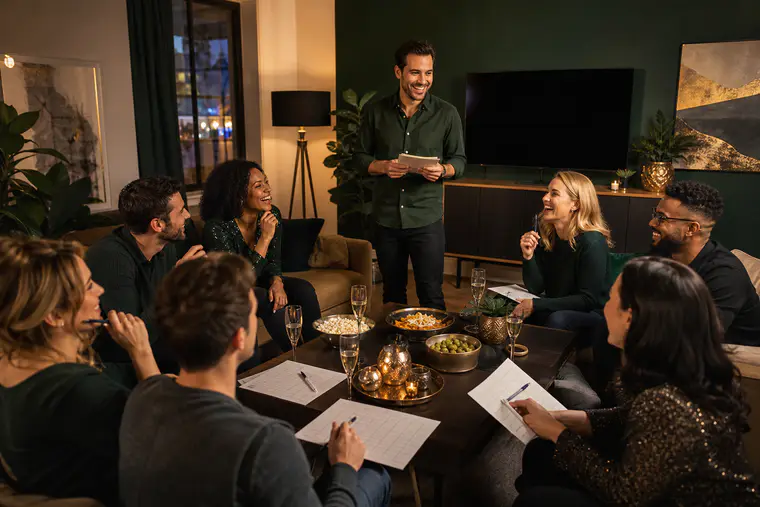
The quick, workable plan
If you are wondering how to plan a trivia night at home, start with this simple formula: 4 to 6 rounds, 8 to 10 questions per round, one short break in the middle, and a light final round with a small wager. That structure fits in about 90 minutes, keeps energy high, and is easy to host with nothing more than printed answer sheets, a timer, and your favorite music for ambiance.
Below you will find a ready-to-run round structure, sample questions, scoring models, hosting scripts, and setup tips so you can invite friends tonight and actually enjoy the evening instead of juggling chaos.
Start with scope: people, place, and pace
Before you write a single question, lock in three decisions. They will shape everything else.
- Group size and teams: Aim for 2 to 5 teams of 2 to 5 players each. With more than 6 teams, you will need stricter timing and clear sightlines to the host.
- Setting: Living room, kitchen island, backyard, or online. Indoors means easier audio; outdoors needs stronger voice or a small speaker.
- Duration: Ninety minutes is the sweet spot. It feels substantial but never drags.
A 90‑minute schedule that works
- 0:00–0:05 Welcome, rules, team names
- 0:05–0:17 Round 1
- 0:17–0:29 Round 2
- 0:29–0:37 Mini break and scoring update
- 0:37–0:49 Round 3
- 0:49–1:01 Round 4
- 1:01–1:11 Lightning round
- 1:11–1:21 Final wager or puzzle round
- 1:21–1:30 Scores, tiebreaker if needed, quick photos and prizes
Build your rounds: a proven structure
You do not need 100s of questions. You need variety and rhythm. Use this template and tweak it to your theme or guests.
- Warm‑up multiple choice (8 questions)
- Purpose: settle nerves, get easy points on the board, show your style
- Format example: read each question twice; teams circle A–D. Score instantly.
- General knowledge short answer (10 questions)
- Purpose: the classic quiz feel with mixed topics
- Tip: balance categories across eras, interests, and cultures.
- Connections or theme round (8 questions)
- Purpose: each answer hides a link; final bonus asks for the connection
- Payoff: big cheers when someone spots it early.
- Audio or picture round (10 items)
- Purpose: refresh the brain with something visual or musical
- At home: display on a TV or pass printed sheets; for audio, use 8–12 second clips.
- Lightning round (one minute per team)
- Purpose: fast hits to lift energy before the finale
- Format: one team at a time, as many correct answers as possible.
- Final wager or puzzle (1 question)
- Purpose: let trailing teams catch up without making the night feel random
- Mechanic: teams can wager up to 5 points they already have; correct adds, wrong subtracts.
Sample questions you can use tonight
These are intentionally evergreen, fact‑checked basics with a clean wording style. Use them as scripts or as models for writing your own.
Round 1: Warm‑up multiple choice
- The Red Planet is which one? A) Venus B) Mars C) Jupiter D) Mercury. Answer: B, Mars.
- What is H2O commonly called? A) Hydrogen B) Water C) Salt D) Oxygen. Answer: B, Water.
- Which number is a dozen? A) 6 B) 10 C) 12 D) 20. Answer: C, 12.
- Which ocean is the largest? A) Atlantic B) Pacific C) Indian D) Arctic. Answer: B, Pacific.
- What instrument has 88 keys? A) Piano B) Guitar C) Violin D) Flute. Answer: A, Piano.
- Which shape has three sides? A) Square B) Triangle C) Pentagon D) Circle. Answer: B, Triangle.
- Which animal is known for black and white stripes? A) Zebra B) Tiger C) Panda D) Skunk. Answer: A, Zebra.
- What gas do plants take in during photosynthesis? A) Oxygen B) Nitrogen C) Carbon dioxide D) Helium. Answer: C, Carbon dioxide.
Round 2: General knowledge short answer
- What city is the capital of France? Answer: Paris.
- Who painted the Mona Lisa? Answer: Leonardo da Vinci.
- In which sport would you perform a slam dunk? Answer: Basketball.
- What do we call a word that is the same forwards and backwards, like level or radar? Answer: Palindrome.
- Which metal has the chemical symbol Au? Answer: Gold.
- What is the tallest land animal? Answer: Giraffe.
- What is the largest planet in our solar system? Answer: Jupiter.
- Which language has the most native speakers worldwide? Answer: Mandarin Chinese.
- How many minutes are in three hours? Answer: 180.
- What is the main ingredient in traditional guacamole? Answer: Avocado.
Round 3: Connections round — every answer is a tree
- Canada’s national flag features the leaf of which tree? Answer: Maple.
- What kind of tree shares its name with the small edible seeds used in pesto called pine nuts? Answer: Pine.
- Hardwood often used in aging wine barrels and a common street name in many U.S. towns. Answer: Oak.
- Dark, dense wood used in piano keys in the past and a common chess piece color. Answer: Ebony.
- Bonus connection: What do all the answers have in common? Answer: They are types of trees.
Round 4: Audio or picture ideas
Pick one of these options to build quickly:
- Music intros: ten 8‑second intros from familiar tracks across decades. Ask for either artist or title. Example prompts: identify the artist after an intro to Billie Jean; name the song after the opening guitar riff of Sweet Home Alabama.
- Picture close‑ups: shoot your own photos of household objects zoomed in (a whisk, a zipper, an orange peel). Teams guess the object.
- Logo mash‑ups: crop brand logos to remove the words and show only shapes and colors. Keep it fair and avoid tiny or region‑specific brands.
Lightning round prompts (one minute per team)
Give a category; read fast; the scribe writes. One point per correct answer.
- Name as many U.S. state capitals as you can.
- Name colors that appear on the flags of at least three different countries.
- Name board games that use dice.
Final wager examples
Pick one and read it once. Teams secretly write a wager up to 5 points and their answer.
- Place these four events in chronological order: printing press introduced in Europe; American Declaration of Independence; first powered airplane flight; first crewed Moon landing. Correct order: printing press, Declaration, airplane, Moon landing.
- Name the seven continents. Answer: Africa, Antarctica, Asia, Europe, North America, Australia or Oceania, South America.
Write questions people love to answer
A great at‑home trivia night balances gettable facts with a few head‑scratchers. Use this simple recipe.
- Difficulty ladder: within each round, start easy, build to medium, then finish with one harder item. Think 6 easy, 3 medium, 1 hard in a 10‑question round.
- Topic spread: across the night, cover geography, arts, science, sports, history, pop culture, and everyday life. Avoid packing too many questions from your own specialty.
- Crisp wording: remove extra clauses and avoid double negatives. If a clue needs two commas, it probably needs a rewrite.
- Single, defensible answers: if two answers might be right, the question is wrong. Tighten wording or accept both in advance.
- Inclusive references: balance eras and regions. Not every guest knows the same childhood shows or internet memes.
Scoring, tiebreakers, and prizes
A simple scoring model
- Warm‑up: 8 questions, 1 point each (8 total)
- General knowledge: 10 questions, 1 point each (10 total)
- Connections: 8 questions plus 2‑point bonus for the link (10 total)
- Audio or picture: 10 items, 1 point each (10 total)
- Lightning: up to 10 points per team in one minute (10 total)
- Final wager: teams risk up to 5 points (swing of minus 5 to plus 5)
This makes a base of 48 points before the final. The wager keeps suspense without making early rounds meaningless.
Tiebreakers that feel fair
Use a closest‑wins numeric guess. Have everyone write it down at the start, reveal it only if needed.
- Example: How many miles is it from New York City to Los Angeles by road to the nearest hundred? Host note: acceptable answer basis is about 2,800 to 2,900 miles depending on route; closest wins.
- Example: How many seconds are in a day? Correct: 86,400.
Prize ideas that fit a living‑room budget
- Traveling trophy made from a thrift‑store trinket and a label maker
- Winner picks the theme for one round next time
- Gift cards for a local coffee shop or bakery
Materials and setup
- Answer sheets: one per team per round or a single sheet with round boxes. Include team name, round number, and a place for the host to initial.
- Pens and clipboards: clipboards stop lap‑writing arguments.
- Timer: a phone is fine; choose a gentle but audible alert.
- Display: a TV via HDMI, or printed photo sheets in plastic sleeves. For online games, share a slides deck.
- Audio: a small Bluetooth speaker helps you speak over chatter. Test the volume once everyone arrives.
- Host station: a stool or chair by the TV, a small table for your notes, and a water bottle. Comfort keeps you confident.
Run the room: hosting basics that actually help
- Open with clarity: welcome, rules in two minutes, and how to submit answers. Smile, breathe, and project your voice.
- Read once, repeat once: this keeps pace consistent. After the repeat, count down from five before moving on.
- Call for hands, not shouts: teams should bring answers to you or you should collect them; avoid yelling across the room.
- Score in batches: score during the break and the round transitions; announce standings two or three times only.
- Name check: refer to teams by their chosen names to personalize the night.
- Keep it light: a one‑liner is fine, but do not roast players or over‑explain answers. Momentum is your friend.
Accessibility and fairness
- Font size: if you print, use at least 12 pt; for slides on a TV, use large sans‑serif fonts.
- Color contrast: avoid red‑green pairings that are hard to distinguish for some players.
- Quiet space: if you have multiple rooms, keep the quiz room free from blender noises and doorbell alerts.
- Inclusive topics: mix decades, sports types, scientific fields, and global regions so everyone sees a question for them.
Virtual or hybrid trivia at home
- Platform: any major video call works. Put teams in breakout rooms for answer discussion time.
- Answer collection: use a shared form or have captains message you privately.
- Audio round online: share computer audio and test volume before guests arrive.
- Timing: add 10 minutes to the schedule to account for lags and tech moments.
Troubleshooting quick wins
- Low energy? Shorten questions, stand to host, and add a one‑minute lightning category.
- Volume issues? Move seating closer, lower background music, and keep your mic or speaker pointed toward players.
- Arguments over answers? Stay calm, state your accepted answer and why, and offer one point of mercy if your wording was ambiguous.
- Running long? Drop two questions from the next round and move straight to scoring.
Your ready‑to‑run checklist
- Confirm headcount and teams
- Print answer sheets and scoring key
- Prepare 4 to 6 rounds plus a tiebreaker
- Build or choose your audio or picture round
- Test display and speaker, set a timer sound
- Place pens, clipboards, and snacks
- Start on time and keep the pace
Strong takeaway
The secret is not secret at all: decide your length, mix round styles, write clear questions with single answers, and host with steady pacing. With this blueprint, you can plan and run a smooth, friendly competition that feels professional without turning your living room into a bar trivia night.
Frequently Asked Questions
How many questions do I need for a 90‑minute at‑home trivia night?
Plan for about 48 scoring opportunities before the final, plus a small wager round. That typically means 4 to 6 rounds with 8 to 10 questions each.
What is the ideal team size?
Two to five players per team is the sweet spot. Smaller teams encourage participation; larger teams can leave quieter players out.
Do I need special equipment for an audio or picture round?
No. A TV with an HDMI cable or screen‑sharing on a video call is enough. For audio, short clips from legal streaming sources played in your living room are fine for personal, non‑commercial use.
What can I do if people have very different knowledge levels?
Use a difficulty ladder within each round and vary topics across eras and interests. Include at least one question per round that every team can answer to keep spirits high.
Approved member comments will appear here.