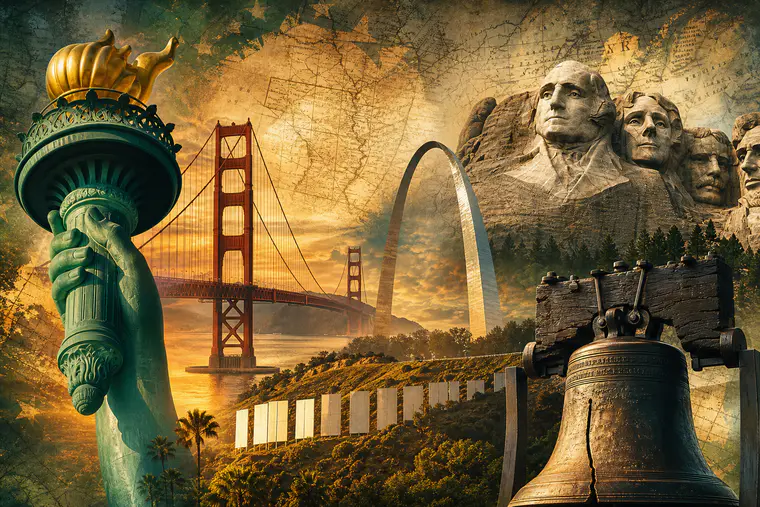
Why this quiz? Because great stories make landmarks unforgettable
If you came here for American landmarks trivia that lands at parties, road trips, or museum lines, you’re in the right spot. Below you’ll find 15 short, surprising stories behind famous U.S. landmarks—each framed as a one‑question quiz with the answer immediately revealed. You’ll walk away with fast facts that are accurate, memorable, and easy to retell.
How to use this American landmarks trivia set
- Play solo: Read the question, guess, then reveal the answer and story.
- Host a quick round: Ask the question only; award a point for nailing the gist of the story.
- On the move: Screenshot 3–5 favorites to keep the conversation lively on tours or road trips.
- Share responsibly: These are concise summaries; if a friend wants more, encourage them to check museum or park service sites for deeper reading.
The Quiz: 15 little‑known stories behind famous U.S. landmarks
1) Statue of Liberty — what country first inspired the torch‑bearing idea?
Quiz question: Before New York City, which country sparked the sculptor’s vision for a colossal woman holding a torch?
Answer: Egypt.
Shareable story: Decades before Liberty reached New York Harbor, French sculptor Frédéric Auguste Bartholdi sketched a lighthouse concept for the Suez Canal—an allegorical robed woman holding a torch. That project never materialized, but the motif lived on. When “Liberty Enlightening the World” finally rose on Bedloe’s Island (now Liberty Island), it carried echoes of that earlier vision. The internal iron framework was engineered by Gustave Eiffel, and the statue’s green hue comes from a protective copper patina that developed naturally over time.
2) Mount Rushmore — why did Jefferson switch sides?
Quiz question: On Mount Rushmore, Thomas Jefferson was supposed to be to Washington’s right. Why is he on the left?
Answer: Bad rock forced a do‑over.
Shareable story: Crews began carving Jefferson to Washington’s right but hit unstable granite. The face was blasted away and re‑carved to Washington’s left, which is why the lineup looks so balanced today—thanks to a geologic compromise rather than an original plan.
3) The White House — when did the name become official?
Quiz question: The president’s residence was once called the Executive Mansion. Which president made “White House” the official name?
Answer: Theodore Roosevelt in 1901.
Shareable story: While the nickname “White House” had circulated for years, Theodore Roosevelt placed it on official letterhead in 1901, standardizing the name. Another essential, less‑taught fact: Enslaved workers were part of the labor force that built the house in the 1790s—history the site now interprets in tours and exhibits.
4) Golden Gate Bridge — what nearly changed its famous color?
Quiz question: The bridge’s International Orange wasn’t a given. What high‑contrast color scheme did some officials prefer for visibility?
Answer: Black (or dark) with yellow striping.
Shareable story: The steel arrived in a reddish‑orange primer, and consulting architect Irving Morrow liked its visibility in fog. While some military officials advocated a striped scheme for safety, the final choice—International Orange—made the span recognizable worldwide and appropriately visible against San Francisco’s shifting grays.
5) Lincoln Memorial — can you spot the famous correction?
Quiz question: There’s a small stone fix in the Second Inaugural Address carved on the north wall. Which word was corrected?
Answer: “Future.”
Shareable story: A stonemason carved an E where an F should have been—“EUTURE.” The error was later patched by filling the notch to read correctly. If you look closely, the repair is still visible—a tiny reminder that even solemn monuments have human fingerprints.
6) Liberty Bell — why is the crack so wide?
Quiz question: The Liberty Bell’s most visible “crack” looks more like a gash. What caused that distinctive seam?
Answer: A 19th‑century repair technique called stop‑drilling and widening.
Shareable story: The bell cracked in service long before it became a symbol. In the 1840s, metalworkers drilled the ends of the fracture to keep it from spreading, then widened the seam to prevent new stresses. That stabilization created the iconic opening you see today—less a single accident, more a deliberate fix for a bell that rang hard and often.
7) Alcatraz — what was here before the prison?
Quiz question: What important maritime first stood on Alcatraz Island prior to its federal‑prison era?
Answer: The first operational lighthouse on the U.S. West Coast (1854).
Shareable story: Long before “The Rock” became synonymous with escapes and inmates, it guided ships into San Francisco Bay. Another lesser‑known chapter followed the prison years: from 1969 to 1971, Native American activists occupied Alcatraz, bringing national attention to Indigenous rights and treaty issues.
8) Empire State Building — what was that needle for?
Quiz question: The skyscraper’s spire wasn’t only decorative. What was it originally intended to do?
Answer: Moor airships.
Shareable story: Designers imagined dirigibles docking at the mast, allowing privileged passengers to disembark high above Midtown. Trials in 1931 proved too dangerous—gusts made mooring nearly impossible—so the fantasy gave way to a practical spire that improved the building’s silhouette and radio utility.
9) Times Square — why were two New Year’s Eves silent?
Quiz question: The Times Square ball has dropped nearly every year since 1907. Which war‑time years skipped the drop and why?
Answer: 1942 and 1943, due to a wartime dim‑out.
Shareable story: During World War II, New York City observed lighting restrictions. Crowds still gathered, but instead of a glowing descent, the new year arrived with a moment of silence and church bells—proof that tradition can adapt even in difficult times.
10) Gateway Arch — how did engineers “close the gap” at the top?
Quiz question: On completion day in 1965, the Arch’s final piece fit only if the two legs lined up perfectly. What tricks helped make that happen?
Answer: Hydraulic jacks, precise surveying, and even water sprays to manage heat expansion.
Shareable story: The stainless‑steel legs moved subtly with sun and temperature. Crews cooled sun‑warmed steel and used hydraulic force to control the final millimeters, sliding the keystone into place. The Arch’s graceful curve is a catenary—mathematically akin to a hanging chain flipped upright.
11) Hoover Dam — what’s with the two names?
Quiz question: Why do some historical references call it Boulder Dam and others Hoover Dam?
Answer: Politics and timing. The name changed more than once.
Shareable story: Early on, officials used “Boulder Dam,” reflecting a proposed site. In 1930, the project was named Hoover Dam for then‑President Herbert Hoover. In 1933, the name reverted to Boulder Dam, and in 1947 Congress restored “Hoover Dam.” The concrete didn’t move—only the politics did.
12) Grand Central Terminal — what’s the whisper trick?
Quiz question: Where in Grand Central can two people face opposite corners and still hear each other’s whispers across the room?
Answer: The Whispering Gallery outside the Oyster Bar.
Shareable story: Tiled vaults carry sound in a surprising arc. Stand at diagonal corners, speak softly into the wall, and your voice travels overhead to your partner’s ear. It’s an unadvertised bit of architectural fun that turns commuters into instant illusionists.
13) The Pentagon — why five sides?
Quiz question: Why is the Pentagon, well, a pentagon instead of a rectangle like most office buildings?
Answer: The original site’s road layout suggested a five‑sided footprint, and the shape stuck even after the site moved.
Shareable story: Early planners sketched a five‑sided building to fit awkward roads near Arlington Cemetery. When President Franklin D. Roosevelt selected a different site, the design stayed—partly because drawings were far along and the shape offered short walking distances between offices. Form followed function and momentum.
14) The Hollywood Sign — what word went missing?
Quiz question: What did the Hollywood Sign originally spell in 1923, and why was it changed?
Answer: “Hollywoodland,” a real‑estate promotion; “land” was removed in 1949.
Shareable story: The sign began as a flashy ad for a hillside development and was only meant to last 18 months. It lingered, decayed, and was ultimately rebuilt in the 1970s after a public fundraising campaign. Today’s letters are steel and engineered to endure—no light bulbs, no ad copy, just the place name.
15) Washington Monument — what’s special about its tip and color banding?
Quiz question: Why does the shaft change color partway up, and what unusual metal tops the obelisk?
Answer: Construction paused for years, so later marble came from a different source, and the capstone is aluminum.
Shareable story: A long halt left visible bands where new stone didn’t perfectly match the old. Capped in 1884 with a small aluminum pyramid—then a rare, high‑value metal—the monument doubled that cap as a lightning conductor. It was briefly the tallest structure in the world until the Eiffel Tower surpassed it.
Quick recap you can share in one breath
- Liberty’s torch idea traces to an unrealized Suez Canal lighthouse.
- Jefferson moved sides at Rushmore due to bad granite.
- “White House” became official under Theodore Roosevelt in 1901.
- Golden Gate’s International Orange beat out striped proposals.
- A carved “EUTURE” was fixed at the Lincoln Memorial.
- The Liberty Bell’s wide seam is a stop‑drilled repair.
- Alcatraz hosted the West Coast’s first lighthouse, then a landmark occupation.
- Empire State’s spire was meant for airships.
- Times Square skipped the ball drop in 1942–43.
- The Gateway Arch closed its keystone with jacks and cooling water.
- Hoover Dam’s name shifted with politics.
- Grand Central’s whispering vault amazes on cue.
- The Pentagon kept its five‑sided plan after a site change.
- The Hollywood Sign once read “Hollywoodland.”
- The Washington Monument has mismatched marble and an aluminum cap.
Tips for remembering and retelling these stories
- Tie facts to visuals: When you see the Golden Gate Bridge’s color, recall the “striped” alternative.
- Use cause and effect: “Jefferson moved because the rock failed.” Simple links make details sticky.
- Add one number or date only when it helps: “1901 made ‘White House’ official.”
- Keep it conversational: Lead with the question, then deliver the short, tidy answer.
What makes this set different
Most trivia lists give you names and dates. This page focuses on party‑ready micro‑stories: short setups that explain why something looks or reads the way it does. That angle turns American landmarks trivia into useful social fuel—perfect for travelers, teachers, tour guides, or anyone who enjoys a smart aside in front of a famous view.
Frequently Asked Questions
Q: Are these stories verified? A: These are well‑established, widely published historical notes summarized for quick recall. For deeper reading, check official sites like the National Park Service, state historical societies, or museum pages.
Q: Can I use these questions for a classroom or tour? A: Yes. They’re designed as concise prompts plus clear answers. For classes, you might hide the answers and ask students to research primary sources before revealing the summary.
Q: What’s the best way to host a short quiz with this list? A: Pick 8–10 questions, give 20 seconds per guess, and score a point for the right concept. Encourage brief storytelling when players explain their answers—people remember narratives better than isolated facts.
Q: How do I avoid common myths around landmarks? A: When in doubt, consult official site histories and be wary of claims that rely on a single anecdote without corroboration. If a detail sounds sensational, it usually deserves a double‑check before you pass it on.
Approved member comments will appear here.