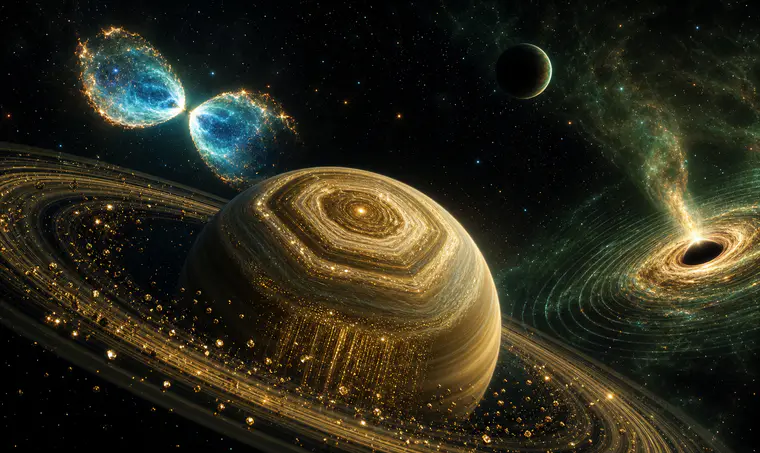
If you love trivia that makes your brain do a double‑take, the cosmos is your playground. Space is stranger than fiction, but it’s also testable, measurable, and wonderfully quiz‑friendly. Below is a curated set of weird cosmic facts that are actually real—each with quick explanations, smart memory hooks, and practical tips to help you dominate your next trivia night.
The coldest natural place we’ve found isn’t on Earth
Meet the Boomerang Nebula
A baby planetary nebula about 5,000 light‑years away in Centaurus, the Boomerang Nebula has gas expanding so fast that it super‑cools by adiabatic expansion to roughly 1 kelvin above absolute zero. That’s colder than the 2.7 K cosmic microwave background.
Why it’s true: As gas rushes outward, it loses energy and temperature plummets. Astronomers measured this extreme chill with millimeter‑wave telescopes.
Quiz tip: If the question mentions “coldest natural place,” think Boomerang Nebula—boomerangs fling out; so does its gas, cooling it down.
A teaspoon of neutron star material would weigh a mountain
Ultra‑dense stellar corpses
Neutron stars form when massive stars explode and their cores collapse. Densities soar to around the mass of our Sun packed into a city‑sized sphere. A teaspoon of this stuff on Earth would weigh billions to trillions of kilograms—comparable to a big mountain.
Why it’s true: Gravity crushes electrons and protons into neutrons, eliminating most empty space inside atoms.
Quiz tip: “Neutron” = “no room.” When there’s no room left, you get extreme density.
Rogue planets probably roam the galaxy without a star
Orphan worlds in the dark
Not every planet has a home star. Gravitational tugs and early‑system chaos can eject planets into interstellar space. Surveys suggest there may be vast numbers of these free‑floaters—possibly outnumbering stars.
Why it’s true: Microlensing and infrared surveys detect massive, cold objects drifting between stars, consistent with planet‑mass bodies.
Quiz tip: If you see “planet with no sunrise,” the answer is a rogue (free‑floating) planet.
Saturn has a six‑sided storm the size of Earths
The hexagon at the north pole
Saturn’s north polar jet stream forms a persistent hexagon—each side longer than Earth’s diameter.
Why it’s true: Fluids can create standing wave patterns. On Saturn, the jet stream’s winds sculpt a stable hexagonal shape observed for decades by spacecraft and telescopes.
Quiz tip: “Saturn” and “six” both start with S. Saturn’s Six‑sided Storm.
On Venus, a day is longer than its year (with a twist)
Slow, backward spinner
Venus rotates so slowly and retrograde (backwards) that its sidereal day is about 243 Earth days, while it orbits the Sun in about 225 Earth days—so the sidereal day is longer than the year. Due to the retrograde spin and orbital dance, the solar day (noon‑to‑noon) on Venus is about 117 Earth days.
Why it’s true: Torque and tidal effects likely altered Venus’s spin over eons.
Quiz tip: Remember “Very Slow Venus”—the only major planet where the sidereal day beats the year.
Space has a smell astronauts can describe
Gunmetal, hot metal, and seared steak
After spacewalks, astronauts report a lingering odor on suits and airlocks, often compared to hot metal or seared steak.
Why it’s true: In vacuum, volatile molecules disperse; but reactive oxygen, ozone, and complex hydrocarbons created by high‑energy radiation can cling to surfaces and then reach human noses inside the spacecraft.
Quiz tip: “Fried steak in space” is an astronaut quote classic.
It might literally rain diamonds on Saturn and Jupiter
Sparkly weather, theoretically
Models suggest lightning turns methane into soot that compresses into graphite and diamond as it falls deeper into the atmospheres of gas giants. At extreme depths, diamonds could even melt.
Why it’s true: Pressure‑temperature pathways allow carbon to transform phases. While we haven’t directly seen diamond hail, lab experiments and atmospheric models support the possibility.
Quiz tip: “Methane to diamond” is the chain to remember: CH4 → carbon → compression → diamond.
There’s a giant cloud with alcohol and simple sugars in space
Cocktail of molecules near the galactic center
Astronomers have found ethyl alcohol and the simple sugar glycolaldehyde in interstellar clouds like Sagittarius B2. No, it’s not drinkable or concentrated like a bar—but complex organic chemistry is definitely out there.
Why it’s true: Radio telescopes detect molecular fingerprints at specific frequencies, revealing surprisingly rich chemistry between the stars.
Quiz tip: “Sgr B2 = Space Brewery.” Just don’t try to pour a pint.
Pluto has blue skies and reddish frosts
Tiny world, dramatic atmosphere
New Horizons images showed Pluto’s haze layers scattering sunlight to create blue‑tinged skies. Organic tholins produced by solar radiation give surface frosts a reddish hue.
Why it’s true: Tiny particles scatter blue light (like Earth’s sky), and tholin chemistry reddens ices of nitrogen and methane.
Quiz tip: “Blue above, red below” helps you picture Pluto’s palette.
Time really does run differently in space—and on mountains
Everyday relativity
General relativity predicts clocks run faster where gravity is weaker and slower where it’s stronger. Atomic clocks confirm that your head ages slightly faster than your feet, and satellites must correct for both gravity and speed to keep GPS accurate.
Why it’s true: Gravity warps spacetime. Precise timing shows the effect exactly as predicted.
Quiz tip: If a question links “GPS” and “Einstein,” the answer is relativity time corrections.
Black holes can make sound—but not the way you think
Whispering giants of galaxy clusters
In hot cluster gas, pressure ripples can carry waves. Astronomers have mapped sound waves in the Perseus cluster driven by a supermassive black hole—at frequencies far below human hearing, many octaves beneath middle C.
Why it’s true: X‑ray and radio observations trace ripples and bubbles inflated by jets from the black hole, translating them into sound wave equivalents.
Quiz tip: “Perseus hum” is a neat hook for black‑hole‑made sound in gas.
Space starts closer than your next road trip
The Kármán line is just about 62 miles up
The edge of space by a common definition is roughly 100 km (62 miles). If you could drive straight up on a highway at 60 mph, you’d get there in about an hour.
Why it’s true: Above this altitude, air is too thin for conventional aerodynamic lift; orbital mechanics rule.
Quiz tip: 100 kilometers = 62 miles. “An hour’s drive to space.”
The Moon is slowly leaving us
A drifting companion
Laser ranging shows the Moon recedes from Earth by roughly 3–4 centimeters per year as tidal interactions transfer angular momentum to the Moon’s orbit.
Why it’s true: Ocean tides raised by the Moon lag slightly, pushing the Moon outward over time and lengthening Earth’s day by milliseconds per century.
Quiz tip: “Tides trade momentum; Moon moves on.”
Saturn would float—in theory
Low‑density giant
Saturn’s average density is lower than water. In a hypothetical enormous ocean, it would float (though in reality, it would be torn apart and the water would flash to steam).
Why it’s true: Saturn is mostly hydrogen and helium; its average density is about 0.7 g/cm³, less than water’s 1.0 g/cm³.
Quiz tip: “Saturn = swimming pool planet” (with a reality asterisk).
In vacuum, clean metals can weld themselves together
Cold welding is a thing
Two ultra‑clean, unoxidized metal surfaces pressed together in vacuum can fuse without heat because there’s no surface contamination to keep their atomic lattices apart.
Why it’s true: Surface oxides and adsorbed gases on Earth usually prevent it; in space, careful engineering avoids accidental fusing.
Quiz tip: If the question mentions “joining without heat in space,” the term is “cold welding.”
The universe is a neutrino rainstorm
Ghost particles everywhere
Trillions of neutrinos from the Sun and cosmic sources pass through your body every second, barely interacting.
Why it’s true: Neutrinos only feel the weak nuclear force and gravity, so most pass through matter unhindered. Detectors in deep mines and ice catch rare interactions.
Quiz tip: “Neutrinos: through you, not at you.”
Fast radio bursts outshine galaxies for milliseconds
Cosmic camera flashes
FRBs are millisecond‑long radio pulses from distant galaxies that can momentarily emit more energy than our Sun does in days. Their origins vary—some repeat, some don’t—with leading models including magnetars.
Why it’s true: Radio telescopes record intense, dispersed signals traveling billions of light‑years, pointing to compact, powerful engines.
Quiz tip: “Millisecond megaflashes = FRBs.”
Cosmic rays constantly pepper Earth
High‑energy visitors
Particles from the Sun and deep space slam into our atmosphere, spawning showers of secondary particles. Some muons created aloft make it all the way to the ground—and through you.
Why it’s true: Interactions between primary cosmic rays and atmospheric nuclei produce cascades detectable by ground instruments and even classroom muon counters.
Quiz tip: Cosmic rays create muons; muons make it to you.
Practical ways to remember space trivia
Turn weird into wired memory
- Attach a letter hook: S for Saturn’s Six‑sided Storm; B for Boomerang = coldest “blown‑out” nebula.
- Use number pegs: Kármán line ≈ 100 km; Venus sidereal day ≈ 243 Earth days.
- Build cause‑effect chains: Lightning → methane → carbon → diamond rain.
- Visualize contrasts: Pluto’s blue sky vs. red frosts; low‑density Saturn vs. dense neutron star.
- Tie to tech: GPS needs relativity fixes; telescopes “taste” molecules by radio fingerprints.
Quiz‑ready mini‑drills
Try these lightning prompts to cement facts:
- Coldest known natural place? Boomerang Nebula.
- Planet with a hexagon at the pole? Saturn.
- Day longer than year? Venus (sidereal day longer; solar day ≈ 117 Earth days).
- Edge of space in miles? ~62.
- What rains on Saturn (theoretically)? Diamonds.
- What particles stream through you by the trillions? Neutrinos.
A quick myth‑check corner
“Black holes suck everything like vacuum cleaners.”
Reality: You can orbit a black hole safely at the right distance, just like you orbit any massive object. Cross the event horizon, though, and there’s no return.
“Space is silent.”
Reality: Mostly. Sound needs a medium, and space is nearly a vacuum—but in dense plasma and hot cluster gas, pressure waves can propagate. We can “hear” them by translating measurements into audio.
“Saturn floats, so it’s buoyant in water.”
Reality: Average density says yes—practically, no. Planet‑sized fluids behave differently, and water wouldn’t remain liquid in space.
Speed‑round fact list for sharing
- Coldest natural place: Boomerang Nebula (~1 K).
- Neutron star teaspoon: billions–trillions of kilograms.
- Rogue planets: likely plentiful, possibly more than stars.
- Saturn’s hexagon: six‑sided polar jet stream.
- Venus: sidereal day (~243 d) longer than its year (~225 d).
- Space smell: hot metal/seared steak on suits post‑EVA.
- Diamond rain: theorized on Saturn/Jupiter.
- Interstellar booze and sugars: detected in Sagittarius B2.
- Pluto: blue haze, reddish tholin frosts.
- Time dilation: GPS and mountaintop clocks prove it.
- Black‑hole “sound”: pressure waves mapped in Perseus cluster.
- Kármán line: ~100 km (62 miles) above Earth.
- Moon drift: ~3–4 cm per year; days lengthen slowly.
- Saturn density: < water; “would float” in theory.
- Cold welding: clean metals fuse in vacuum.
- FRBs: millisecond radio megaflashes from afar.
- Cosmic rays: muons reach the ground and you.
How to use these facts in real quizzes
Spot the telltale wording
Question writers often embed the clue. Phrases like “coldest known natural place,” “six‑sided storm,” “day longer than its year,” or “millisecond bursts” usually point uniquely to the facts above. Train your eye to lock on distinctive qualifiers.
Practice with spaced repetition
Make a deck with one card per fact, plus a “why it’s true” sentence. Review daily for a week, then weekly. Retention skyrockets when you link the headline to a simple physical reason.
Build cross‑links
Connect topics: neutron star density ↔ diamond rain (pressure phases); Saturn hexagon ↔ fluid dynamics; FRBs ↔ magnetars. The more links, the faster recall.
Frequently Asked Questions
What’s the single strangest true space fact to memorize first?
Start with the Boomerang Nebula being colder than the cosmic microwave background. It’s counterintuitive, unique, and shows up in high‑level trivia.
Are diamond rains on gas giants proven?
Not directly. They’re supported by laboratory data and atmospheric models, but we don’t yet have in‑situ measurements inside Saturn or Jupiter.
Is it true Venus’s “day longer than its year” is a trick question?
Partly. The sidereal day is longer than its year, but the solar day (noon to noon) is about 117 Earth days due to retrograde rotation—know both for full credit.
How can I quickly estimate the edge of space in miles?
Remember 100 km ≈ 62 miles. Think: “An hour’s highway drive—straight up.”
Approved member comments will appear here.