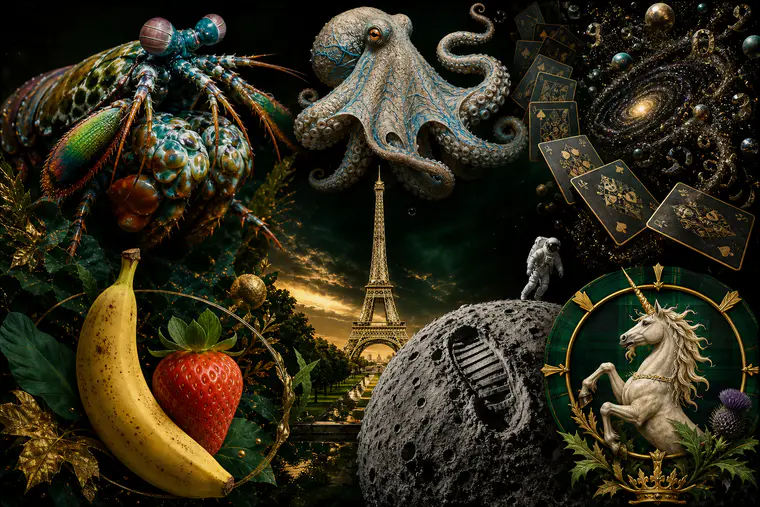
Welcome to the rabbit hole of unbelievable trivia
Some facts don’t just inform you — they flip your mental furniture. This collection brings together science oddities, time-warping history, and everyday details hiding in plain sight. Each one is short, memorable, and rigorously phrased so you can share it without getting fact-checked at the table.
Why your brain loves wow-worthy facts
Your memory tags unusual information with a mental highlighter. Psychologists call this the distinctiveness or von Restorff effect: the more unexpected a detail is, the more likely you are to recall it later. That’s why a mix of surprise plus clarity is your best recipe for unbeatable trivia.
Science that bends intuition (and wins bonus points)
Bananas are berries; strawberries are not
In botany, a true berry comes from a single flower with one ovary and typically contains multiple seeds embedded in the flesh. Bananas fit. Strawberries don’t — they’re aggregate accessory fruits where those tiny dots on the outside are the seeds.
Tip to remember: picture a banana wearing a berry badge and a strawberry standing outside the club.
Water can be solid, liquid, and gas at once
At its triple point (about 0.01°C and a very low pressure of roughly 611 pascals), water can exist as ice, liquid, and vapor simultaneously in equilibrium. It’s a favorite demonstration in physics labs and a perfect short-form stumper.
A day on Venus is longer than a year on Venus
Venus spins backwards and slowly. One full rotation takes roughly 243 Earth days; orbiting the Sun takes about 225 Earth days. So on Venus, the planet’s day exceeds its year.
Mnemonic: V for Venus, V for Very slow.
Footprints on the Moon can last for eons
With no rain, running water, or wind-driven weather to erase them, Apollo-era boot prints may persist for millions of years, disturbed only by micrometeoroids or future visitors.
Honey basically doesn’t go bad
Honey’s low water activity and acidity inhibit microbial growth. Sealed honey stored away from moisture can remain edible for centuries. If it crystallizes, warm it gently and it reliquefies.
There are more ways to shuffle a 52-card deck than atoms on Earth
The number of possible orders for a standard deck is 52! (about 8.07 × 10^67). Estimates for atoms making up planet Earth are around 10^50. That means every casual riffle likely creates an arrangement that has never existed before.
Try this: next time you shuffle, say, 'I probably just made a brand-new order in the universe.' You won’t be wrong about Earth-scale comparisons.
The word typewriter can be typed using only the top row of QWERTY
It’s a neat relic of early typing demonstrations. Challenge a friend to type a long word on one row only — then show yours.
Animals with superpowers you didn’t learn in school
Octopuses have three hearts and blue blood
Two hearts pump blood to the gills; the third sends it through the body. Their blood uses copper-based hemocyanin, which looks blue and helps in cold, low-oxygen waters.
Wombats produce cube-shaped droppings
Differences in elasticity along the wombat’s intestines help shape feces into rough cubes, which don’t roll away. That helps mark territory on rocky ground.
Koala fingerprints can fool the file
Koala fingerprints are so human-like under a microscope that they can confuse forensic analysis. Nature invented whorls more than once.
A frog that freezes and returns to life
The North American wood frog can survive being frozen solid for winter, its heartbeat stopping while sugars protect its cells. When spring comes, it thaws and hops on.
The mantis shrimp sees a world we can’t
Humans have three types of color receptors; many mantis shrimp species have up to 16 and can detect polarized light. If there were a 'best eyes' award show, they’d host it.
The jellyfish that turns back the clock
Turritopsis dohrnii can revert its adult body to a juvenile polyp stage after stress or injury. It’s not invincible, but it’s the closest thing we have to biological reset.
History that scrambles timelines
Sharks are older than trees
Fossil evidence places early sharks over 400 million years ago. The earliest woody trees appear tens of millions of years later. Next time someone calls something 'prehistoric,' sharks can raise a fin.
Cleopatra was closer to the iPhone than to the Great Pyramid
Cleopatra VII lived from 69 to 30 BCE. The Great Pyramid at Giza was completed around 2560 BCE. The iPhone arrived in 2007 CE. That puts Cleopatra about 2,000 years from the iPhone but more than 2,500 years from the Pyramid’s construction. History isn’t just old; it’s lopsided.
The shortest war on record lasted under an hour
The Anglo–Zanzibar War of 27 August 1896 ended after roughly 38–45 minutes of conflict. It’s proof that 'war' and 'long' don’t have to be synonyms.
The first 'computer bug' was literal
On 9 September 1947, operators working with the Harvard Mark II found a moth causing a malfunction and taped it into the logbook. The team had used the term 'bug' before, but the pun became immortal.
Everyday things, newly interesting
Pringles chips aren’t flat — they’re hyperbolic paraboloids
That saddle-shaped curve lets chips stack neatly and resist breaking while staying crispy. It’s snack engineering you can meet in a calculus textbook.
The Eiffel Tower grows in summer
Thanks to thermal expansion, the iron structure can stand about 15 cm (roughly 6 inches) taller on hot days than in winter. Sunlight literally lifts Paris.
Orange carrots are a comparatively recent hit
Carrots were originally cultivated in hues like purple, yellow, and white. Orange varieties rose to prominence in Europe, especially the Netherlands, by the 1600s and 1700s. Today, purple carrots are staging a comeback in trendy produce aisles.
There’s no letter Q in any U.S. state name
From Alabama to Wyoming, the alphabet skips Q. (If someone says 'Albuquerque,' remind them that’s a city.)
The dot above i and j has a name
It’s called a tittle — a perfectly tiny word for a tiny dot.
Scotland’s national animal is the unicorn
A symbol of purity and power in Celtic mythology, it’s been part of Scottish heraldry for centuries. Fantasy meets flag.
Everest is tallest above sea level; Mauna Kea is tallest from base
Everest’s summit is the highest altitude. But if you measure from Mauna Kea’s seafloor base to its peak, that Hawaiian volcano stretches taller overall. Two records, two yardsticks.
In Switzerland, guinea pigs are legally recognized as social animals
Animal-welfare rules in Switzerland require social species such as guinea pigs to have companionship, which has led to practices like adopting them in pairs. It’s a kindness written into policy.
Lightning-round facts you can share today
- The smell of rain has a name: petrichor.
- Dice on standard six-sided sets have opposite faces that sum to seven.
- The symbol # is also called an octothorpe.
- Peanuts aren’t nuts; they’re legumes that grow underground.
- The Canary Islands are named after dogs (from Latin 'canariae'), not canary birds.
How to remember trivia so it sticks (and scores)
Turn facts into mini stories
Your brain stores narratives better than raw data. 'Venus spins so slowly its day beats its year' is a mini plot with a twist.
Use spaced repetition
Apps like Anki or simple calendar reminders help you revisit facts at expanding intervals. Five 1-minute reviews over two weeks outperform a single 5-minute cram.
Build quick image hooks
- Bananas as berries: imagine a banana wearing a tiny berry beret.
- Wombat cubes: a dice factory in the outback.
- Eiffel Tower in July: a thermometer leaning against iron.
Group by theme
Make decks labeled 'Animals,' 'Space,' 'Language,' and 'Everyday Math.' Pattern recognition accelerates retention.
Practice with timed sprints
Set a 60-second sand timer and try recalling five facts from one category. The light pressure simulates quiz-night conditions.
How to fact-check viral claims (fast and friendly)
Step 1: Pin down the claim
Rewrite it with a concrete number, place, and date. Example: 'Shortest war? Anglo–Zanzibar, 27 Aug 1896, under 1 hour.' Ambiguity fuels myths.
Step 2: Ask what would have to be true
If a claim involves 'more than the atoms in the universe,' that’s a red flag — astronomically big numbers need careful comparisons and clear scope.
Step 3: Look for primary or expert references
For space, check NASA or space agencies; for language, dictionaries; for biology, museums or universities; for history, reputable encyclopedias or archives. Avoid articles that only cite other listicles.
Step 4: Watch the weasel words
Terms like 'some say' or 'it’s been reported' often mask shaky sourcing. Trivia is more fun when it’s verifiable.
Turn these facts into party games
Two truths and a wow
Pick any three items in a theme; make two familiar, one mind-bending. Example (Animals): 'Cats purr, ducks quack, wombats poop cubes.' Ask players to rank from least to most surprising and explain why.
The 3–2–1 challenge
- 3 facts you already know well
- 2 you find new
- 1 you’re going to verify tonight It sparks discussion while modeling good skepticism.
Head-to-head lightning round
Two players alternate true facts for 60 seconds. Stumbles or repeats lose the point. Keep categories tight to boost difficulty.
Make your own 'can’t-be-true' list
Pick a topic you love and hunt for one jaw-dropper in each of these angles:
- A definition that flips a word you thought you knew (like berries)
- A timeline twist (like Cleopatra vs. the Pyramid)
- A number comparison that feels impossible but checks out (like 52!)
- A design detail hiding in plain sight (like Pringles geometry)
- An animal adaptation that sounds like sci-fi (like the wood frog)
Curate five, write your own memory hooks, and you’ll have a shareable micro-collection ready for your next quiz night.
Frequently Asked Questions
What makes a great trivia fact?
It’s short, surprising, and verifiable. The best ones pair a clear number or definition with an intuitive hook, so they’re easy to remember and hard to dispute.
How can I remember dozens of facts without mixing them up?
Use spaced-repetition flashcards, group facts by theme, and add a visual or verbal cue to each item. Quick, regular reviews beat long cram sessions.
How do I check if a viral 'wow' claim is actually true?
Rewrite it with specific numbers and dates, then look for primary or expert sources (museums, space agencies, dictionaries, academic sites). If every citation points to another list, keep digging.
Are these facts safe for pub trivia?
Mostly yes, but quizmasters sometimes want exact values, dates, or wording. If a question asks for the 'tallest mountain,' listen for whether they mean 'highest above sea level' (Everest) or 'tallest from base' (Mauna Kea).
Approved member comments will appear here.