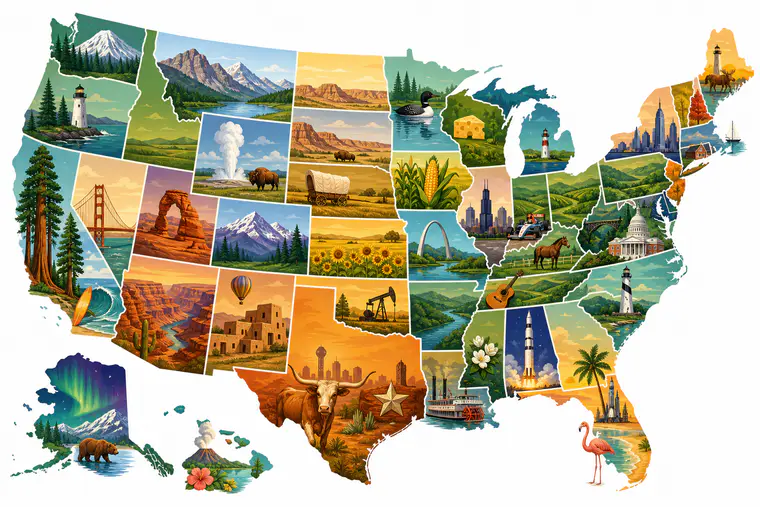
If you’re looking for fun facts about the 50 states you can trust in any trivia setting, this guide gives you reliable, easy-to-remember nuggets—no myths, no fuzzy superlatives. You’ll find one rock-solid fact per state, plus regional patterns and quick tips to help you recall them faster. Whether you’re prepping for a pub quiz, leading a classroom activity, or planning a road‑trip challenge, you’ll leave with facts you can bank on.
How to use this guide for quick wins
- Pick one “anchor” fact per state and memorize it before layering in details.
- Group similar ideas (borders, capitals, geography) to create mental folders.
- Turn statements into questions (“Which state uses parishes?”) to self-test.
- Teach a friend—explaining out loud helps you retain the essentials.
50 state-by-state facts you can bank on
Below is a concise, one-per-state sampler designed for fast recall. Each item states a stable, broadly accepted fact without fragile rankings or time-sensitive claims.
- Alabama: Engineers at NASA’s Marshall Space Flight Center in Huntsville played a central role in developing the Saturn V rockets used in the Apollo program.
- Alaska: Denali, at 20,310 feet, is the highest point in North America.
- Arizona: Grand Canyon National Park protects a vast section of the Grand Canyon, one of the world’s best-known geological landmarks.
- Arkansas: Crater of Diamonds State Park lets the public search for—and keep—diamonds found in its fields.
- California: Coast redwoods (Sequoia sempervirens), found along California’s north coast, are the tallest tree species on Earth.
- Colorado: Denver is known as the “Mile High City,” with a 5,280‑foot elevation marker on the State Capitol steps.
- Connecticut: The world’s first nuclear-powered submarine, USS Nautilus (SSN‑571), is preserved in Groton.
- Delaware: Delaware was the first state to ratify the U.S. Constitution, on December 7, 1787.
- Florida: The Florida Reef is the only living coral barrier reef system in the continental United States.
- Georgia: Coca‑Cola originated in Atlanta in 1886, created by pharmacist John S. Pemberton.
- Hawaii: Hawaii is the only U.S. state composed entirely of islands—and Honolulu’s ʻIolani Palace is the only former royal palace in the United States used by a reigning monarch.
- Idaho: Idaho’s state seal (adopted in 1891) is the only one designed by a woman, Emma Edwards Green.
- Illinois: Engineers reversed the flow of the Chicago River in 1900 to protect the city’s water supply.
- Indiana: The Indianapolis Motor Speedway hosts the Indianapolis 500, a signature motorsport event held annually since 1911 with wartime exceptions.
- Iowa: The Field of Dreams movie site in Dyersville is a real ballfield visitors can see and, at times, play on.
- Kansas: A marker near Lebanon denotes the geographic center of the contiguous United States.
- Kentucky: Mammoth Cave National Park contains the world’s longest known cave system, with hundreds of miles of surveyed passages.
- Louisiana: Louisiana is divided into parishes rather than counties.
- Maine: Maine is the only U.S. state with a one‑syllable name and it borders only one other state (New Hampshire).
- Maryland: The United States Naval Academy has trained naval officers in Annapolis since 1845.
- Massachusetts: Harvard University (1636) is the oldest institution of higher education in the United States.
- Michigan: Michigan consists of two large peninsulas—Upper and Lower—connected by the Mackinac Bridge.
- Minnesota: The Mississippi River’s headwaters begin at Lake Itasca in northern Minnesota.
- Mississippi: Elvis Presley was born in Tupelo in 1935.
- Missouri: Missouri borders eight other states, tying Tennessee for the most neighbors.
- Montana: At Triple Divide Peak in Glacier National Park, water can flow toward the Pacific Ocean, the Atlantic (via the Gulf of Mexico), or the Arctic (via Hudson Bay).
- Nebraska: Nebraska has the nation’s only unicameral, officially nonpartisan state legislature (established in 1937).
- Nevada: Nevada is the driest U.S. state by average annual precipitation.
- New Hampshire: The state motto “Live Free or Die” is widely used in official contexts, including license plates.
- New Jersey: Thomas Edison’s Menlo Park laboratory was the site of major inventions, including the phonograph.
- New Mexico: The first detonation of a nuclear device (the Trinity test) occurred in New Mexico on July 16, 1945.
- New York: The Erie Canal, completed in 1825, linked the Hudson River to the Great Lakes and transformed trade routes.
- North Carolina: Orville and Wilbur Wright achieved the first controlled, sustained powered flight near Kitty Hawk on December 17, 1903.
- North Dakota: The International Peace Garden, dedicated in 1932, straddles the U.S.–Canada border between North Dakota and Manitoba.
- Ohio: Ohio’s state flag is the only non‑rectangular U.S. state flag; it’s a swallowtail burgee.
- Oklahoma: The Oklahoma Panhandle was once called the Public Land Strip, nicknamed “No Man’s Land,” before becoming part of Oklahoma Territory in 1890.
- Oregon: Oregon’s state flag has different designs on its front and back.
- Pennsylvania: The Declaration of Independence was adopted in Philadelphia on July 4, 1776.
- Rhode Island: Rhode Island is the smallest U.S. state by land area.
- South Carolina: The first shots of the American Civil War were fired at Fort Sumter in Charleston Harbor on April 12, 1861.
- South Dakota: Mount Rushmore National Memorial, in the Black Hills near Keystone, features the carved faces of four U.S. presidents.
- Tennessee: Tennessee borders eight other states, tying Missouri for the most neighbors.
- Texas: Texas has more counties than any other state—254 in total.
- Utah: Salt Lake City hosted the 2002 Winter Olympic Games.
- Vermont: Vermont was the first state admitted after the original 13, joining the Union on March 4, 1791.
- Virginia: Jamestown, founded in 1607, was the first permanent English settlement in what became the United States.
- Washington: Mount Rainier is the highest peak in Washington and a prominent stratovolcano.
- West Virginia: West Virginia became a separate state in 1863, during the Civil War, after splitting from Virginia.
- Wisconsin: Taliesin, the estate and studio of architect Frank Lloyd Wright, is located in Spring Green, Wisconsin.
- Wyoming: The Wyoming Territory granted women the right to vote in 1869; the state retained that right at statehood in 1890.
Patterns that turn state facts into trivia advantages
Knowing a few broader patterns helps you answer multiple questions at once—and check your memory on the fly.
Border and location quirks
- Four Corners is the only point in the United States where four states meet: Arizona, New Mexico, Utah, and Colorado.
- Two states border eight others: Tennessee and Missouri. When a quiz asks for “the most borders,” you can safely name both.
- Only one state borders just one other state: Maine (it borders New Hampshire and neighbors Canada to the north and east).
- Michigan is the only state made up of two major peninsulas linked by a long suspension bridge (the Mackinac Bridge).
- Because Alaska’s Aleutian Islands cross the 180th meridian, the state contains the nation’s westernmost and by longitude also its easternmost points—an excellent trick question.
Time and measurement notes that stick
- Most of Arizona does not observe Daylight Saving Time, while the Navajo Nation within Arizona does—useful for time-change questions.
- Florida’s highest natural point, Britton Hill, is 345 feet above sea level—far lower than most state high points, which makes it a common quiz wrinkle.
- Denali in Alaska is North America’s highest mountain, but Colorado’s “Mile High City” note (5,280 feet) often appears in trivia as a quick elevation cue.
Culture, government, and symbolism
- Louisiana’s parishes and Alaska’s boroughs/census areas are frequent “gotcha” alternatives to the word “county.”
- Ohio’s swallowtail flag and Oregon’s two‑sided flag design are routine flag-quiz staples.
- Nebraska’s unicameral, officially nonpartisan legislature is a distinctive civics fact that regularly shows up in quizzes.
Make your own state‑trivia questions (templates)
- Geography: “Which state is home to [landform/park]?” Example: “Which state contains Mammoth Cave National Park?”
- History: “In which state did [event] happen?” Example: “Where was the first nuclear device detonated?”
- Symbols: “Which state’s flag/seal is unique for [feature]?” Example: “Which state flies a swallowtail burgee instead of a rectangle?”
- Borders: “Name a state that [border pattern].” Example: “Name one of the two states that border eight others.”
Crafting your own turns facts into active knowledge, and it makes road trips, classrooms, and family nights more engaging.
Key takeaway
A single reliable anchor fact per state—plus a handful of patterns about borders, time, and symbols—covers a surprising share of quiz questions. Use this list to build confidence, then expand with your local favorites. By focusing on dependable details, you’ll keep your answers accurate and your team’s score climbing.
Frequently Asked Questions
Which five U.S. states touch the Pacific Ocean?
Alaska, Washington, Oregon, California, and Hawaii.
What is the only place in the U.S. where four states meet at one point?
The Four Corners Monument area, where Arizona, New Mexico, Utah, and Colorado meet.
Which states border the most other states?
Tennessee and Missouri each border eight states.
Is there a state that borders only one other state?
Yes—Maine borders only New Hampshire (and shares international borders with Canada).
Approved member comments will appear here.