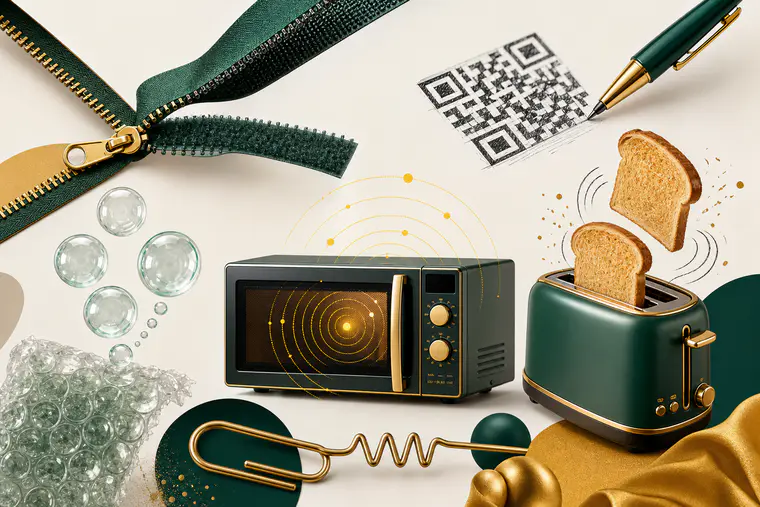
Why Everyday Tech Has Such Odd Backstories
If you’ve ever wondered why a microwave was once taller than a person, why your keyboard looks scrambled, or how bubble wrap was almost wallpaper, you’re in the right place. The tools we touch daily are full of misfires, accidents, marketing gambits, and wartime needs that shaped their final forms. This roundup blends weird origin stories with bite-size facts, practical memory tricks, and mini challenges you can drop into your next trivia night.
Kitchen Accidents That Changed the World
The microwave that began with a melted candy bar
During World War II radar research, engineer Percy Spencer noticed a candy bar in his pocket had softened near an active magnetron. Curiosity led to a focused test with popcorn kernels and then an egg that explosively overcooked. The first commercial microwave ovens arrived soon after, initially enormous, water-cooled machines for restaurants and ships. Only when prices fell and countertop designs emerged decades later did home adoption boom.
Quick facts to remember:
- Early microwaves were called Radaranges and stood taller than many users.
- The breakthrough wasn’t culinary ambition; it was radar experimentation.
- Popcorn became the poster snack because kernels show obvious, instant results.
Trivia tip: Link microwave to magnetron and melted chocolate with the alliterative cue: Magnetron → Melted → Microwave.
The toaster that learned to pop
Bread has been toasted over coals for millennia, but safe, repeatable electric toasting took time. Once nichrome heating wire made the job practical, inventors raced to standardize timing so bread wouldn’t burn while you stared. The key leap was an automatic pop-up mechanism in the early 20th century. By the 1920s, sleek counter models made breakfast more predictable—and slightly more dramatic.
Try this: Next time someone says the toaster is boring, ask whether their machine uses a bimetallic thermostat or electronic timing. Either way, it traces back to the problem of getting repeatable browning without babysitting.
Tea bags born from a packaging misunderstanding
In the 1900s a New York tea importer shipped samples in small silk pouches. Many customers dunked the pouches directly instead of opening them, loving the no-mess convenience. Paper replaced silk, strings appeared, and a new ritual took over kitchens worldwide.
Remember it: Tea bags weren’t invented for brewing; they were invented for shipping.
Clothing Closures With Strange Beginnings
The zipper that struggled to catch on
Whitcomb Judson’s late-19th-century fastener, the awkwardly named clasp locker, jammed easily. Gideon Sundback refined the interlocking design in the 1910s, and zippers finally found practical uses on tobacco pouches, boots, and flight suits. Fashion houses were suspicious at first; then designers discovered the sleek line a zipper creates compared with a row of buttons, and the rest is history zipped up.
Quiz nugget: Zippers succeeded only after a second inventor polished the idea. Name them both: Judson (prototype) and Sundback (success).
Velcro: a burr, a dog, and a microscope
On a post-hike curiosity spree in the 1940s, Swiss engineer George de Mestral examined cockleburs clinging to his dog’s fur. Under magnification he saw tiny hooks that grabbed onto loops of hair and fabric. He fabricated a two-part fastener of hooks and loops—Velcro—that would later secure everything from children’s shoes to space-station gear.
Memory hook (pun intended): Hooks on one side, loops on the other—think burrs and sweaters.
Pens, Paper, and Office Oddities
The ballpoint pen that soared at altitude
Hungarian journalist László Bíró was tired of fountain-pen smears. He noticed newspaper ink dried fast and, with his brother György, engineered a thicker ink and tiny rolling ball that delivered smooth lines without blots. Pilots appreciated that ballpoints didn’t leak at high altitude, which boosted early adoption. Today, billions of inexpensive biros prove that a better ink flow can change the world.
Speed fact: The word biro became a generic name for ballpoints in several countries, honoring the original inventor.
Post-it Notes: a failed glue that stuck a landing
3M chemist Spencer Silver created a curious low-tack adhesive that wouldn’t fully bond. Years later, colleague Art Fry needed bookmarks for a church hymnal that wouldn’t fall out. He dabbed Silver’s adhesive on small papers, and the sticky note was born. The genius wasn’t a stronger glue; it was a weaker one that was consistently reusable.
Remember it: The innovation wasn’t stickier—it was stick-again.
Paper clips, patriotism, and a persistent myth
The familiar Gem-style paper clip has no definitive single inventor and emerged in late-19th-century Britain. A Norwegian inventor, Johan Vaaler, patented a different, less effective shape around the same time. During World War II, Norwegians quietly wore Gem clips as a symbol of unity against occupation, cementing the paper clip as more than stationery.
Trivia trap: Many sources credit Vaaler with inventing the modern clip, but his design wasn’t the Gem shape everyone uses. Reward careful players who catch that nuance.
Bubble wrap: the wallpaper that became a stress toy
In 1957, two inventors tried to make textured plastic wallpaper by sealing two shower curtains together. The decor market yawned, the greenhouse-insulation market shrugged—then shippers realized the trapped air made superb cushioning. Bubble wrap became a packaging staple and later a pop-culture fidget.
Pro tip: If someone says bubble wrap was born for packaging, give a half point unless they mention wallpaper.
Home Gadgets and Invisible Infrastructure
The remote control’s beam war
Early TV remotes tried visible-light beams in the 1950s (which sometimes changed channels when sunlight hit the sensor). Ultrasonic models soon followed, and modern infrared remotes eventually won out for reliability and cost. The arms race shows a recurring theme: a good idea grows through awkward prototypes that teach engineers what not to do.
Stumpers to use:
- Which came first: light-based or ultrasonic remotes? (Light-based.)
- Why did IR win? (Low cost, reliability, and immunity to most household noise.)
Smoke detectors that sniffed the wrong gas first
A scientist working on a poison-gas sensor noticed his device spiked when exposed to cigarette smoke. That serendipity pointed toward ionization-based smoke detection, which later combined with photoelectric sensors. The mass-market revolution arrived once battery-powered units made home installation simple.
Safety reminder: Whether ionization or photoelectric, test your detectors monthly and replace the entire unit every 10 years.
Barcodes and QR codes: from groceries to everything
Barcodes originated from an idea to automate checkout and inventory in the mid-20th century. The modern UPC followed standardization in the 1970s, and the first live retail scan reportedly rang up a pack of gum in an Ohio supermarket. In the 1990s, Japanese engineers introduced the QR code to store more data in two dimensions so factory scanners could read parts faster. Smartphones later turned QR codes into a bridge between the physical world and the web.
Anchor facts you can bank:
- UPC codes: one-dimensional lines, optimized for speed at checkout.
- QR codes: two-dimensional squares with three big corner boxes (finder patterns) for quick alignment.
Duct tape and WD-40: the chaotic-good duo
Duct tape began as waterproof cloth tape for sealing ammo boxes in World War II. Workers called it duck tape after the cotton duck fabric. Postwar, people slapped it on heating ducts (not ideal for long-term HVAC use), and the misnomer stuck. WD-40, short for Water Displacement, 40th formula, started as a corrosion inhibitor for missiles before landing in toolboxes everywhere.
Memory rhyme: If it moves and shouldn’t, duct tape. If it doesn’t and should, WD-40.
Typing, Trolleys, and Counterintuitive Design
Why your keyboard looks scrambled
QWERTY took shape in the 19th century when metal arms in typewriters jammed if common letter pairs sat too close. By spreading frequent combinations apart, typists could go faster overall. Some scholars argue market forces and training inertia mattered as much as mechanics, but either way, QWERTY became the standard that shaped computing.
Use in a quiz: Ask players to find three high-frequency English letters on the top row (hint: T, Y, R, E are all up there). Then invite a speed-typing mini contest for bragging rights.
The shopping cart shoppers didn’t want
In 1937, an Oklahoma grocer named Sylvan Goldman added wheels to baskets when he saw customers stop buying once their handheld baskets got heavy. People initially resisted—men thought carts implied weakness, women felt they resembled baby carriages. Goldman hired models to wheel them around, normalizing the idea. Today we push his insight without thinking: lighten the load, lengthen the purchase.
Conversation starter: Ask your group what modern habit still needs a Goldman-style nudge. Refill stations? Larger phone battery cases? Reusable bags with better convenience?
How to Turn These Stories Into Trivia Power
Memory strategies that stick
Use these quick tactics to keep details straight and ready for quiz night:
- Build story chains: Magnetron → Melted chocolate → Microwave. Burrs → Hooks and loops → Velcro. Wallpaper → Greenhouses → Packaging → Bubble wrap.
- Compare opposites: Stronger vs. weaker adhesives (Post-it Notes). Visible light vs. ultrasonic vs. infrared (remotes). One-dimensional UPC vs. two-dimensional QR.
- Tie facts to senses: Popcorn scent for microwaves, the pop of a toaster, the tactile pull of Velcro.
- Use dates sparingly but strategically: 1930s–1940s for microwaves/Velcro breakthroughs; 1970s retail standardization for barcodes; 1990s for QR codes.
- Rehearse with spaced repetition: Drop one fact a day into a notes app or flashcard deck; review at increasing intervals.
Ready-made mini-round for your next quiz
Use or adapt this 8-question set:
- Which kitchen device traces back to radar research and a melted candy bar?
- What clothing fastener took off only after Gideon Sundback refined an earlier, jam-prone design?
- Which office staple became a resistance symbol in Norway during WWII?
- What packaging material began as experimental wallpaper?
- Which writing tool was prized by pilots because it didn’t leak at altitude?
- Name the remote-control technology that could be fooled by sunlight.
- Which code type has square finder patterns in three corners?
- Duct tape got its original nickname from what kind of cloth?
Answer key: 1) Microwave oven. 2) The zipper. 3) The Gem-style paper clip. 4) Bubble wrap. 5) The ballpoint pen. 6) Early light-based remotes. 7) QR codes. 8) Cotton duck fabric.
Five Flash Facts Your Friends Won’t See Coming
- The first microwaves were water-cooled giants for commercial kitchens and ships; home versions took decades to miniaturize and cheapen.
- Ballpoint pens owed early success to pilots, not office workers.
- The paper clip most people use (Gem) has no single credited inventor, yet is among the world’s most recognizable designs.
- QR codes weren’t made for phones; they were invented to track auto parts in factories.
- Duct tape is famously not the best tape for ducts; aluminum foil tapes outperform it in HVAC applications.
How These Tales Shape Better Design Today
- Embrace near-misses: A misfit adhesive became a global sticky-note system. Ask: where is my team overlooking a useful mistake?
- Build onboarding, not just hardware: Shopping carts only worked once people saw others using them. Consider the user’s first five minutes as part of the product.
- Optimize the bottleneck: QWERTY didn’t make letters easier—it made jams rarer. In your workflow, identify the equivalent of jammed typebars.
- Stack small conveniences: Tea bags, zippers, and ballpoints win because they shave seconds many times a day. Micro-friction multiplies; so do micro-wins.
Frequently Asked Questions
What is the strangest origin story on this list?
Bubble wrap starting life as wallpaper is hard to beat. The inventors even tried pitching it as greenhouse insulation before packaging took off.
Are these stories really useful for trivia, or just fun facts?
They’re perfect for trivia because they pack strong narrative hooks (accidents, misunderstandings, wartime pivots) that make details stick. Turn each story into a three-beat chain to recall under pressure.
Which single date should I memorize if I hate dates?
Remember the 1970s as the decade when retail barcodes standardized and the first grocery-item scan happened. It’s a high-yield anchor for multiple questions.
What’s a quick way to practice these for a quiz night?
Make eight digital flashcards: one per section above. On the front, write the odd origin (for example, wallpaper). On the back, write the product (bubble wrap) and one bonus fact. Review them for two minutes a day until your event.
Approved member comments will appear here.