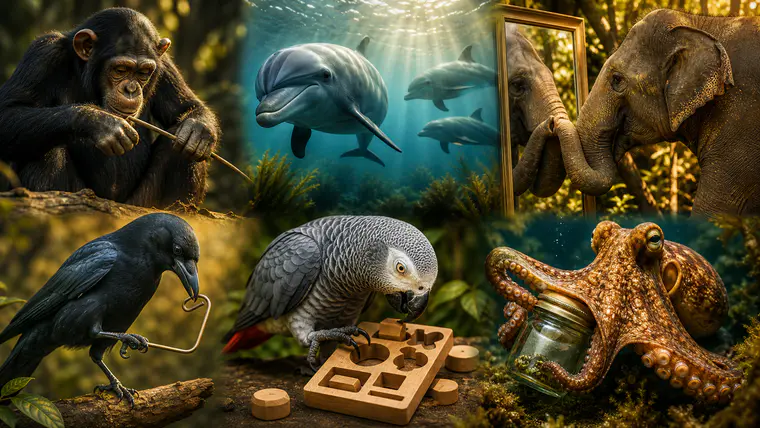
Why “smart” in animals is tricky—and fascinating
Ask five scientists to name the smartest animal and you’ll hear five different answers. That’s because intelligence isn’t one thing; it’s a toolbox of abilities that evolved to solve specific problems. A dolphin’s brilliance is tuned to social life in a 3D ocean. A crow’s genius shines in tool-making and urban problem‑solving. An octopus excels at solitary stealth and puzzles. Rather than crown a single champion, this guide explains how researchers measure animal smarts and spotlights stand‑out species with mind‑bending feats you can turn into shareable trivia.
How scientists measure animal intelligence
It’s not just brain size
- Encephalization quotient (EQ) compares brain size to body size, offering a rough gauge of brain investment.
- But structure matters: birds pack dense, efficient neurons; octopuses distribute neurons through their arms, enabling decentralized control.
- Bottom line: bigger isn’t always smarter—efficiency and wiring count.
Key abilities researchers test
- Problem‑solving: opening latches, boxes, or jars to reach food.
- Flexibility: switching tactics when the rules change.
- Social learning and culture: copying behaviors and passing them on.
- Communication: signals with specific meanings or “names.”
- Self‑control: resisting immediate treats for better future rewards.
- Planning: saving tools for tomorrow, caching food for next season.
- Self‑awareness: recognizing one’s reflection in the mirror (the “mirror test”), or in some species, using other senses for a similar task.
Context is king
A trait’s value depends on lifestyle. Elephants benefit from stellar memory for migration routes; scrub jays profit from remembering hundreds of hiding places; octopuses thrive by solving spatial puzzles alone. Comparing across species is fun—but always remember the yardsticks differ.
The smartest animals on Earth, explained by category
Great apes: flexible problem‑solvers with culture
- Chimpanzees use sticks to “fish” for termites and stones to crack nuts. They learn these techniques socially, which counts as culture.
- Orangutans in forests use leaves as gloves or napkins and show long‑term planning in foraging routines.
- Bonobos display sophisticated social intelligence and peacemaking strategies.
- Many great apes pass the mirror test, suggesting a degree of self‑recognition.
Trivia bite: In some labs, apes have shown striking working memories, recalling the order of briefly flashed numbers faster than most humans in timed tests.
Dolphins and whales: social minds of the sea
- Bottlenose dolphins use individual “signature whistles” that function like names and coordinate hunts with intricate teamwork.
- Orcas (killer whales) have distinct cultural traditions—different pods favor different prey and techniques, such as wave‑washing seals off ice floes.
- Several cetaceans pass variations of the mirror test, implying self‑recognition.
Tip for observers: If you visit coastal lookouts, bring binoculars and note behaviors like synchronized surfacing and coordinated herding—hallmarks of social cognition.
Elephants: memory, empathy, and teamwork
- Elephants remember water holes and safe routes across years and droughts.
- They collaborate to move heavy objects and have been seen assisting injured herd members.
- Asian elephants have passed the mirror test in controlled studies, hinting at self‑awareness.
Practical example: Elephant keepers use puzzle feeders and cooperative tasks to stimulate captive elephants’ problem‑solving skills—proof that enrichment can unlock impressive abilities.
Corvids (crows, ravens, jays): toolmakers with street smarts
- New Caledonian crows craft hooks from twigs and even combine parts to make multi‑step tools.
- Urban crows drop nuts onto roads so cars crack them, then retrieve the kernels safely at crosswalks.
- Ravens plan ahead, saving useful objects for future use and bartering in experiments.
- Clark’s nutcrackers cache tens of thousands of seeds and relocate them months later using spatial memory.
Try this (ethically): Observe local crows with a notebook. Record how they solve everyday problems—like opening bins or washing food in puddles. Don’t feed wildlife; just watch and learn.
Parrots: vocal learners and concept jugglers
- African grey parrots can learn labels for colors, shapes, and quantities and answer simple questions about them.
- Kea parrots from New Zealand excel at mechanical puzzles and show curiosity-driven exploration.
- Many parrots learn socially, picking up calls and behaviors from flock mates.
Enrichment tip: For pet parrots, rotate puzzle toys and foraging challenges. Variety keeps their problem‑solving circuits buzzing.
Octopuses: eight arms, nine brains (sort of)
- Octopuses open jars, solve mazes, and can remember solutions after delays.
- The veined octopus was filmed collecting coconut shells to assemble portable shelters—a striking case of tool use.
- Their nervous systems are unusual: a large central brain plus substantial neural control in each arm.
Observation idea: At an aquarium, watch how quickly an octopus explores new objects. You’re seeing flexible learning in action.
Dogs and wolves: reading us like a book
- Dogs are champions at interpreting human gestures like pointing—often outperforming our closest primate relatives on these tasks.
- Some border collies have learned the names of hundreds of objects and can fetch them on command.
- Dogs may show a sense of self via smell, distinguishing their own scent from others in experiments, even if they don’t pass visual mirror tests.
At‑home test: Hide treats in easy puzzle feeders, then gradually increase the challenge. Track how your dog adapts—does it try new strategies or persist with old ones?
Pigs: underrated whizzes
- Pigs learn mazes quickly, remember solutions, and can use mirrors to find hidden food.
- In joystick‑style tasks, pigs have been trained to move cursors on screens to earn rewards, showing spatial understanding and motor control.
Practical takeaway: Farm enrichment—balls that dispense pellets, manipulable chains—reduces stress and reveals pigs’ knack for exploration and problem‑solving.
Rats and mice: tiny brains, big insights
- Rats master complex mazes, show impulse control in delay‑of‑gratification tests, and can demonstrate empathy by freeing trapped companions.
- Because they’re curious and adaptable, rodents are model learners in laboratories, shedding light on memory and decision‑making.
Fun fact: Rats are excellent at “reversal learning,” switching strategies when rules change—an ability tied to cognitive flexibility.
Bees and ants: the power of many (and sometimes of one)
- Honeybees perform the waggle dance to communicate direction and distance to nectar sources—a symbolic code in miniature.
- Bees can count small numbers and in some lab tasks have distinguished “nothing” from “something,” hinting at a primitive sense of zero.
- Ant colonies display collective intelligence, building living bridges and optimizing foraging trails without a central planner.
Backyard science: Plant bee‑friendly flowers and quietly watch. Note how returning bees dance and how recruits fan out along the indicated route.
Honorable mentions that will surprise your friends
- Pigeons: Learn categories and can discriminate complex images—famously even spotting subtle patterns in medical images in some studies.
- Cleaner wrasse: Show intriguing behaviors in modified mirror tests; whether this reflects self‑recognition is debated, making them great trivia fodder.
- Jumping spiders (like Portia): Plan detours to stalk prey and flexibly update routes when blocked—mini strategists.
- Sea lions: Understand abstract cues and can learn to combine symbols in sequences.
Who’s the smartest? It depends on the scoreboard
If your metric is tool innovation, crows and chimpanzees lead. For social culture and communication, dolphins and orcas shine. For memory, elephants and seed‑caching birds are hard to beat. For puzzle‑solving in a solitary life, octopuses stand out. And for reading humans, dogs take gold. The fairest conclusion is this: evolution builds different kinds of intelligence tailored to different worlds.
Quick trivia you can drop at any party
- New Caledonian crows craft hooks—some even make multi‑part tools to reach food out of view.
- African grey parrots can label objects by color and shape and answer questions about “same” and “different.”
- Elephants recognize themselves in mirrors and show empathy, cooperating to solve tasks.
- Dolphins use signature whistles akin to personal names and coordinate hunts with precise roles.
- Octopuses collect coconut shells as portable armor and can unscrew jars from the inside.
- Honeybees dance‑talk about where to find lunch, encoding both distance and direction.
How to spot animal intelligence (ethically) in daily life
Build a mini field notebook
- Pick one species you see often (crows, squirrels, pigeons, or even ants).
- For a week, jot down problem‑solving behaviors and context—weather, time, obstacles.
- Look for patterns: Are solutions copied by others? Does the animal switch tactics when conditions change?
Enrich your pet’s mind
- Rotate puzzle feeders, snuffle mats, and hide‑and‑seek games.
- Teach signals across senses: hand gesture plus spoken cue; this challenges integration.
- Track progress. Can your pet adapt when a favorite trick no longer works?
Become a citizen observer
- Join local nature walks or contribute observations to community science platforms. Recording behaviors helps science and sharpens your eye for intelligence at work.
What the future of animal intelligence research looks like
- Better tools: tiny, noninvasive sensors and underwater microphones will reveal hidden communication and coordination.
- Fairer tests: species‑appropriate challenges (e.g., smell‑based tasks for dogs, 3D spatial tasks for dolphins) avoid underestimating abilities.
- Culture maps: scientists are building catalogs of regional traditions—from whale songs to chimpanzee tool kits—that show how knowledge spreads.
- AI in the loop: machine learning will sift hours of audio and video to discover patterns humans might miss, such as subtle call combinations or coordinated movements.
The bottom line
There’s no single crown for “the smartest animal.” Instead, nature offers a gallery of specialized intelligences—each ingenious in its own niche. That’s what makes animal smarts such great trivia: whether it’s a crow bending a hook, an elephant remembering a water hole from years ago, or an octopus inventing a new escape plan, the stories are true, surprising, and wonderfully shareable.
Frequently Asked Questions
Which animal is the smartest overall?
There isn’t a universal champion. Intelligence is specialized: crows and apes innovate tools, dolphins excel in social communication, elephants shine in memory, and octopuses ace solitary puzzles.
Do animals really have culture?
Yes—when behaviors are learned socially and persist across generations. Examples include chimp tool traditions, regional whale songs, and orca hunting styles that differ by pod.
Can birds really be as smart as primates?
Absolutely. Corvids and some parrots rival great apes in problem‑solving and planning. Dense neuron packing in bird brains helps support these advanced abilities.
Is the mirror test the final word on self‑awareness?
No. It’s informative but vision‑centric. Some species may reveal self‑knowledge better through other senses—dogs, for instance, excel in smell‑based recognition tasks.
Approved member comments will appear here.