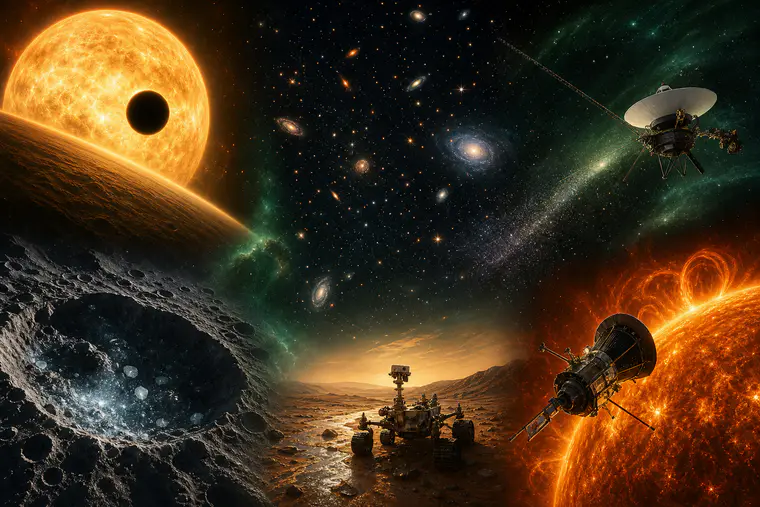
Space is full of jaw-dropping moments, but NASA’s best discoveries don’t have to be hard to understand. In this friendly guide, we translate landmark findings into plain English and pack them with trivia-worthy facts you can share at your next quiz night.
How NASA turns curiosity into discovery
Tools of the trade
NASA learns about the universe with a mix of smart machines:
- Space telescopes (Hubble, Spitzer, James Webb) that collect faint light from distant objects.
- Orbiters and landers (Mars Reconnaissance Orbiter, Curiosity, Perseverance) that map and test worlds up close.
- Probes (Voyager 1 and 2, Parker Solar Probe) that travel where humans can’t and sample the space environment directly.
- Earth-observing satellites (Landsat, GRACE, Aura) that watch our planet change in real time.
The simple pattern behind big finds
Behind every headline is the same three-step rhythm:
- Detect a signal (a dip in starlight, a plume of gas, a burst of particles).
- Rule out the impostors (instrument glitches, dust, or unrelated sources).
- Repeat and compare with models until the pattern is undeniable.
If you remember that process, many discoveries start to feel intuitive rather than mysterious.
1) We found thousands of worlds beyond our Sun
NASA helped confirm that planets are common in our galaxy. Two missions led the charge: Kepler, which stared at 150,000 stars from 2009 to 2018, and TESS (launched in 2018), which scans nearly the whole sky.
How to spot a planet you can’t see
Most exoplanets are found by the “transit method.” When a planet crosses in front of its star, the star’s light dims by a tiny amount. Measure that dip regularly and you can estimate the planet’s size and year length. If you also catch the star’s gentle wobble (the “radial velocity” method, usually from ground telescopes), you can infer the planet’s mass. Size plus mass tells you if it’s likely rocky, puffy, or something in between.
Fun example: a planet twice Earth’s radius with a short, hot year probably has a thick atmosphere—more mini-Neptune than super-Earth.
Quick facts to wow a room
- There are now over 5,000 confirmed exoplanets. Many are unlike anything in our solar system: hot Jupiters skimming their stars, super-Earths with short years, and compact systems with multiple worlds in tight orbits.
- NASA’s Spitzer Space Telescope helped confirm and characterize the TRAPPIST-1 system—seven Earth-sized planets, several within the star’s temperate zone.
- With the James Webb Space Telescope (JWST), astronomers have directly measured molecules—like carbon dioxide—in some exoplanet atmospheres, turning distant pinpricks into places with chemistry we can study.
Trivia tip: Ask, “Which two methods find most exoplanets?” Answer: transits and radial velocity.
2) Water, water… in surprising places
Water is key to life as we know it, and NASA has found it or its fingerprints across the solar system.
The Moon: sunburned desert with hidden frost
For decades we thought the Moon was bone-dry. Then in 2009, NASA’s LCROSS mission deliberately impacted a dark crater near the lunar south pole and kicked up debris that included water ice. Around the same time, a NASA instrument on India’s Chandrayaan‑1 spacecraft detected signs of water or hydroxyl across the lunar surface. Later, the SOFIA airborne observatory identified molecular water in sunlit soil in the Moon’s Clavius Crater. The upshot: the Moon is drier than the Sahara, but there’s usable ice tucked away in permanent shadows—potential rocket fuel and drinking water for future explorers.
Mars: a wet past written in stone
Rovers and orbiters have shown Mars once had rivers, lakes, and possibly a long‑lived ocean. NASA’s Curiosity rover found ancient lakebed sediments and complex organic molecules trapped in 3‑billion‑year‑old rocks. The Perseverance rover is exploring an ancient river delta at Jezero Crater and caching rock cores for a future mission to return to Earth. Today, Mars is cold and dry; past “recurring slope lineae” (dark streaks on crater walls) are now thought to be mostly dry flows rather than modern trickles. Still, the chemistry shouts that water once shaped the planet.
Ocean worlds: Europa and Enceladus
Beneath Europa’s cracked ice likely lies a global, salty ocean, hinted at by magnetic measurements from NASA’s Galileo spacecraft and surface features that resemble “sea ice” movement. Saturn’s small moon Enceladus vents water vapor and organics from a subsurface sea through tiger‑stripe cracks at its south pole, a discovery by NASA’s Cassini mission. Both are prime targets in the search for habitable environments. NASA’s Europa Clipper mission is designed to investigate Europa’s ice shell and ocean in detail.
Quiz nugget: Name two places besides Earth with evidence for liquid water today. Good answers: Europa and Enceladus (subsurface oceans).
3) Taking the universe’s baby picture—and its age
In the early 2000s, NASA’s WMAP spacecraft mapped the cosmic microwave background (CMB), the faint afterglow of the Big Bang. Those temperature freckles across the sky are a fossil record of the young universe. By fitting those patterns with physics models, scientists pinned down key numbers like the universe’s composition and age—about 13.8 billion years. The European Space Agency’s Planck mission later sharpened those numbers, but WMAP set the stage.
Why the afterglow matters
The CMB tells us:
- The universe started hot and dense and has been expanding and cooling ever since.
- Ordinary matter is only a small slice; dark matter and dark energy dominate.
- Tiny early ripples seeded the galaxies we see today.
That’s a lot to learn from a glow just a few degrees above absolute zero!
4) The Voyagers: postcards from the edge
Launched in 1977, Voyagers 1 and 2 gave humanity its first close‑ups of the outer planets. Trivia gold: Voyager 1 discovered active volcanoes on Jupiter’s moon Io in 1979—the first time volcanoes were seen beyond Earth. The spacecraft also revealed Jupiter’s faint ring and complex weather on the giant planets. Decades later, they did something even more dramatic.
What interstellar space feels like
Voyager 1 crossed into interstellar space in 2012; Voyager 2 followed in 2018. “Interstellar” doesn’t mean out of the Sun’s gravity—it means they passed beyond the solar wind’s protective bubble into the region filled by gas between the stars. Instruments recorded a jump in plasma density and shifts in magnetic fields, proving they’d entered a new environment. They are now our farthest robotic emissaries, still sending data home with the power of a refrigerator light bulb.
5) Hubble’s deep look and the expanding‑universe detective story
Since 1990, the Hubble Space Telescope has transformed astronomy. Its Deep Field images—long exposures staring at seemingly empty sky—revealed thousands of faint galaxies, a cosmic city where we thought there was countryside. Hubble also refined the “cosmic distance ladder” by measuring variable stars called Cepheids and bright Type Ia supernovae. Those measurements gave a local expansion rate of the universe that’s a bit faster than what we infer from the CMB. This “Hubble tension” is not a problem with Hubble per se—it’s a clue that either our measurements or our models might need tweaking. Scientists love puzzles like this; they spur better data and new ideas.
6) Clues for life: organics, methane, and sample tubes
NASA hasn’t found life beyond Earth, but it keeps closing in on the right questions.
- Curiosity detected complex organic molecules in Martian rocks. Organics are not proof of life—geology can make them too—but their presence shows the building blocks survived for billions of years.
- Seasonal methane variations have been recorded in Mars’s air. Methane can come from life or from rocks reacting with water and heat. Untangling the source requires more data and laboratory analysis on Earth.
- Perseverance is collecting carefully chosen rock cores for a potential return mission. If those samples make it to Earth labs, we can apply the full toolkit of geochemistry and search for subtle biosignatures impossible to confirm with a rover alone.
7) The Sun up close: surfing the corona
The Sun’s outer atmosphere—the corona—is mysteriously hotter than its visible surface. NASA’s Parker Solar Probe, launched in 2018, repeatedly swoops closer to the Sun than any craft before. In 2021 it “touched the Sun,” flying through the corona and sampling magnetic “switchbacks,” dust, and charged particles right at the source. These measurements are helping explain how the solar wind is born and why solar storms sometimes wallop Earth with auroras and radio blackouts.
8) Looking back at Earth: discoveries at home
Not all big NASA discoveries are out there—many are about here.
- Landsat satellites (with the U.S. Geological Survey) revealed that humans are now the primary shapers of many landscapes, tracking urban growth, deforestation, and recovery after fires.
- GRACE mission pairs weighed Earth’s water by sensing tiny changes in gravity, uncovering hidden groundwater depletion and ice‑sheet loss.
- Atmospheric missions like Aura monitor ozone and air pollution, showing how policies and natural events change what we breathe.
These insights inform everything from farming to disaster planning.
9) James Webb’s big swing: first galaxies and alien skies
The James Webb Space Telescope (a partnership of NASA, ESA, and CSA) sees infrared light, which is perfect for two things: peering back in time to the universe’s earliest galaxies and probing the chemistry of exoplanet atmospheres. Webb has spotted galaxies that formed within a few hundred million years after the Big Bang and revealed crisp spectra of planets like WASP‑39b, showing clear signs of carbon dioxide and other molecules. It even directly imaged a known giant exoplanet, proving its coronagraphs can block starlight well enough to photograph worlds.
What’s exciting isn’t any one headline—it’s the new habit Webb has given astronomy: turning faint smudges into rich, chemical stories.
Turn trivia into mastery: easy ways to explore NASA discoveries
- Browse the NASA Image and Video Library to grab verified, creditable visuals for quiz slides or classroom demos.
- Follow Astronomy Picture of the Day (APOD) to learn one cool fact daily with a stunning image from NASA or partner observatories.
- Try NASA’s “Eyes” apps (Eyes on the Solar System, Eyes on Exoplanets) to fly through missions in 3D and quiz yourself on what each spacecraft is doing right now.
- Track the International Space Station with “Spot the Station” and plan a family skywatch when it passes overhead.
- Compare exoplanets at NASA’s Exoplanet Catalog; sort by size, temperature, or discovery method and invent your own trivia challenges.
- For kids (and curious adults), JPL’s education pages turn real mission data into hands‑on activities—from building a paper Mars helicopter to decoding light curves.
Quiz fodder: 15 quick facts
- The first active volcanoes beyond Earth were seen on Io by Voyager 1 in 1979.
- Jupiter’s faint ring system was discovered by Voyager 1 the same year.
- Kepler’s prime mission confirmed thousands of exoplanets; TESS is now finding many around bright, nearby stars.
- The TRAPPIST‑1 system has seven Earth‑sized worlds; several orbit in the star’s temperate zone.
- JWST provided the first clear detection of carbon dioxide in an exoplanet atmosphere (WASP‑39b).
- WMAP’s CMB maps helped fix the universe’s age at about 13.8 billion years.
- Voyager 1 entered interstellar space in 2012; Voyager 2 followed in 2018.
- Cassini discovered geyser‑like plumes at Enceladus in 2005, implying a subsurface ocean.
- LCROSS confirmed water ice in a lunar polar crater in 2009.
- Curiosity found complex organics preserved in ancient Martian rocks.
- Perseverance is caching Mars rock samples for a potential return to Earth.
- Parker Solar Probe became the first craft to fly through the Sun’s corona in 2021.
- Hubble’s Deep Field images revealed galaxies so numerous that “empty” sky teems with them.
- GRACE satellites measured groundwater losses by tracking tiny gravity changes.
- Europa likely hides a global ocean beneath ice; NASA’s Europa Clipper is built to investigate.
Frequently Asked Questions
Did NASA discover the first exoplanet?
No. The first confirmed exoplanets were found in the 1990s by ground‑based astronomers. NASA missions—especially Kepler, Spitzer, and TESS—greatly expanded the tally and enabled detailed follow‑up.
Has NASA found life on Mars?
Not yet. NASA has found organics and past water environments that could have supported life. The most decisive tests may come from Mars rock samples returned to Earth for analysis.
What’s the single most important NASA discovery?
It depends on the field. For cosmology, WMAP’s mapping of the Big Bang’s afterglow ranks highly. For planetary science, Voyager’s tour and the discovery of ocean worlds are game‑changers. For exoplanets, Kepler and TESS reshaped our view of planetary systems.
Can I use NASA images in my quiz or classroom?
Generally yes—most NASA images are in the public domain. Credit the source and check any mission‑specific guidelines on NASA’s media pages before publishing.
Approved member comments will appear here.