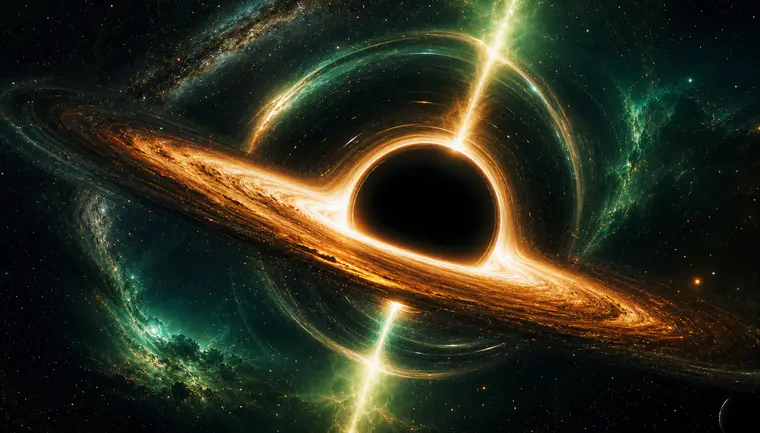
What Is a Black Hole, Really?
A black hole is a region of spacetime where gravity is so intense that nothing—no matter, no light—can escape once it crosses an invisible boundary called the event horizon. Outside the horizon, space and time are distorted but still navigable; cross the threshold, and every possible future points inward. The center is often described as a singularity, not because we know there’s an infinitely dense point, but because our current physics (general relativity) predicts a breakdown there. In other words: black holes are where our best theories meet their limits—cosmic laboratories that test how the universe works.
Quick vocabulary to sound like a pro
- Event horizon: The “point of no return.”
- Accretion disk: A hot, bright whirlpool of gas spiraling into the hole.
- Photon sphere: A precarious circular path where light can orbit the hole.
- Ergosphere: A whirlpool-like region around a spinning black hole where space itself is dragged around.
Not All Black Holes Are the Same Size
Black holes come in a family of sizes:
- Stellar-mass black holes form when massive stars collapse. They usually weigh a few to a few dozen times the Sun’s mass.
- Intermediate-mass black holes (IMBHs) sit in the hundreds to tens of thousands of solar masses. They’re trickier to catch but increasingly supported by observations.
- Supermassive black holes (SMBHs) anchor most large galaxies, including our Milky Way. They span millions to tens of billions of solar masses and power some of the brightest beacons in the universe.
- Primordial black holes are a speculative idea from the early universe; we don’t yet have evidence that they exist.
Trivia nugget: because a supermassive black hole’s event horizon is vast, the tidal forces at the boundary can be surprisingly gentle. You could cross the horizon of a giant quietly—only to face doom much deeper in. By contrast, a small stellar-mass black hole would tear you apart via tidal forces long before you reached the horizon.
You Can’t See One—But You Can See Its Shadow
Black holes, by definition, don’t emit light. But matter around them does. Gas rushing inward heats up and glows, forming an accretion disk that can outshine entire galaxies. Against that light, a black hole carves a telltale “shadow”—a dark, circular silhouette roughly 2.6 times the size of the event horizon due to the way gravity bends light. In 2019 and 2022, astronomers used an Earth-sized virtual telescope to capture images of the shadows of two supermassive black holes: one in the galaxy M87 and another in the center of our Milky Way. Those historic images were made by combining radio telescopes worldwide in a project called the Event Horizon Telescope.
Tip for trivia night: the “shadow” isn’t the event horizon itself; it’s the bright background light gravitationally lensed around the black hole, with the hole’s presence cutting out a darker circle.
Black Holes Can Sing—We Call It a “Chirp”
When two black holes spiral together and merge, they shake spacetime, sending out ripples known as gravitational waves. Detectors on Earth can convert these signals into audible sounds: rising whoops called chirps. The chirp’s pitch and length reveal the masses and spins of the black holes that merged. Listening to the universe is no longer a metaphor; it’s a measurement.
Try this: search for “LIGO black hole chirp audio” to hear a real merger. It’s a perfect party trick for science trivia night.
Time Slows Down Near a Black Hole (But Not For You)
From a safe distance, you’d watch a falling astronaut appear to slow down, dim, and freeze just above the event horizon. That’s gravitational time dilation and redshift at work. To the astronaut, though, time marches forward normally, and they’d cross the horizon without noticing anything special at that precise instant. The drama ramps up later, as tidal forces grow overwhelming.
Spaghettification: Delicious Word, Terrible Fate
Tidal gravity is the difference in gravitational pull between your head and your feet. Near compact objects like stellar-mass black holes, that difference can become extreme, stretching objects into long, thin shapes—hence “spaghettification.” For supermassive black holes, the tidal gradient at the horizon can be mild, but the interior remains inescapable.
The Fastest Merry-Go-Round in the Universe
Many black holes spin. A maximally spinning (Kerr) black hole drags spacetime so fiercely that within the ergosphere, nothing can stand still relative to distant space. This twist on reality enables exotic processes like energy extraction (the Penrose process), at least in principle. Some observed black holes appear to rotate at phenomenal rates, with dimensionless spin parameters approaching the theoretical limit.
Trivia booster: “no-hair theorem” is the catchy phrase that black holes, in classical general relativity, are fully described by just three things—mass, spin, and electric charge. No other “hairy” details persist.
The Brightest Beacons Come From the Darkest Hearts
Quasars and blazars—among the brightest objects in the cosmos—are powered by supermassive black holes feeding rapidly. Magnetic fields threading the disk can launch particle jets that shoot out at nearly light speed. These jets don’t come from inside the event horizon; they’re powered by the intense environment just outside it. Point a jet almost directly at us, and you get a blazar, a cosmic lighthouse blinking across billions of light-years.
Hawking Radiation: Black Holes Do Evaporate (Extremely Slowly)
In the 1970s, Stephen Hawking showed that black holes aren’t entirely black. Quantum effects near the horizon let them emit a tiny spectrum of radiation and slowly lose mass. For stellar and supermassive black holes, this process is glacial—far longer than the current age of the universe. But a hypothetical tiny black hole would evaporate quickly, growing hotter as it shrinks. The counterintuitive punchline: the smaller the black hole, the faster it evaporates.
The Gravity of Light: Photon Spheres and Orbits
Light can orbit a black hole at the photon sphere, which for a non-rotating hole sits at 1.5 times the Schwarzschild radius (the radius of the event horizon is 1.0 Schwarzschild radii). For matter, the innermost stable circular orbit (ISCO) is at 3 Schwarzschild radii for non-rotating holes; inside that, stable orbits become impossible and matter plunges inward. Spin changes everything: for a rapidly rotating hole, the prograde ISCO moves closer to the horizon, raising the maximum theoretical efficiency of converting infalling mass to radiant energy.
Black Holes Make Great Lenses
Gravity bends light. If a black hole passes in front of a background star or galaxy, it can act like a magnifying glass, distorting and brightening what’s behind it. Perfect alignment can produce an “Einstein ring.” Astronomers exploit gravitational lensing to map invisible mass and probe the distant universe—an elegant cosmic trick where darkness helps reveal light.
Records That Blow Minds (and Win Trivia Rounds)
- Heaviest black holes: supermassive giants likely weighing tens of billions of Suns lurk at the centers of some galaxies. A famous quasar host known as TON 618 is often cited as an example with an estimated mass in that range.
- Biggest shadow we’ve imaged: the M87 black hole’s silhouette is so large that, from Earth, it matched the apparent size of a bagel on the Moon.
- Speed demons: gas in the inner accretion disk orbits at a significant fraction of light speed.
- Energy champs: accreting black holes can convert 10–40% (or more, depending on spin and magnetic fields) of infalling mass into radiation—far more efficient than nuclear fusion.
Common Myths, Busted
- “Black holes are cosmic vacuum cleaners that will swallow everything.” Not quite. Their gravity acts like any other mass at a distance. If the Sun were replaced by a black hole of the same mass (it won’t be), Earth would keep orbiting nearly the same.
- “Nothing escapes a black hole.” From inside the horizon, that’s true. But jets and brilliant light from the hot disk just outside the horizon escape easily—and that’s what we see.
- “Black holes break physics.” They stress test it. We know general relativity works extremely well outside the singularity. What happens at the center likely requires a quantum theory of gravity we don’t yet have.
Practical Ways to Experience Black Hole Science From Home
- Hear gravitational waves: search for official observatory sites that host merger audio clips and interactive demos.
- Simulate orbits: tools like open-source planetarium software or physics sandboxes let you model gravity and visualize accretion.
- Explore real data: many observatories release public datasets. You can see spectra, images, and even citizen-science projects that help classify phenomena.
- Visualize spacetime: look for reputable visualizations that ray-trace light around spinning black holes to show lensing, photon rings, and shadows.
Pro tip: when trying apps or simulations, pick ones that let you vary black hole mass and spin. Watch how the ISCO shifts inward as spin increases, and how the efficiency and disk color profile change—great for a quick show-and-tell during a quiz night or classroom demo.
How Do We Find Hidden Black Holes?
Astronomers rely on indirect clues:
- Companion star motions: a visible star wobbling around an unseen partner can betray a stellar-mass black hole.
- X-ray binaries: hot gas stolen from a companion star glows in X-rays as it spirals inward.
- Stellar “tidal disruption events”: sometimes a star wanders too close to a supermassive black hole and gets shredded, lighting up the galaxy’s core for months.
- Gravitational waves: mergers of black holes and neutron stars leave unambiguous ripples in spacetime.
- Megamasers and gas dynamics: radio “maser” spots and swirling gas near galactic centers map the gravity around supermassive black holes with exquisite precision.
Could a Black Hole Threaten Earth?
Space is huge and black holes are relatively rare. The nearest known examples are thousands of light-years away, and none is on a collision course with our solar system. The Sun is also too light to become a black hole; it will end its life as a white dwarf. Bottom line: black holes are awe-inspiring, not an immediate local hazard.
Memory Hooks for Quiz Champs
- Three-word summary: mass, spin, charge (no-hair theorem).
- 1.5–3–inward: photon sphere at 1.5 Rs; ISCO at 3 Rs; inside that, plunge.
- “Chirp, shadow, jet”: three observational signatures you can talk about in seconds.
- Evaporation is slow: Hawking radiation empties the bank over mind-bending timescales.
Frequently Asked Questions
Q: Can the Sun ever become a black hole? A: No. The Sun doesn’t have enough mass. It will eventually shed its outer layers and leave behind a white dwarf, not collapse into a black hole.
Q: What happens at the singularity—does physics break? A: Our equations predict a singularity, signaling they’re incomplete there. We expect a future quantum theory of gravity to replace that “infinite” with a physical description.
Q: Are wormholes or time travel through black holes possible? A: Traversable wormholes are theoretical and unsupported by evidence. Falling into a real black hole is a one-way trip; you can’t use it to travel elsewhere and report back.
Q: What’s the “shadow” we saw in those famous images? A: It’s the dark silhouette cast by the black hole against glowing material behind it, enlarged by gravitational lensing. It outlines, but is larger than, the event horizon.
Approved member comments will appear here.