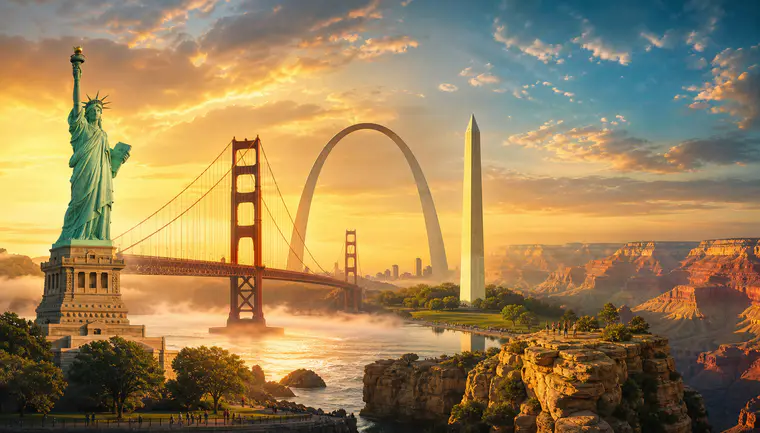
If you’ve road-tripped across the United States, you’ve probably stood beneath the Statue of Liberty, gazed up at the Washington Monument, or watched mist rise from Niagara Falls. But even the most photographed places still keep a few surprises. Here are little-known facts, smart visiting tips, and shareable tidbits about America’s most beloved landmarks—perfect for trivia nights, travel planning, and impressing your road‑trip crew.
Statue of Liberty, New York
What most people don’t know
- Lady Liberty functioned as a working lighthouse for years after her 1886 dedication. Ships entering New York Harbor navigated by her torch before modern navigation lights took over.
- The statue arrived from France disassembled into hundreds of crates and thousands of pieces. The copper skin is about the thickness of two stacked pennies—far thinner than people imagine.
- Her original torch was replaced in the 1980s due to weather damage. The torch you see today is a careful reconstruction; the original sits in the pedestal museum.
Quick tips for your visit
- Crown tickets are limited and sell out weeks in advance; pedestal tickets are easier to snag last-minute.
- Aim for the first ferry of the day for shorter lines and cooler temperatures in summer.
Mount Rushmore, South Dakota
What most people don’t know
- Hidden behind Lincoln’s head is a chamber often called the “Hall of Records.” It isn’t a public exhibit, but it does hold a time capsule-style repository that explains the memorial’s purpose to future generations.
- The sculptures aren’t carved into a freestanding mountain; they’re hewn from a granite outcrop chosen for its stability and sunlight.
Quick tips for your visit
- Arrive close to sunset for soft, dramatic light on the faces, then stay for the evening lighting ceremony in peak season.
- Drive the nearby Iron Mountain Road for cleverly framed tunnel views of the presidents.
Golden Gate Bridge, California
What most people don’t know
- Its famous color—International Orange—wasn’t the original plan. The hue was chosen because it stood out in fog and complemented the surrounding hills.
- The bridge isn’t “repainted end-to-end.” Instead, crews constantly touch up areas as needed, an endless choreography against salt and wind.
Quick tips for your visit
- Best crowd-avoiding photo angles: Battery Spencer at dawn, Fort Point at low tide, and Marshall’s Beach for a wild shoreline view.
- Bring layers—wind over the strait makes even sunny days feel brisk.
The White House, Washington, D.C.
What most people don’t know
- A glass-roofed conservatory graced the White House in the 19th century, complete with tropical plants and cut flowers for state events.
- The building has seen many makeovers: gaslight to electric, horse stables to garages, even a bowling alley and a movie theater.
Quick tips for your visit
- Public tours must be requested in advance through a Member of Congress. If you can’t get one, the White House Visitor Center offers excellent exhibits, artifacts, and a scale model.
The Grand Canyon, Arizona
What most people don’t know
- Some of the rocks at the canyon’s bottom are nearly two billion years old—making the canyon not just deep, but a time machine into Earth’s geologic past.
- The “Skywalk” glass platform often seen online isn’t inside Grand Canyon National Park. It’s on Hualapai Tribal lands at Grand Canyon West, a separate destination.
- The Grand Canyon has its own pinkish rattlesnake species, superbly camouflaged against rose-colored rock.
Quick tips for your visit
- South Rim = classic views and amenities; North Rim = fewer crowds and cooler summertime temps (seasonal access only).
- For sunrise with elbow room, try Navajo Point or Lipan Point instead of the busier Mather Point.
Independence Hall, Philadelphia
What most people don’t know
- The Assembly Room where the Declaration and Constitution were debated is arranged to reflect how it looked during the Constitutional Convention, right down to George Washington’s “Rising Sun” chair.
- Many artifacts you’ll see—including the desks and inkwells—are faithful period pieces that transport you straight into the 18th century.
Quick tips for your visit
- Timed-entry tickets are free but required in much of the year; pick them up online or at the Independence Visitor Center.
- Pair your visit with nearby Carpenters’ Hall and Congress Hall for a full founding-era circuit.
Gateway Arch, St. Louis
What most people don’t know
- At 630 feet, it’s not just tall—it’s exactly as wide as it is high. That perfect dimension gives the arch its elegant catenary curve.
- The tram is a marvel: a series of small, self-leveling capsules that combine elevator, cable car, and Ferris wheel mechanics to climb the inside of the leg.
Quick tips for your visit
- Clear days make the observation windows sparkle, but post-storm afternoons can produce dramatic Mississippi River skies.
- Museum exhibitions under the Arch are free; tram rides require timed tickets.
Empire State Building, New York
What most people don’t know
- The spire was originally envisioned as a mooring mast for airships. Wind and safety concerns made the idea impractical after a few test attempts.
- The building is so iconic it has its own ZIP code. That’s how much mail and business it handles.
Quick tips for your visit
- For classic cityscapes, time your ticket for one hour before sunset to see daylight, twilight, and the city lights switch on.
- Consider the less-crowded 102nd-floor observatory for a serene, glassed-in experience.
Washington Monument, Washington, D.C.
What most people don’t know
- The aluminum tip at the very top was considered a precious, cutting-edge metal when it was installed. It also serves as a lightning rod.
- The color shift partway up the shaft isn’t grime—it’s a result of construction pauses and stone sourced from different quarries.
Quick tips for your visit
- Free, timed entry tickets are released in advance online; a same-day limited batch drops early each morning.
- Walk the ring of commemorative stones along the interior stairwell via ranger-led programs when available.
Hoover Dam, Nevada/Arizona
What most people don’t know
- The dam wasn’t poured as a single slab. Engineers used a honeycomb of interlocking concrete blocks with pipes running through them to speed cooling.
- Lake Mead’s pale “bathtub ring” is natural mineral residue from fluctuating water levels.
Quick tips for your visit
- The power plant tour adds context to the art deco details you’ll notice on the dam’s exterior.
- Cross the Mike O’Callaghan–Pat Tillman Memorial Bridge pedestrian path for a sweeping, less vertigo-inducing view of the dam.
Yellowstone’s Old Faithful, Wyoming
What most people don’t know
- Old Faithful’s eruptions aren’t perfectly punctual; intervals vary from roughly half an hour to about two hours depending on the previous eruption’s duration and volume.
- The geyser sits atop a complex hydrothermal plumbing system fed by rain and snowmelt heated by a vast volcanic hotspot.
Quick tips for your visit
- Check prediction boards at the visitor center or official apps for the next eruption window.
- Respect boardwalks—ground near geysers can be thin and dangerously hot even where it looks solid.
Alcatraz Island, California
What most people don’t know
- Before it became a federal penitentiary, Alcatraz hosted the first lighthouse on the U.S. West Coast.
- The island’s gardens—tended by military families and later by inmates—are so resilient that many original plantings still thrive in salty winds.
Quick tips for your visit
- Night tours sell out and reveal a surprisingly atmospheric side of “The Rock,” including ranger talks and cellhouse stories.
- Wear sturdy shoes; you’ll climb steep lanes and historic stairways.
The Liberty Bell, Philadelphia
What most people don’t know
- The famous crack we see today is actually the result of an attempted repair that widened an earlier fracture.
- The inscription spells “Pennsylvania” with a single “n”—a spelling variant acceptable in the 18th century.
Quick tips for your visit
- It’s free to see, but queues can grow. Early morning or late afternoon lines are lightest.
- Don’t miss the exhibits that trace the bell’s evolving symbolism, from abolitionist icon to civil-rights emblem.
Mesa Verde’s Cliff Palace, Colorado
What most people don’t know
- Cliff Palace is the largest cliff dwelling in North America, part of a vast cultural landscape left by the Ancestral Pueblo people.
- Many structures were expertly plastered and painted; traces survive in protected alcoves.
Quick tips for your visit
- Ranger-guided tours are required for most cliff dwellings; book early in the season.
- Altitude is real here—pace yourself, bring water, and wear grippy footwear for ladders and uneven steps.
Niagara Falls (American Side), New York
What most people don’t know
- In the 19th century, an upstream ice jam temporarily halted the flow of the American Falls, drawing stunned crowds onto the empty riverbed.
- The Cave of the Winds wooden walkways below Bridal Veil Falls are rebuilt each year due to winter ice and spring torrents.
Quick tips for your visit
- For the mist-in-your-face experience, bring quick-dry layers and a waterproof phone pouch.
- Evening illuminations paint the falls in vivid colors—check the nightly schedule when planning dinner.
Brooklyn Bridge, New York
What most people don’t know
- Although John Roebling designed it, his son Washington and daughter-in-law Emily played decisive roles in completion. Emily Roebling became the essential on-site liaison and project manager when Washington fell ill.
- The bridge’s granite towers contain arched vaults that once served as bonded wine cellars because of their cool, stable temperatures.
Quick tips for your visit
- Start in Brooklyn at sunrise and walk toward Manhattan for skyline views and gentler crowds.
- Keep right on the pedestrian path and mind the bike lane—etiquette keeps this icon enjoyable for everyone.
Mount Vernon, Virginia
What most people don’t know
- George Washington was a forward-thinking agrarian entrepreneur. His large-scale, water-powered distillery produced rye whiskey and other spirits; the working reconstruction operates seasonally.
- The mansion’s iconic “stone” look is actually wood siding treated with sand-infused paint, a technique called rustication.
Quick tips for your visit
- Mansion tour tickets are timed; the grounds, museums, and farm outbuildings reward slow, curious exploration.
- Visit the wharf for Potomac River breezes and a quieter vantage point.
Practical Tips: Turn Trivia Into Better Travel
- Book timed tickets early for crown/pedestal climbs, narrow trams, or popular observatories.
- Seek alternative vantage points (bridges, riverfronts, side trails) for iconic photos without iconic crowds.
- Learn the “quirk” before you go: aluminum capstones, hidden chambers, or long-lost greenhouses. You’ll spot details others miss.
- Go early or late. Golden hours not only beautify photos—they shorten lines and soften heat.
- Pair landmarks with nearby under-the-radar sites: Battery Spencer with Fort Point (Golden Gate), Congress Hall with Independence Hall, or the Arch museum with the Old Courthouse.
- Respect closures and cultural boundaries. Some experiences (like the Grand Canyon Skywalk) are on tribal lands with their own rules and ticketing.
Fast-Track Trivia Round
- Which U.S. monument is both its height and its width? The Gateway Arch—630 feet each way.
- Which landmark once tried (briefly) to host airships? The Empire State Building’s spire.
- Which bridge color wasn’t the original plan but became iconic anyway? International Orange on the Golden Gate Bridge.
- Which D.C. obelisk has a once-precious metal at its tip? The Washington Monument’s aluminum capstone.
How to Build a Landmark Bucket List That Feels Fresh
Instead of sprinting from postcard to postcard, give each place a theme:
- Engineering Marvels: Hoover Dam, Brooklyn Bridge, Gateway Arch. Focus on how they solved wind, load, and geology challenges.
- Birth of a Nation: Independence Hall, Liberty Bell, Mount Vernon. Read a primary-source excerpt on your phone before stepping inside.
- Nature’s Power: Grand Canyon, Yellowstone geyser basins, Niagara Falls. Compare the forces shaping each landscape—water, heat, or time.
- Island Stories: Alcatraz and Liberty Island. Consider how islands magnify symbolism—freedom at the harbor’s mouth, isolation in the fog.
Give yourself one trivia quest per stop—find a specific carving at Mount Rushmore, a commemorative stone in the Washington Monument, or a subtle paint line on the White House façade. By the time you leave, you’ll have a real memory, not just a camera roll.
Frequently Asked Questions
Which American landmarks are free to visit?
Many are free or low-cost to enter: the National Mall monuments, the Liberty Bell Center, and the Gateway Arch museum (tram extra). Always check if timed tickets are required.
What’s the best time of day to avoid crowds at popular landmarks?
Early morning typically offers the quietest experience and best light. Sunset can work too, but expect more people at photogenic spots.
How can I uncover little-known facts while I’m on-site?
Visit official visitor centers and museums, chat with rangers or docents, and look for special-topic tours. Interpretive signs and exhibits often answer the “why” behind the “wow.”
Are there any hidden rooms or restricted areas I can actually see?
Some “secret” spaces require special tours—like interior stair exhibits or seasonal programs. When available, book ahead and be ready for small-group, timed entries.
Approved member comments will appear here.