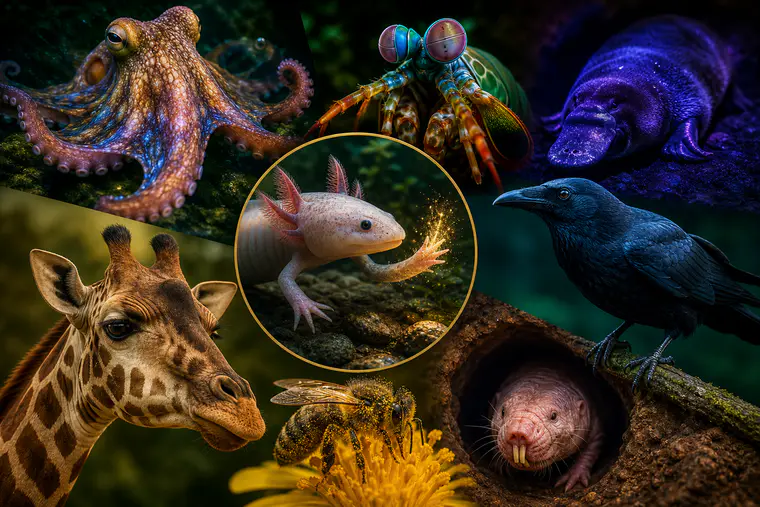
Think you know the animal kingdom? Prepare to have your assumptions joyfully upended. These science-backed facts and bite-size explanations are perfect for wowing friends, leveling up your trivia game, and seeing familiar creatures in a brand-new light.
Brainy Behaviors You Didn’t See Coming
Crows remember faces—and spread the word
Crows can recognize individual human faces and remember who treated them well (or badly) for years. Even more impressive, they can teach other crows which faces to avoid. If a trivia clue mentions long-term memory or “avian grudges,” think corvids.
Octopuses taste with their arms
An octopus’s suckers are lined with chemoreceptors, letting it “taste by touch.” Combine that with three hearts, blue copper-based blood, and color-morphing skin, and you’ve got one of the ocean’s most adaptable problem solvers.
Cleaner wrasse show signs of self-recognition
A small reef fish, the cleaner wrasse, has shown behavior in experiments suggesting it can recognize itself in a mirror—long considered a benchmark of self-awareness. Whether you accept the interpretation or not, it’s a great reminder: big brains aren’t the only brains that surprise us.
Bees understand the concept of zero
Honeybees can learn that an empty set (zero) is less than one—an abstract idea children take time to grasp. In quizzes, when “small-brained animals” meet “surprising math,” bees are a strong bet.
Physics Masters Hiding in Plain Sight
The pistol shrimp’s shockwave “punch”
Pistol shrimp snap a specialized claw so fast it creates a cavitation bubble that collapses with a flash of light (sonoluminescence) and a stunning shockwave. Locally, the bubble reaches extreme pressure and very high temperatures—enough to incapacitate prey.
Archerfish correct for refraction
Archerfish spit precise jets of water to knock insects off leaves above the surface. The trickier part: they compensate for the way light bends at the air–water boundary, calculating the correct aim from underwater.
Leafcutter ants run farms
These ants don’t eat the leaves they harvest; they use them to cultivate a specialized fungus, which feeds the colony. Ant farmers even use antimicrobial secretions to keep their gardens healthy—a tiny echo of human agriculture.
Bodies Built for the Extreme
Tardigrades tough it out
Microscopic tardigrades (water bears) can withstand extreme dehydration, freezing, intense radiation, and even the vacuum of space by entering a near-suspended state called a tun. They’re not invincible—but they’re champions of survival.
Axolotls regenerate with flair
The axolotl can regrow full limbs, parts of its spinal cord, heart tissue, and even parts of its brain without scarring. It stays in a youthful, aquatic form for life (a trait called neoteny), making it a staple in regeneration research.
Antarctic icefish have transparent blood
Some icefish species living in frigid Antarctic waters lack hemoglobin. Instead, their oxygen-poor environment and cold-adapted physiology, including antifreeze proteins, let them survive with colorless blood.
Wombats make cube-shaped poop
Wombats produce surprisingly cubical droppings due to subtle differences in elasticity along their intestines. The cubes don’t roll, helping the animals stack scent markers on rocks and logs to communicate.
Senses That Feel Like Superpowers
Platypuses sense electricity—and glow under UV
The duck-billed platypus hunts with electrolocation, detecting faint electric fields from muscle movements of prey. As a bonus twist, their fur biofluoresces under ultraviolet light, shining in blue-green hues.
Reindeer see ultraviolet
Arctic winters are dim and snowy, but reindeer can detect ultraviolet wavelengths. UV highlights lichen (key winter food) and the urine trails of predators, giving reindeer crucial contrast in a washed-out landscape.
Elephants talk in rumbles you can’t hear
Elephants produce infrasound—very low-frequency calls that travel long distances and are felt as much as heard. These rumbles carry social and navigational information across savannas.
Owls fly in near-silence
Specialized feather edges break up turbulence along an owl’s wings, dramatically muffling flight noise. That quiet approach, paired with forward-facing eyes and a facial disk that funnels sound, makes them stealth hunting experts.
Records That Defy Intuition
Sharks are older than trees
Sharks appeared more than 400 million years ago, predating the first modern trees. Next time a question asks which group has the deeper evolutionary roots, “sharks” is often the winning answer.
Giraffes and humans share the same number of neck bones
Despite the giraffe’s skyscraper neck, it has seven cervical vertebrae—the same count as humans and most mammals. Each vertebra is just greatly elongated.
Dolphins sleep with half a brain at a time
To breathe consciously and keep watch, dolphins and some other cetaceans practice unihemispheric sleep—resting one side of the brain while the other stays alert.
Some birds nap while flying
Great frigatebirds have been recorded sleeping briefly mid-flight, catching micro-naps during long ocean journeys. Sleep strategies can be wildly flexible in the animal world.
Everyday Creatures With Extraordinary Details
Koalas have fingerprints like ours
Koala fingerprints are so similar to human ones that they can, in theory, confuse forensic analysis. Another primate-like trait in a decidedly non-primate animal.
Goats’ rectangular pupils improve their view
Horizontal, rectangular pupils give goats and many grazing animals a panoramic field of view and improved ground contrast—useful for spotting predators on open terrain.
Pigeons are pattern pros
Often dismissed as “city birds,” pigeons are adept learners. Studies show they can distinguish complex visual categories, from artworks to letter-like shapes—making them unexpectedly brainy urbanites.
Vampire bats share meals
If a vampire bat fails to feed, roost-mates may regurgitate blood to keep it alive, a rare example of reciprocal food sharing in mammals. Social bonds matter, even for night fliers with a spooky reputation.
The Strange and the Spectacular Underwater
Cuttlefish can wait for a better reward
Cuttlefish have shown the ability to delay gratification—opting to wait for a preferred snack. Combine that with dynamic camouflage that matches patterns and textures, and you have a cephalopod both patient and sneaky.
Box jellies have eyes—lots of them
Box jellyfish possess multiple clusters of eyes, some with lenses and retinas that can form images. Their visual system helps them navigate around roots and obstacles in mangrove habitats.
Sea stars can see, too
At the tips of their arms, many sea stars have simple eyes that detect light and dark, helping them orient toward reefs. They’re not “blind”—just using a very different visual strategy.
Animal Architecture That Works Like Technology
Termite mounds self-ventilate
Tall termite mounds use a network of vents and porous walls to regulate temperature and humidity—natural climate control for fungus farms and growing colonies. Engineers study these designs for greener buildings.
Bowerbirds build to impress
Male bowerbirds construct artful bowers and decorate them with shells, berries, and found objects. Some species even arrange items by size to create forced perspective—optical illusions that make the display look larger.
Sneaky Reproduction Strategies
Parthenogenesis pops up in sharks and reptiles
In the absence of males, some female sharks and reptiles can reproduce asexually via parthenogenesis, producing viable offspring. It’s rare, but nature keeps a few unexpected cards up her sleeve.
Seahorse dads carry the babies
In seahorses and their pipefish relatives, males incubate embryos in a brood pouch, providing oxygen and nutrients until birth. If a question asks, “Which animal has male pregnancy?”—you’ve got the answer.
Feel-Good Facts for Sharing
- Sea otters often wrap themselves in kelp—and sometimes hold paws—so they don’t drift apart while resting.
- Flamingos aren’t born pink; they gain color from carotenoid pigments in their diet.
- Butterflies and many other insects can “taste” with sensory receptors on their feet.
- Penguins have dense, solid bones (not hollow like many flying birds) to reduce buoyancy for diving.
- Cockroaches can live without their heads for days due to their open circulatory system and breathing through spiracles—but dehydration eventually ends the streak.
- The “immortal jellyfish” (Turritopsis dohrnii) can revert from its adult form back to a juvenile polyp stage under stress, effectively resetting its life cycle.
Turn These Facts Into Trivia Superpowers
Spot the pattern
Many high-scoring answers center on one of these themes:
- Evolutionary outliers: animals that break the rules (male pregnancy—seahorses; cube poop—wombats; no hemoglobin—icefish).
- Physics feats: creatures that weaponize water, bubbles, or light (pistol shrimp, archerfish, bioluminescent or biofluorescent species).
- Braininess in small packages: insects and fish with surprising cognition (bees and zero; cuttlefish delaying rewards).
- Senses beyond humans: magnetoreception, infrasound, electrolocation, UV vision.
When you catch one of these themes in a clue, list likely candidates quickly. With practice, you’ll buzz or tap faster.
Build memory hooks
Pair an animal with a vivid mental image:
- Platypus: a glowing, duck-billed electrician hunting in the dark.
- Archerfish: an underwater sniper compensating for light refraction.
- Wombat: a careful builder stacking cubes like Lego blocks.
- Axolotl: a forever-young scientist regrowing limbs in a lab coat.
Practice with “which of the following” traps
If a question pits several plausible facts against each other, eliminate statements that sound too absolute (“never,” “always,” “only”) unless it’s a real signature trait (e.g., only male seahorses carry pregnancies). Then look for the oddball that matches a known pattern—like “electrolocation” pointing straight to the platypus.
Turn watching into learning
- Documentary nights: Keep a notepad or phone list of one-sentence zingers (“Cleaner wrasse pass mirror test?”) and review them before quiz night.
- Zoo/aquarium visits: Read the placards; they’re full of record-holders and superlatives quiz writers love.
- Backyard science: Try spotting pollinators at different times of day and note how behavior changes with light and temperature.
Quick Quiz-Style Warm‑Ups
- Which mammal glows under UV light and locates prey via electrolocation?
- Platypus.
- What underwater hunter uses a shockwave from a collapsing bubble to stun prey?
- Pistol shrimp.
- Name one animal that can reproduce via parthenogenesis.
- Some sharks and reptiles (e.g., Komodo dragons) in rare cases.
- Which bird constructs elaborate, decorated structures to attract mates?
- Bowerbird.
Frequently Asked Questions
Are these animal facts really useful for trivia?
Yes. Quiz writers love counterintuitive biology, “only-in-nature” superlatives, and animals that break the rules. Memorize a handful from each theme—senses, physics feats, extreme bodies—and you’ll spot patterns fast.
What’s a good way to remember so many facts?
Use vivid mental images and group facts by theme. Flashcards work, but a short “fact list” on your phone that you scan before a quiz can be just as effective.
Do any of these facts change as science advances?
Sometimes. For example, interpretations of animal cognition (like mirror tests) evolve with new studies. Keep an eye on reputable science news to refresh your knowledge.
What’s the single best “gotcha” fact to learn first?
Start with seahorse dads carrying pregnancies or sharks being older than trees—both are short, memorable, and show up surprisingly often in general trivia.
Approved member comments will appear here.