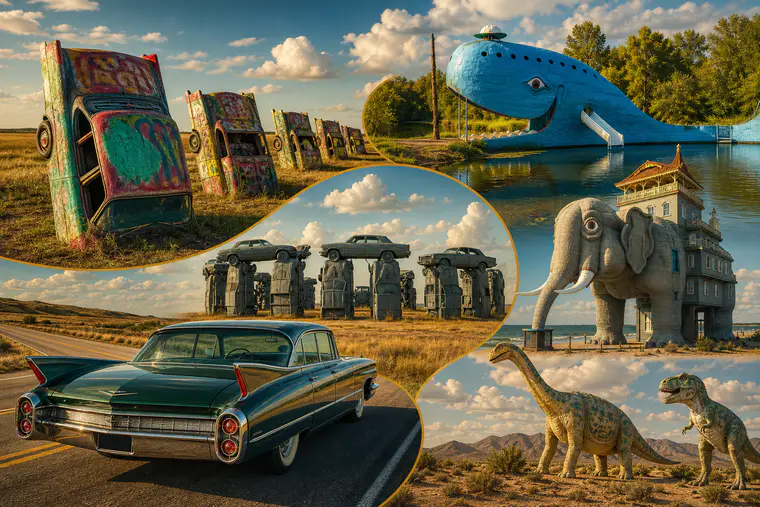
Every great American road trip has a moment when the map goes quiet, the highway widens, and something gloriously odd appears on the horizon: a brontosaurus looming over the desert, a ring of cars planted nose-first in the prairie, a six-story elephant gazing at the sea. Roadside attractions are the country’s most democratic museums—free (or nearly), photogenic, and open to anyone with a tank of gas and a sense of humor.
What Makes a Roadside Attraction “Worth the Stop”
The best roadside oddities deliver three things:
- A clear, memorable visual: giant fruit, towering mascots, neon dinosaurs. You spot them at 65 mph and instantly know you’re somewhere specific.
- A backstory that sparks trivia: who built it, when, and why? The weirder the origin story, the better the memory.
- Easy access: ideally right off a highway with parking, bathrooms, and maybe a snack or gift shop.
If a stop checks those boxes, it earns a place on your must-see list.
How to Plan a Weird-Stop Road Trip
Quick planning blueprint
- Pick a corridor with history: Route 66 (IL–CA), I‑90 across the northern plains, or the I‑10 desert stretch all promise maximum oddities.
- Cluster your stops: aim for 3–6 attractions within a day’s drive so you’re not racing the clock.
- Cross-check details the day before: many attractions are always-on photo ops, but some have seasonal hours or tours.
- Budget for surprises: a $5 museum, a slice of pie, or a souvenir postcard is part of the fun.
- Pack “weird-ready” gear: sunscreen, water, a wide‑angle lens/phone, small bills for donations, and a trash bag so you leave places cleaner than you found them.
Pro tip
Drop pins ahead of time and download offline maps. In rural stretches, one bar of service can be rarer than a jackalope.
America’s Strangest Crowd-Pleasers, Coast to Coast
Below are standout oddities with bite-size history, why they’re special, and how to enjoy them.
Cadillac Ranch — Amarillo, Texas
- The gist: Ten vintage Cadillacs are buried nose-first in a Panhandle field, tailfins jutting toward the sky like neon shark fins.
- Why it’s weird: Created in 1974 by the art collective Ant Farm, the cars trace the evolution of Cadillac tailfins. Visitors are encouraged to add fresh layers of spray paint, turning the installation into a living, changing canvas.
- Smart tip: Bring your own paint, but pack out empties. Wind can be fierce—secure hats and tripods. After rain, expect mud.
Carhenge — Alliance, Nebraska
- The gist: A faithful, stone-for-car recreation of Stonehenge, assembled from 30‑plus gray‑sprayed autos.
- Why it’s weird: It’s both parody and love letter to ancient monuments—Midwestern humor cast in Detroit steel.
- Smart tip: Sunrise and sunset side‑light the forms beautifully. Summer crowds thin dramatically at dawn.
The Blue Whale — Catoosa, Oklahoma (Route 66)
- The gist: A smiling, bright‑blue whale lounges in a pond beside the Mother Road.
- Why it’s weird: Built in the early 1970s as an anniversary gift, it became a Route 66 legend and a family picnic staple.
- Smart tip: Bring a picnic and mosquito spray in warm months. If there’s a line for photos, offer to snap pictures for the next group—instant goodwill.
Lucy the Elephant — Margate City, New Jersey
- The gist: A six‑story, elephant‑shaped building from the 1880s—part real estate promotion, part seaside spectacle.
- Why it’s weird: She outlasted the era of seaside novelties to become a National Historic Landmark and a beloved Jersey shore icon.
- Smart tip: Check for interior tour availability before you go. Golden hour adds a warm glow to Lucy’s tin hide.
Mystery Spot — Santa Cruz, California
- The gist: A gravity‑defying cabin in the redwoods where balls roll “uphill” and people appear to tilt at impossible angles.
- Why it’s weird: It’s an old‑school physics illusion experience presented with deadpan showmanship.
- Smart tip: Weekends can sell out—book ahead. Wear shoes with grip; the slanted floors are part of the fun (and the challenge).
Corn Palace — Mitchell, South Dakota
- The gist: A civic arena wrapped in murals made from corn, grains, and natural grasses.
- Why it’s weird: Each year’s designs are newly “harvested,” turning agriculture into architecture.
- Smart tip: Late summer into fall often shows the freshest murals, but the palace is picture‑worthy year‑round.
Wall Drug — Wall, South Dakota
- The gist: A sprawling, old‑west‑meets-roadside emporium famous for billboards, free ice water, and cheeky Americana.
- Why it’s weird: What began as a small pharmacy now anchors an entire mythology of prairie kitsch.
- Smart tip: It’s an easy break on I‑90. Look for the giant jackalope photo op and stock up on snacks before the Badlands.
Salvation Mountain — Near Niland, California (Salton Sea)
- The gist: A technicolor hillside painted with messages of love by outsider artist Leonard Knight.
- Why it’s weird: It’s part art, part pilgrimage site, and entirely handmade from adobe, straw, and paint in the desert heat.
- Smart tip: Go early or late to avoid roasting temperatures. Stay on marked paths; the artwork is fragile. Consider a small donation for upkeep.
Cabazon Dinosaurs — Cabazon, California
- The gist: Two towering concrete dinosaurs—“Dinny” the long‑neck and “Mr. Rex”—guard the edge of the desert.
- Why it’s weird: Built by a theme‑park sculptor in mid‑century style, they’re photogenic guardians of countless road trips.
- Smart tip: Wide‑angle shots capture both dinos and dramatic skies. Bonus points for a retro outfit in your photo.
House on the Rock — Spring Green, Wisconsin
- The gist: A labyrinthine museum/house hybrid with the gravity‑defying Infinity Room and a carousel crammed with creatures.
- Why it’s weird: It blends folk art, collectors’ mania, and architectural bravado into one mesmerizing detour.
- Smart tip: Plan at least 2–3 hours. Photos can be dim—bring a phone with good low‑light performance.
Enchanted Highway — Between Gladstone and Regent, North Dakota
- The gist: A 30‑plus‑mile stretch lined with massive scrap‑metal sculptures—geese, deer, grasshoppers—rising from rolling prairie.
- Why it’s weird: The rural scale is part of the punchline; each piece looks like a mirage until you’re right beside it.
- Smart tip: Start from I‑94 and work south. Keep an eye out for small pull‑offs and informational plaques.
The Thing? — Near Benson, Arizona (I‑10)
- The gist: A billboard‑teased museum of oddities culminating in a mysterious, mummified “Thing.”
- Why it’s weird: It’s the purest form of roadside marketing suspense—hundreds of signs building to one question.
- Smart tip: Budget 45–60 minutes if you go inside; even a quick photo with a “The Thing?” sign scratches the itch.
World’s Largest Ball of Twine(s) — Kansas and Minnesota
- The gist: America loves a superlative, even when it tangles. One enormous ball in Kansas grew as a community event; another in Minnesota was famously wound by a single man.
- Why it’s weird: Dueling claims, dueling pride—and both are fantastic excuses for a detour and a selfie.
- Smart tip: If you’re nearby in summer, ask whether additions or festivals are happening; small‑town celebrations are half the charm.
Field of Corn (with Osage Oranges) — Dublin, Ohio
- The gist: 109 human‑sized concrete ears of corn planted in tidy rows like a surreal harvest.
- Why it’s weird: It’s public art that turns a corporate lawn into a dreamscape—and a sly nod to Ohio’s agricultural roots.
- Smart tip: Overcast days reduce harsh shadows, letting the repetitive shapes stand out in your photos.
Jolly Green Giant — Blue Earth, Minnesota
- The gist: A 50‑plus‑foot statue of the famous vegetable mascot lording benevolently over the prairie.
- Why it’s weird: It’s advertising made monumental—and surprisingly good‑natured in person.
- Smart tip: There’s a nearby museum and fun cutouts for kids. The base platform gives you flattering, upward‑angle shots.
Bonus wild card: Marfa Lights Viewing Area — Marfa, Texas
- The gist: An official pull‑off where visitors hope to spot unexplained lights dancing on the horizon.
- Why it’s weird: It’s a roadside attraction that might not appear at all, and that’s part of the thrill.
- Smart tip: Bring patience and a jacket; desert nights can swing cool even after hot days.
Photo Tips That Make the Oddities Pop
- Go early or late: Softer light, fewer people, and richer colors.
- Leave room to breathe: Step back and include sky, prairie, or passing traffic to show scale.
- Add a human for scale: A friend beside a dino or corn ear gives instant context.
- Embrace symmetry (or break it): Center a subject like Carhenge, or shoot diagonally at Cadillac Ranch for dynamic lines.
- Clean the frame: A two‑step shuffle can remove a trash can or power line from your composition.
Roadside Etiquette and Safety
- Don’t trespass. If a site is on private land or roped off, respect the boundary.
- Follow local rules. Some places welcome participation (spray paint at Cadillac Ranch); others are look‑don’t‑touch.
- Pack it in, pack it out. A tidy site stays open and welcoming.
- Watch the shoulder. Use designated pull‑offs and signal early.
- Ask before flying drones. Rules vary widely; when in doubt, skip it.
A One‑Day Oddities Sampler on Route 66 (Oklahoma–Texas)
- Start in Tulsa with a coffee and a quick detour to the Blue Dome District’s neon for warm‑up photos.
- Head to Catoosa for the Blue Whale. Aim for 30 minutes to stroll, snack, and shoot.
- Cruise west and break in Clinton for a roadside museum or pie (pick your adventure).
- Roll into Amarillo by late afternoon. Hit Cadillac Ranch for golden hour paint and pictures.
- Cap the day with a kitschy steakhouse dinner or neon‑lit ice cream stand—because road trips deserve dessert.
Trivia Corner: Test Your Roadside Smarts
- Which prairie installation invites visitors to add fresh layers of spray paint? (Cadillac Ranch.)
- What animal shape houses an entire seaside building from the 1880s? (An elephant—Lucy.)
- Which Midwestern monument mirrors an ancient stone circle using cars? (Carhenge.)
- What corn‑themed landmark refreshes its murals with real crops? (The Corn Palace.)
- What Route 66 classic in Oklahoma features a giant smiling creature by a pond? (The Blue Whale.)
Frequently Asked Questions
Are most roadside attractions free?
Many are free to view from the outside, especially sculptures and oversized icons. Museums or interior tours (like Lucy the Elephant or certain oddity collections) may charge modest admission. Always check locally if you’re budgeting carefully.
What’s the best way to find attractions along my route?
Plan with a mix of map apps and curated roadside databases, then drop pins for each stop. Offline maps help in rural zones. Local visitor centers, gas‑station clerks, and diner servers also know great nearby oddities.
Is it okay to spray‑paint at Cadillac Ranch?
Yes—participation is part of the artwork’s spirit. Bring your own paint, be considerate of other visitors, and pack out empties so the field stays clean.
Are these stops kid‑friendly?
Generally, yes. Big sculptures, dinosaurs, and novelty buildings make easy family photo ops. Use caution near busy roads, obey signs, and schedule snack/bathroom breaks at larger stops like Wall Drug or museum‑style attractions.
Approved member comments will appear here.