Why fast‑food trivia is so irresistible
Fast food is everywhere—on highway exits, in airports, and probably a short walk from your home. That ubiquity hides a treasure trove of offbeat stories, design quirks, and marketing experiments that make great trivia. From space-bound pizzas to holiday traditions a world away, the strangest facts about fast‑food chains reveal how these brands innovate, adapt, and occasionally stumble in spectacular fashion.
Use this guide to stock your next quiz night, stump your foodie friends, or just see your go‑to drive‑thru in a whole new light.
Founding quirks and name oddities
Arby’s isn’t named after roast beef
It’s one of the most persistent misconceptions in food trivia: people assume “Arby’s” means “R.B.” for roast beef. The initials actually point to the founding Raffel Brothers, who launched the chain in the 1960s. The fact that it also became known for roast beef is an ironic, catchy coincidence.
White Castle’s slider science (and an industry first)
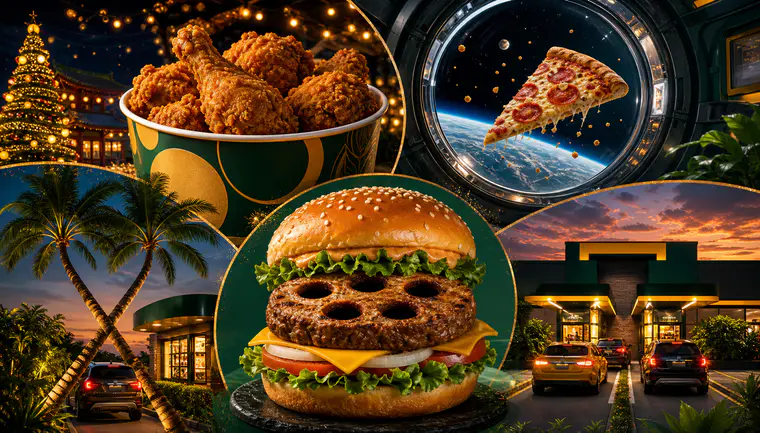
White Castle, founded in 1921, is widely credited as America’s first fast‑food hamburger chain. Its signature sliders have five little holes in each patty. That’s not a design flourish—it speeds up cooking by letting steam pass through, so the meat cooks evenly without flipping. In the assembly-line days of early fast food, those seconds mattered.
Burger King is “Hungry Jack’s” in Australia
The Burger King name was already taken by a small restaurant in Adelaide, so the franchisee opted for “Hungry Jack’s” (after a flour brand) when expanding in Australia. Same flame-grilled Whopper, different marquee. If you ever spot a Hungry Jack’s abroad, you’re looking at the Down Under cousin of Burger King.
PFK in Quebec
KFC goes by PFK in parts of French‑speaking Canada—short for “Poulet Frit Kentucky.” The name swap keeps the brand consistent with language laws, but the secret blend of 11 herbs and spices stays the same.
Global menu curveballs you won’t see at home
Christmas means…KFC in Japan
Thanks to a wildly successful 1970s marketing campaign, KFC became a Christmas tradition in Japan. Families place orders days in advance, and buckets sell out quickly. It’s a great illustration of how global brands adapt to local culture—in this case, creating a new holiday ritual altogether.
Regional specials that surprise
Fast‑food chains tailor their menus to local tastes in delightful ways:
- McDonald’s in India swaps out beef for chicken and veggie options, including the Maharaja Mac.
- Japan has featured shrimp burgers like the Ebi Filet‑O and seaweed‑seasoned fries.
- The Philippines keeps McSpaghetti on the menu—sweet-style tomato sauce, hot dogs, and all.
- In the Middle East, you’ll often find halloumi cheese items at Starbucks and other quick‑serve spots.
- Dessert pies at McDonald’s vary widely: taro, corn, and banana flavors have all taken turns in Asia.
Pro tip: If you’re traveling, check local-language social pages or the in‑country version of the brand’s app. Limited-time items and regional exclusives often appear there first.
Marketing stunts that went from odd to iconic
Pizza Hut delivered to outer space
In 2001, Pizza Hut sent a pizza to the International Space Station—part PR stunt, part logistics flex. It was customized for space conditions and delivered aboard a resupply mission. Whether you’d eat vacuum‑sealed pepperoni is another matter, but as far as brand one‑ups go, it’s tough to top “first pizza in orbit.”
A&W’s “1/3‑pounder” beat by math confusion
A&W tried to compete with McDonald’s Quarter Pounder by launching a bigger 1/3‑pound burger. It underperformed because many customers believed 1/3 was smaller than 1/4. It’s now a beloved case study in marketing—and a gentle reminder that clarity beats cleverness.
From book reports to pan pizzas
If you grew up in the U.S., there’s a good chance the Pizza Hut Book It! program motivated your reading habits with the promise of a personal pan pizza. It’s an unusual, long‑running example of fast food intersecting with education—and for many, a nostalgic trivia gem.
Free tacos for stolen bases
Taco Bell has built a ritual around big baseball games: when a player steals a base in the championship series, everyone in the country gets a free taco on a set redemption day. It’s a brilliant blend of sports hype, national participation, and a simple, craveable reward.
Design secrets hiding in plain sight
The McFlurry spoon isn’t a straw
That big square‑handled spoon at McDonald’s isn’t a failed straw design—it’s actually the mixing spindle. Workers clip it into a machine that blends the toppings into the soft serve, then hand you the same spoon. Once you know, you can’t unsee it.
Double drive‑thrus are more than a traffic fix
Many chains now run dual‑lane drive‑thrus. Yes, they handle more cars, but they also reduce perceived wait times—a psychological win. Some locations even deploy staff with tablets outdoors during peak rushes so orders hit the kitchen sooner than the car reaches the window.
Why those tiny pickle placements matter
Ingredient placement isn’t random. Pickles provide acid to cut richness; their exact placement can affect every bite’s balance. Chains test layouts to make flavor and texture consistent in each mouthful—think of it as micro‑engineering for mass delight.
In‑N‑Out’s crossed palm trees
In‑N‑Out often plants crisscrossed palm trees near its stores—a nod to the owner’s love for the film It’s a Mad, Mad, Mad, Mad World. For fans, the trees are a photo‑op; for trivia buffs, they’re a brand signature hiding in the landscaping.
Menu experiments: brilliant, bizarre, and brief
The Double Down and other “can we do that?” items
KFC’s Double Down replaced a bun with two breaded chicken fillets. It sounded like a dare because, in a way, it was: limited‑time items let chains grab headlines and test extremes. Not every experiment sticks, but the buzz often pays for itself.
Doritos Locos Tacos changed a category
Taco Bell’s Doritos‑dust shells were a genuine blockbuster, converting a novelty into one of the brand’s most successful launches. Lesson: a wild‑sounding mashup can work if the flavors already play well together.
Secret menus aren’t really secret
“Secret menu” orders—Animal Style at In‑N‑Out, a Purple Cow milkshake at some Sonic drive‑ins, a “suicide” soda mix at various spots—are mostly informal customizations. Staff may know the nicknames, but you’ll always succeed if you describe the build (“grilled onions, extra spread, mustard‑fried patty,” etc.).
Pro tip: If you’re trying a secret order at a busy location, be precise and patient. You’re asking a kitchen tuned for speed to go off‑script—kindness goes a long way.
Operational oddities that keep your order moving
Fries that changed agriculture
Quick‑serve fries owe a lot to frozen technology perfected in the mid‑20th century, which let restaurants deliver consistently crispy results at scale. Chains often contract growers for specific potato varieties, then cut and par‑fry them to get that signature texture after a final dip in the store’s fryer.
Sodas taste different (and it’s not your imagination)
Fountain sodas use syrups mixed with carbonated water on-site, and each chain tunes ratios, water filtration, and even ice shape for consistency. That’s why your cola may taste sharper at one brand and smoother at another.
Why not all ice cream machines “work”
Soft‑serve machines require strict cleaning cycles to meet safety standards. Those cycles take time and sometimes overlap with service hours. The result: the dreaded “machine’s down right now.” It’s usually about sanitation, not sabotage.
Quick‑hit facts to stump your friends
- Subway’s name isn’t about metro trains; the original décor nodded to New York City’s subways, but the core idea was “submarine” sandwiches.
- Chick‑fil‑A’s Sunday closures are part of its founding ethos; the brand prioritizes a guaranteed day off for employees.
- Five Guys publishes potato origins on sacks near the counter, emphasizing freshness with a small operational show‑and‑tell.
- Dairy Queen’s “curlicue” on top of a cone is a trained wrist flick—some franchises even treat it as a quality standard.
- Shake Shack’s name comes from a carnival ride in the movie Grease; the original stand opened as part of a park revitalization project in New York City.
How to turn this trivia into a killer quiz night
Build a round around “true or false” misconceptions
- True or false: Arby’s is named after roast beef. (False—Raffel Brothers.)
- True or false: The McFlurry spoon is a straw. (False—it’s a mixer.)
- True or false: Burger King operates as Hungry Jack’s in Australia. (True.)
Add a world‑tour picture round
Grab photos of international menu items (shrimp burgers, taro pies, halloumi sandwiches) and have players match them to countries. Bonus points for naming the chain.
Finish with a lightning “name origin” challenge
Call out chain names and have teams shout the origin story—Raffel Brothers, Poulet Frit Kentucky, etc. Speed and confidence matter as much as accuracy.
Smart tips for fast‑food explorers
- Use the app: Chains increasingly hide the best deals, exclusive items, and early tests inside their apps. Opt‑in to location notifications while traveling for region‑specific drops.
- Ask for a “light” version: Many kitchens can hold the sauce, skip the cheese, or swap to a smaller bun—even if it’s not on the board. Clear requests reduce errors and waste.
- Share limited‑time items: Splitting unusual menu drops lets you taste widely without committing to a whole meal. Great for group tastings or content creators.
- Visit at off‑peak times: If you’re hunting for a special prep (fresh fries, complex custom orders), mid‑afternoon windows are friendlier than lunch rush.
- Talk to the staff: Crew members often know when seasonal favorites return or which days a store tests new items. Polite curiosity pays.
Myth‑busting corner
- The “Wendy’s collar says ‘MOM’ on purpose” myth: The logo’s lettering can look like it spells MOM, but the brand says it’s an unintentional quirk of the design.
- “Secret menus are official everywhere”: Not quite. Many are fan‑invented and only work because the ingredients already exist. Describe the build if the nickname draws a blank.
What these weird facts reveal
When a burger chain changes its name in one country, when a fried‑chicken brand creates a new holiday tradition, or when a pizza flies to space, you’re seeing the same engine at work: experimentation. Fast food is a global laboratory where marketing, logistics, and culture collide at high speed. The weirdness isn’t a side effect—it’s a feature. And for trivia lovers, that means an endless buffet of bite‑sized stories.
Frequently Asked Questions
What’s the strangest fast‑food marketing stunt ever?
Pizza Hut’s space delivery is tough to beat. It involved product tweaks for zero‑G and a well‑timed resupply mission—equal parts engineering and publicity.
Why do chains create so many limited‑time items?
Limited runs generate buzz, test supply chains, and let brands iterate quickly without long‑term risk. If something catches fire (like Doritos Locos Tacos), it can graduate to the core menu.
Are “secret menus” real?
They’re mostly informal. If the ingredients exist and the kitchen has time, most places will assemble your custom order. Skip the nickname and describe exactly what you want.
How can I find international or regional exclusives?
Check the local version of the brand’s app, follow in‑country social accounts, and ask staff. Traveling off the tourist path increases your odds of discovering regional specials.
Approved member comments will appear here.