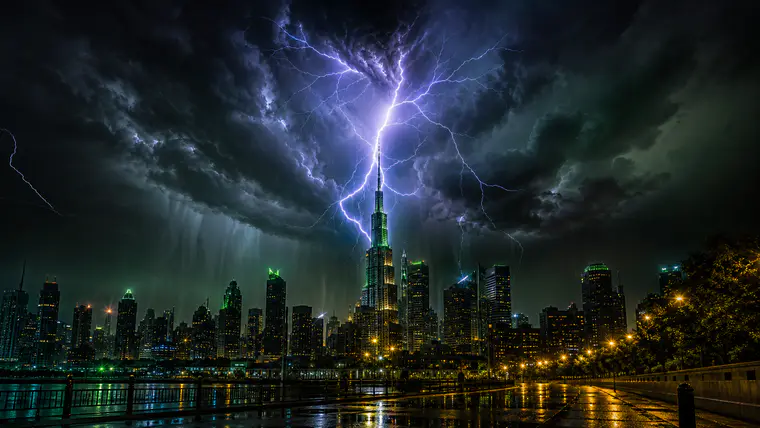
The Myth vs. the Sky’s Reality
You’ve probably heard the saying “lightning never strikes the same place twice.” It’s catchy—but it’s wrong. Lightning regularly hits the same object again and again, sometimes within fractions of a second and sometimes in separate storms, seasons, or years. Tall buildings, towers, ridgelines, and even lone trees can be struck repeatedly because they offer lightning an easy, reliable path to ground. Understanding why this happens isn’t just interesting trivia—it’s practical knowledge that keeps people and property safer.
In this guide, you’ll learn how lightning forms, why repeat strikes are common, what locations are most at risk, and the smartest ways to protect yourself and your gear when thunderheads build.
Lightning Basics: How a Strike Forms
Charge separation in a storm
Inside a thundercloud, turbulent updrafts and downdrafts make ice particles collide. These collisions separate electrical charges—typically leaving the top of the cloud positively charged and the bottom negatively charged. The ground below the storm becomes positively charged in response, as the Earth’s electric field rearranges.
Leaders and streamers
When the voltage difference grows large enough, a branched, invisible “stepped leader” of negative charge descends from the cloud toward the ground in quick jumps. As it nears the surface, objects on the ground—especially tall, sharp, or isolated ones—launch upward “streamers” of positive charge. When a descending leader and an upward streamer connect, a conductive channel is created.
Return strokes: one flash, many strikes
The brilliant, blinding part of lightning—the return stroke—then surges from the ground up to the cloud along that channel. Here’s the key: a single lightning flash often contains multiple return strokes separated by tens of milliseconds. To a camera, these look like repeated flashes along the same path; to your eyes, they blur into one flicker. That means lightning can effectively “hit” the same place several times in under a second. On longer time scales, the same object is also a favored target in later flashes from the same storm or storms months or years apart.
Why Lightning Targets the Same Place
Height, isolation, and sharpness amplify risk
The electric field near tall and isolated objects is stronger than over flat ground. Sharp points—including mast tips, antennae, and flagpoles—intensify that field even more. Stronger fields make upward streamers more likely to launch, which is why skyscrapers, towers, turbines, ship masts, and even solitary trees on a hill are “lightning magnets.”
Upward leaders from man‑made structures
Very tall structures can emit upward leaders even without a downward leader directly overhead, especially in intense storms. This tendency increases the chance that subsequent flashes during the same storm will again connect with that structure. Once an object has facilitated a strike, it’s often perfectly positioned to do it again.
The path of least resistance
Lightning doesn’t choose targets out of habit or memory, but physics. Once a conductive path is established, it’s relatively easy for additional current to travel along that ionized channel. In quick succession, subsequent return strokes reuse the same path because it’s still a low‑resistance route to neutralize charge. On longer time scales, the same objects remain attractive because their height and geometry don’t change.
Grounding and materials matter
Materials that conduct electricity—metal frameworks, wet masonry, and interconnected grounding systems—offer easier paths for charge to flow. Well‑designed lightning protection systems intentionally become the “same place” lightning strikes, guiding energy safely into the ground instead of through people, wiring, or flammable materials.
Real‑World Examples of Repeat Strikes
Skyscrapers and observation towers
Famous tall buildings are struck often—sometimes dozens of times in a year—because they rise above surrounding terrain and sprout many sharp features: spires, antennae, and lightning rods. Observation towers on hills are similarly frequent targets; their location and design functionally invite streamers to meet descending leaders.
Mountains, ridgelines, and lone trees
Mountain peaks and ridges naturally focus electric fields. A solitary tree in an open field is especially vulnerable: it stands out from the flat terrain, channels moisture and sap (both conductive), and may get struck over and over across multiple storms and seasons. Campers should avoid pitching tents near isolated trees for exactly this reason.
Bridges, wind turbines, and lighthouses
Anything tall near water—bridge towers, wind turbines on coastal ridges, and lighthouses perched on promontories—can experience frequent strikes. Wind turbines are engineered with built‑in receptors and down‑conductors precisely because repeat lightning is expected over their service life.
Common Myths—Busted
- Myth: “Lightning never strikes the same place twice.” Reality: It often does—within one flash and over many years.
- Myth: “Rubber tires keep you safe in a car.” Reality: It’s the metal frame acting as a Faraday cage that helps; convertibles and motorcycles do not offer the same protection.
- Myth: “If it’s not raining, you’re safe.” Reality: Lightning can strike miles from the rain core. If you can hear thunder, you’re within striking distance.
- Myth: “Lightning always hits the tallest thing.” Reality: Height increases risk, but geometry, materials, and local electric field strength all matter. Lightning can and does hit lower objects nearby.
Safety: What To Do When Storms Threaten
Lightning safety is about time, distance, and shelter. Here are practical steps that save lives:
- Follow the 30–30 rule: When the time between seeing lightning and hearing thunder is 30 seconds or less, go indoors immediately. Wait at least 30 minutes after the last thunder before resuming outdoor activities.
- Choose the right shelter: A substantial building with wiring and plumbing or a fully enclosed metal‑topped vehicle with windows up. Small open shelters, tents, and porches do not count.
- Avoid conductive paths: Stay off wired electronics, corded phones, and plumbing (showers, sinks, laundry) during an active storm. Electricity can travel through wires and pipes.
- Spread out in open areas: If caught outside with no shelter, avoid high ground, isolated trees, and open fields. If a group is in an exposed place, spread out to reduce the chance of multiple injuries.
- Ditch tall gear: Lower tripods, fishing rods, golf clubs, and metal flagpoles. Keep metal tools away from shoulders and heads.
- Water warning: Clear pools, lakes, and beaches at the first sound of thunder. Water conducts current and increases exposure.
- Know local patterns: Some regions see storms build in predictable afternoon windows. Plan hikes, boating, and tee times to finish earlier.
Special tips for photographers, anglers, and hikers
- Photographers: Don’t chase storms without training. If you insist on shooting lightning, do so from inside a vehicle with a remote trigger and keep the tripod low, away from the car body. Better yet, use a window clamp.
- Anglers: Stow rods when clouds build. Fiberglass and carbon fiber can launch upward streamers. Head to shore early.
- Hikers: Start early, aim to be off ridges by midday, and identify bailout routes to tree‑dense, lower terrain (but not under a lone tree).
Protecting Homes and Businesses from Repeat Strikes
Install a lightning protection system (LPS)
A code‑compliant LPS includes rooftop air terminals (lightning rods), properly sized down‑conductors, bonding that equalizes potential across metal components, and deep earth electrodes. The goal is to attract and safely conduct lightning energy into the ground, minimizing side‑flashes through building materials.
Add surge protection in layers
Even if a building isn’t directly struck, nearby strikes can induce damaging voltage spikes on power and data lines. Use a layered approach: a service‑entrance surge protective device (SPD), panel‑level SPDs for critical subpanels, and point‑of‑use protectors for sensitive electronics. Bond cable, satellite, and phone lines at a single ground point to avoid dangerous differences.
Maintain grounding and bonding
Corroded clamps, loose connections, and paint over bonding points weaken protection. Inspect annually, especially after roof work, repainting, or equipment upgrades. For farms, bond long runs of metal fencing and install SPDs on well pumps, electric gates, and irrigation controls—systems likely to see repeat surges.
Consider risk‑based upgrades
Facilities on hilltops, near tall trees, or with rooftop mechanical equipment are more likely to take repeat hits. Add extra air terminals on protrusions, bond rooftop units, and route down‑conductors along multiple paths to reduce current per path.
Why Some Places Seem to “Attract” Lightning Year After Year
Lightning frequency isn’t random. Geography and climate shape storm patterns:
- Warm, humid regions with sea‑breeze boundaries and daily convection see more thunderstorm days.
- Mountains force air to rise (orographic lift), sparking storms in predictable afternoon windows.
- Large lakes and coastlines can focus convergence zones that repeatedly fire up storms on certain sides of the water.
Pair those patterns with tall, sharp structures and you get reliable repeat targets. That’s why certain towers, stadiums, and hills develop reputations for being “lightning magnets.” It isn’t superstition—it’s statistics guided by physics.
Interesting Lightning Facts to Share
- A return stroke can heat the air to around 30,000°C—hotter than the surface of the Sun—creating thunder as the air explosively expands.
- Many lightning flashes are multi‑stroke events: several pulses along the same channel in less than half a second, which is literally the same place being struck repeatedly.
- Cloud‑to‑ground is only part of the story. Intra‑cloud lightning is even more common and can precede or accompany ground strikes that follow the same conductive channels.
- Slow‑motion videos reveal “dart leaders” racing down previously ionized paths. These leaders help explain why successive strokes favor the same exact route.
A Quick Personal Safety Checklist
Before storm season or a big outdoor day, run through this five‑point list:
- Forecast: Check the hourly radar and thunderstorm potential. If the window is likely, move plans earlier.
- Shelters: Identify sturdy buildings or enclosed vehicles along your route. Know how to reach them fast.
- Gear: Pack a small weather radio or enable emergency alerts. Keep an umbrella’s metal tip away from above your head in stormy conditions.
- Electronics: Use battery power during storms; unplug sensitive devices at home if severe weather is imminent.
- Mindset: At the first rumble, act. Don’t wait to “see one more swing, cast, or photo.” Lightning safety is about being early, not lucky.
Key Takeaways
- Lightning can and does strike the same place multiple times—within a single flash and across different storms.
- Tall, isolated, and sharp‑tipped objects are frequent targets because they intensify the local electric field and more readily launch upward streamers.
- Good shelter, early action, and proper building protection dramatically reduce risk from both direct hits and induced surges.
- Recognizing repeat‑strike hotspots helps you plan smarter adventures and protect your property.
Frequently Asked Questions
Can lightning strike the ocean and endanger swimmers?
Yes. Lightning readily hits open water. While current spreads out on the surface, it can still be lethal within a considerable radius. If you hear thunder, clear the water immediately and seek a substantial shelter or a fully enclosed vehicle.
Do cell phones or metal jewelry attract lightning?
No. Small metal items and phones don’t “attract” lightning. However, metal conducts electricity if you’re in a strike, so remove large metal objects and avoid holding tall metal gear aloft during storms. The biggest risk is being in an exposed location, not carrying a phone.
Why are cars relatively safe during lightning?
Protection comes from the metal frame, which routes current around occupants like a Faraday cage. Close the windows and avoid touching metal parts. Convertibles, golf carts, and motorcycles provide little to no lightning protection.
Is it true I shouldn’t shower during a thunderstorm?
Yes. Plumbing can conduct electricity from a strike, so avoid showers, baths, and washing dishes during active thunderstorms. Use battery‑powered devices and wait until the storm has passed.
Approved member comments will appear here.