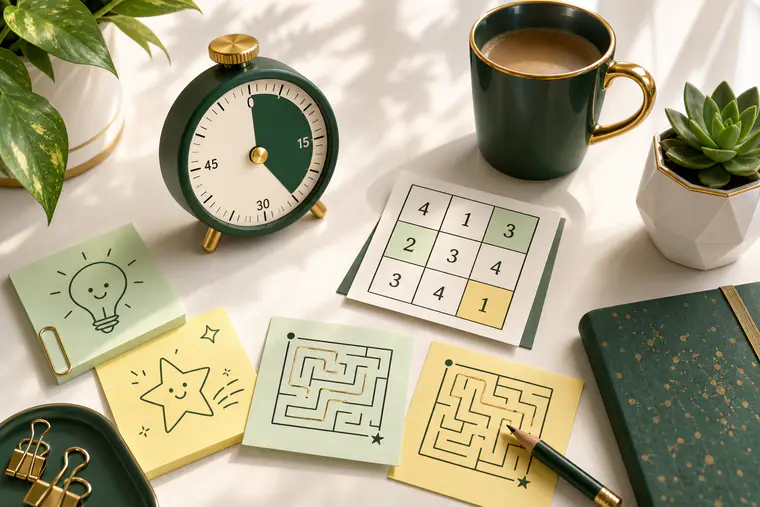
What counts as a quick brain break?
You don’t need an app, a long stretch, or a science-backed routine to reset your attention. A quick brain break is a short, low-stakes mental detour—usually 30 to 120 seconds—that gives you a fresh angle before you slide back into your main task. The goal here isn’t to transform your brain; it’s simply to change gears for a moment so work feels less heavy when you return.
Below are 12 original mini challenges designed for small windows of time. They’re playful, screen-light (or screen-free), and easy to start anywhere—at a desk, in a break room, or between errands. Two include light puzzle play: Number Forge for number-building fun and classic Sudoku for pattern spotting.
Use what you like, skip what you don’t, and return to your task as soon as you feel ready. These ideas are for general refreshment only—they’re not medical or mental‑health advice, and they’re not a substitute for rest, movement, or professional care.
How to use these quick brain breaks
- Pick one challenge that fits your time: 30, 60, or 90 seconds.
- Keep it playful. There’s no scoreboard and no stakes.
- Stop while it’s still fun. You’re aiming for a reset, not a rabbit hole.
- Return to your main task with a tiny next step in mind (send one email, write one sentence, label one cell). That small action helps you re-enter smoothly.
The 12 mini challenges
Each one includes a simple setup, how long it takes, and a clean finish so you can switch back quickly.
1) Category Sprint (30–60 seconds)
- Pick a letter (like M) and a broad category (foods, cities, animals).
- In 30–60 seconds, list as many as you can (mango, muffin, meatloaf…).
- Extra twist: Switch letters halfway through.
- Clean finish: Circle your favorite item and stop.
Why it works: Rapid retrieval pulls you away from your main task without deep effort. It’s brisk, contained, and a little competitive—just with yourself.
2) Mirror Doodle (45–90 seconds)
- Draw a simple squiggle with your dominant hand.
- With your other hand, try to copy it as a mirror image beneath.
- Extra twist: Swap hands and repeat with a new squiggle.
- Clean finish: Pick the doodle you like best and add one flourish.
Why it works: Crossing hands and mirroring lines is a gentle, tactile shift that engages attention differently than typing or scrolling.
3) Reverse Alphabet Chunks (30 seconds)
- Say the alphabet backward out loud—but only in chunks of five letters (Z–V, U–Q, P–L…).
- Extra twist: Whisper the letters but clap once at each vowel.
- Clean finish: Stop at T and call it a win.
Why it works: A familiar sequence made unfamiliar nudges you to focus without overthinking.
4) Number Forge Flash (60 seconds)
- Open a Number Forge puzzle and pick a single target to attempt for just one minute.
- Ignore perfection; explore a couple of number combinations and see what gets close.
- Clean finish: Note the closest result you reached, then close it.
Why it works: Light number play is absorbing but brief if you set a hard stop. This keeps the reset quick.
5) Sudoku Snapshot (60–90 seconds)
- Open any easy or medium Sudoku grid.
- Spend up to 90 seconds scanning only for “singles” (cells where just one number fits) and fill a few in.
- Clean finish: Stop the moment you place two to three digits.
Why it works: Spotting obvious placements is satisfying and finite; you can bail out fast without leaving a half-hour puzzle hanging.
6) Three-Word Ladder (45–60 seconds)
- Choose a start word and an end word that are three letters apart (CAT → DOG).
- Change one letter per move to form real words (CAT → COT → DOT → DOG).
- Extra twist: Require each new word to be something you can draw quickly.
- Clean finish: If you can’t finish in a minute, write your best partial and stop.
Why it works: Tiny constraints push quick creativity while staying bite‑size.
7) Tapback Pattern (30–45 seconds)
- Tap a four-beat pattern on your desk (e.g., tap–tap–pause–tap).
- Repeat it once. Now reverse it and repeat (tap–pause–tap–tap).
- Extra twist: Do it eyes closed.
- Clean finish: End after two successful forward-and-back cycles.
Why it works: Rhythm gives your mind a compact puzzle without screens or words.
8) Desk Scavenger Trios (45–75 seconds)
- Find three trios of items around you: three circles, three things with a label, three objects with corners.
- Extra twist: Photograph one trio from an unusual angle.
- Clean finish: Line them up, admire the set, then put them back.
Why it works: Quick visual searching resets your focus and gets you to look away from your main task briefly.
9) One-Minute Micro-Maze (60 seconds)
- Draw a small start and finish on a sticky note.
- Create a tangle of 8–12 lines in between. Now solve your own maze.
- Extra twist: Switch pens for building vs. solving.
- Clean finish: Add a tiny checkmark at the finish and stick it to your monitor edge.
Why it works: Making and solving a tiny puzzle gives instant progress with almost no setup.
10) Map-in-Memory Sketch (60–90 seconds)
- From memory, draw a simple map to a place you visit often (your grocery store, your gym).
- Include 5–7 landmarks, then label them.
- Extra twist: Try it with your eyes closed first for 10 seconds, then refine with eyes open.
- Clean finish: Box the map with a rectangle and write “Done.”
Why it works: Spatial recall offers a fresh lane for your attention and a tiny sense of completion.
11) Seven-Item Snapshot (45–60 seconds)
- Look at your desk and pick seven different items to memorize.
- Close your eyes and name them in a different order.
- Extra twist: Name them by color or material instead of by item.
- Clean finish: Open your eyes, check yourself, and carry on.
Why it works: Brief memory games are engaging but not absorbing—perfect for a fast reset.
12) Two-Thing Mashup (60 seconds)
- Pick two unrelated objects near you (a mug and a paperclip).
- In one minute, sketch or describe a new item that combines them.
- Extra twist: Write a five-word ad for your mashup.
- Clean finish: Put the sketch aside and get back to your main task.
Why it works: Playful recombination breaks monotony and reintroduces a sense of play.
Pick-a-break menu (by time and energy)
- 30–45 seconds, no materials: Category Sprint, Reverse Alphabet Chunks, Tapback Pattern.
- About a minute, pen/paper helps: Mirror Doodle, Micro-Maze, Two-Thing Mashup, Seven-Item Snapshot.
- 60–90 seconds, light puzzle play: Number Forge Flash, Sudoku Snapshot, Three-Word Ladder, Map-in-Memory Sketch, Desk Scavenger Trios.
Pro tip: If your break window is uncertain, choose a challenge with a built-in “clean finish,” like placing two Sudoku digits or listing 10 items—so it ends naturally.
Make quick brain breaks work for you
Set tiny triggers
Tie a break to something that already happens: sending a message, finishing a call, or returning from the printer. “After I hit send, I do a 30‑second break” is easier to keep than a vague goal like “take more breaks.”
Use a timer, not willpower
A visible countdown keeps a quick brain break quick. Stop when the timer ends—even if you’re mid-puzzle. The boundary is the point.
Keep tools within reach
A small notepad, a pen you like, and a sticky note stack handle 80% of these ideas. Digital fans can pin a blank note window and a basic timer.
Return with a micro‑move
Before your break, decide the next tiny step in your main task. After your break, do only that step. This handoff prevents the “now what?” fog.
Guardrails and good sense
- Don’t use these while driving or during tasks that require full attention.
- If you’re consistently exhausted or unable to focus, consider basics first: sleep, hydration, and a realistic workload. For ongoing concerns, speaking with a qualified professional can help.
- Keep breaks short on purpose. The goal is a reset, not avoidance.
Why quick brain breaks feel helpful (without the hype)
Short mental detours change what you’re paying attention to—words to numbers, screens to lines, stillness to a quick scan. That contrast can make your main task feel more approachable when you return. You’re not training anything specific or guaranteeing results; you’re simply giving your mind a different lane for a moment and then re-emerging with slightly fresher eyes.
Try one right now
- If you have 30 seconds: Reverse Alphabet Chunks to T.
- If you have 60 seconds: Two-Thing Mashup with the first two items you see.
- If you have 90 seconds: Open Sudoku, place two singles, and stop.
Want more light number play? Open a Number Forge puzzle for one minute, or fire up an easy Sudoku and call it after three placements. Then close the tab and get back to your day.
Frequently Asked Questions
How long should a quick brain break be?
Aim for 30 to 120 seconds. The shorter the better if your schedule is tight. A visible timer helps you end cleanly and get back to your main task.
How often should I take one?
Use them as needed—after you finish a small chunk of work, when your attention drifts, or between meetings. If you like structure, try one brief break every 60–90 minutes and adjust based on how you feel.
Do I need special apps or tools?
No. Most of these work with a pen, a sticky note, or nothing at all. If you want light puzzle play, open Number Forge or any easy Sudoku for under two minutes and stop on time.
What if short breaks turn into long detours?
Pick challenges with a clear “done” point (place two Sudoku digits, list 10 items), set a timer, and close the activity as soon as it ends. The boundary keeps the break refreshing instead of consuming.
Approved member comments will appear here.