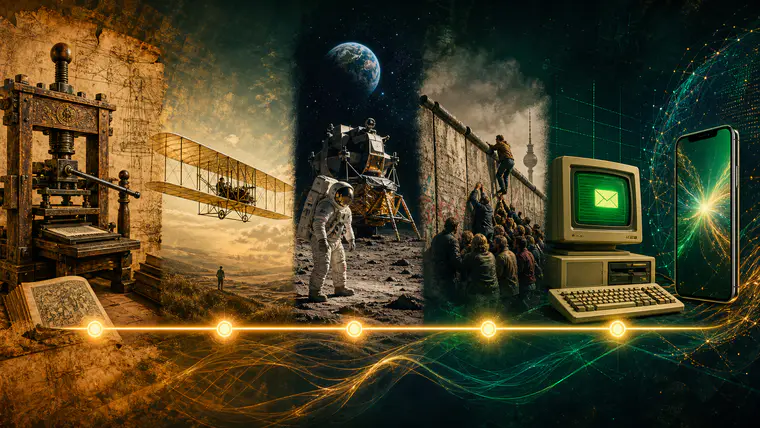
Why “What Happened First?” Is Such a Good Brain Test
If you’ve ever stared at two well-known events and hesitated—Was email older than the web? Did the moon landing come before Woodstock?—you’ve felt the tug-of-war at the heart of great trivia. “What happened first?” questions work because they measure how well you connect facts into a timeline, not just whether you’ve memorized dates. The key is context: place each item in its decade, link it to a larger story, and then compare.
This guide gives you 25 carefully chosen timeline face‑offs, clear answers with dates, plus quick strategies you can use under a shot clock at trivia night or when writing your own quiz round. By the end, you’ll not only remember more—you’ll recall faster and with more confidence.
How to Tackle Timeline Questions Quickly
When you can’t recall exact dates, use anchors and comparisons. Here are practical ways to reason your way to the correct order:
- Start with decade anchors. Lock events into a decade first (e.g., “Wright brothers—early 1900s; Titanic—1912”). The earlier decade wins.
- Link each item to bigger stories. Connect a technology to what made it possible (email to ARPANET-era computing; the web to 1990s browsers).
- Use cultural landmarks. Albums, films, or TV moments often place you precisely (“Beatles on Ed Sullivan—1964 U.S. Beatlemania”).
- Remember causality. Sometimes one event enables the other (printing press before mass religious reform; telegraph before telephone).
- Watch out for same-year traps. If two items share a year, compare months (Apollo 11 in July 1969 vs. Woodstock in August 1969).
25 “What Happened First?” Questions (With Dates and Context)
Below are 25 matchups spanning world history, technology, science, and pop culture. Each answer includes a quick explanation you can memorize as a cue.
- Q: Gutenberg’s movable-type printing press or Martin Luther’s 95 Theses?
- A: Gutenberg’s press came first (mid‑1450s; Gutenberg Bible c. 1455). Luther’s 95 Theses were posted in 1517. Printing capacity helped fuel the Reformation’s spread.
- Q: Wright brothers’ first powered flight or the sinking of the Titanic?
- A: Wright flight came first (December 17, 1903). Titanic sank on April 15, 1912. Early aviation predates many assume.
- Q: Apollo 11 moon landing or Woodstock?
- A: Apollo 11 came first (July 20, 1969). Woodstock ran August 15–18, 1969. Space before the stage.
- Q: U.S. Declaration of Independence or the start of the French Revolution?
- A: Declaration came first (July 4, 1776). The French Revolution began in 1789, symbolized by the storming of the Bastille on July 14.
- Q: The fall of the Berlin Wall or the first SMS text message?
- A: Berlin Wall came first (November 9, 1989). The first SMS—“Merry Christmas”—was sent December 3, 1992.
- Q: The first email or the World Wide Web?
- A: Email came first (1971, early ARPANET). The web’s foundational proposal surfaced in 1989, with the first website in 1991.
- Q: Twitter’s launch or the first iPhone release?
- A: Twitter came first (March 2006). The original iPhone was released June 29, 2007. Many early tweets were sent via SMS and web.
- Q: The first Nobel Prizes or Einstein’s general relativity?
- A: The Nobels came first (1901). Einstein presented the field equations of general relativity in 1915.
- Q: U.S. women’s suffrage via the 19th Amendment or the Civil Rights Act of 1964?
- A: The 19th Amendment came first (ratified August 18, 1920). The Civil Rights Act was signed July 2, 1964.
- Q: The Beatles on The Ed Sullivan Show or the release of Sgt. Pepper’s Lonely Hearts Club Band?
- A: Ed Sullivan came first (February 9, 1964). Sgt. Pepper’s released June 1, 1967 (UK) and June 2, 1967 (U.S.).
- Q: The first modern Olympic Games or the founding of FIFA?
- A: The Olympics came first (Athens, 1896). FIFA was founded in 1904.
- Q: Fleming’s discovery of penicillin or the first widely used polio vaccine?
- A: Penicillin came first (1928). Jonas Salk’s inactivated polio vaccine was introduced in 1955.
- Q: The start of the American Civil War or Canadian Confederation?
- A: The American Civil War began first (April 12, 1861). Canadian Confederation was July 1, 1867.
- Q: Nelson Mandela’s release from prison or South Africa’s first multiracial elections?
- A: Mandela’s release came first (February 11, 1990). The elections were held in April 1994.
- Q: Google’s founding or Wikipedia’s launch?
- A: Google was founded first (September 1998). Wikipedia launched January 15, 2001.
- Q: The dissolution of the Soviet Union or the introduction of the euro (as a non‑cash currency)?
- A: The Soviet Union dissolved first (December 26, 1991). The euro began as an accounting currency January 1, 1999; coins and notes arrived January 1, 2002.
- Q: Roald Amundsen reaching the South Pole or the opening of the Panama Canal?
- A: Amundsen reached the pole first (December 14, 1911). The Panama Canal officially opened August 15, 1914.
- Q: The consumer VHS video recorder or the compact disc (CD) market debut?
- A: VHS came first (1976). CDs reached consumers in 1982 (Japan) and 1983 (U.S.).
- Q: The Great Fire of London or Newton’s Principia Mathematica?
- A: The Great Fire came first (1666). Newton’s Principia was published in 1687.
- Q: The telegraph’s first long‑distance message or the telephone patent?
- A: The telegraph message came first (May 24, 1844: “What hath God wrought”). Alexander Graham Bell’s telephone patent was March 7, 1876.
- Q: The fall of Constantinople or Columbus’s first voyage across the Atlantic?
- A: Constantinople fell first (May 29, 1453). Columbus’s first voyage began in 1492, reaching the Americas that October.
- Q: The first Harry Potter book or Apple’s original iMac G3?
- A: Harry Potter and the Philosopher’s Stone came first (June 26, 1997, UK). Apple introduced the iMac in May 1998 (U.S. retail followed in August 1998).
- Q: Facebook’s launch or YouTube’s launch?
- A: Facebook launched first (February 4, 2004). YouTube launched February 14, 2005; its growth accelerated after the 2005–2006 period of viral clips and embeds.
- Q: The first underground railway (subway) or the opening of the Brooklyn Bridge?
- A: The subway came first (London’s Metropolitan Railway opened January 10, 1863). The Brooklyn Bridge opened May 24, 1883.
- Q: The first photograph or the first public film screening by the Lumière brothers?
- A: The photograph came first (Nicéphore Niépce’s image from 1826/1827). The Lumière brothers held their famous public screening in 1895.
How to Memorize These Faster
You don’t need to memorize every day and month. Instead, glue events to reliable anchors:
- Mid‑1400s: Gutenberg and the printing revolution; then 1517 Reformation spreads via print.
- Late 19th century: Telegraph before telephone; subways before big U.S. suspension icons like the Brooklyn Bridge.
- Early 20th century: Aviation (1903), then Titanic (1912); Amundsen (1911) before Panama Canal (1914).
- Mid‑20th century: Penicillin (1928) before polio vaccine (1955); Olympics modernized (1896) before FIFA (1904).
- Late 20th century: Berlin Wall fall (1989) before SMS (1992); web (1991) after email (1971); CDs (1982) after VHS (1976).
- Turn of the millennium: Google (1998) before Wikipedia (2001); Facebook (2004) before YouTube (2005); euro accounting launch (1999) after the USSR’s end (1991).
These storylines help you reason even when you blank on an exact year.
Create Your Own “What Happened First?” Round
Want to build a quiz that your group will actually talk about the next day? Use pairings that are close enough to be tricky but distinct enough to be fair.
- Choose a category mix.
- Include at least one pair each from world history, science/tech, and pop culture. Variety keeps players with different strengths engaged.
- Calibrate difficulty.
- Easy: 1776 vs. 1789. Medium: 1903 vs. 1912. Hard: same‑year traps (e.g., two 1969 events). For same‑year items, always provide months to keep it fair.
- Provide dates in answers.
- Answers without dates feel unsatisfying and are harder to remember later. A month‑year anchor is enough.
- Avoid ambiguity.
- Be precise when an “invention” and a “commercial launch” differ (e.g., the web’s proposal in 1989 vs. the first website in 1991; CD market debut varies by region). State which milestone you mean.
- Add a quick cue.
- One short sentence that links the event to a bigger story (“Printing capacity amplified reform” or “ARPANET culture predates the web”) helps learners encode the timeline.
Sample Round Template You Can Reuse
- Pair 1: Movement vs. enabling technology (Reformation vs. printing press).
- Pair 2: Transportation milestone vs. headline disaster (Wright flight vs. Titanic).
- Pair 3: Scientific discovery vs. medical rollout (penicillin vs. polio vaccine).
- Pair 4: Pop culture breakpoint vs. later artistic peak (Ed Sullivan vs. Sgt. Pepper’s).
- Pair 5: Political change vs. tech adoption (Berlin Wall vs. SMS).
Common Traps and How to Beat Them
- Recency confusion: Newer technologies can feel older because we use them more. Counter it by recalling “pre‑web internet” items like email and Usenet.
- Geography drift: Events from different regions don’t always line up with your local history. Attach a location to each fact (“London Underground, 1863”).
- Same‑year illusions: Big years (1969, 1989) pack many events. Compare months and days to break ties.
- Definition drift: “Invention” can mean first idea, first demo, or first mass market. Specify which one the question uses.
Use These in Games, Classrooms, or Team Warm‑Ups
- Pub trivia: Put these in a speed round—15 seconds per pair. Require month‑year on two tie‑breaker items.
- Classrooms: Have students research a one‑sentence cue that links an event to a broader unit theme (e.g., “Industrial tech spread enabled mass media”).
- Team icebreakers: Give each person a pair and have them justify their pick out loud, then reveal the date. It’s quick, collaborative, and memorable.
Final Takeaway
Great timeline trivia isn’t about hoarding dates. It’s about building a mental map where events snap into place relative to each other. Use decade anchors, causal links, and story cues, and you’ll turn “I think…” into confident, quick answers. The 25 examples above cover classic pitfalls—pre‑web vs. web, discovery vs. deployment, and month‑level tie‑breakers—so you can recognize and outsmart them when they show up in the wild.
Frequently Asked Questions
How precise do my answers need to be in a quiz setting?
Unless the rules say otherwise, getting the order right is the goal. When two events are close, a month‑year note (e.g., “July 1969 vs. August 1969”) helps settle disputes quickly and fairly.
What if sources list different “firsts” for the same technology?
Clarify the milestone you’re using—proposal, patent, first public demo, or consumer launch. Then cite that standard consistently across the round to keep it fair.
How can I remember tough comparisons without memorizing every date?
Use anchors and cues: place each event in a decade, link it to a larger story (e.g., “ARPANET era”), and memorize one short sentence that explains why it came earlier.
Are same‑year questions considered trick questions?
They can be, but they’re fair if you specify months or days in the answer. Same‑year pairs test precision rather than pure recall and make excellent tie‑breakers.
Approved member comments will appear here.