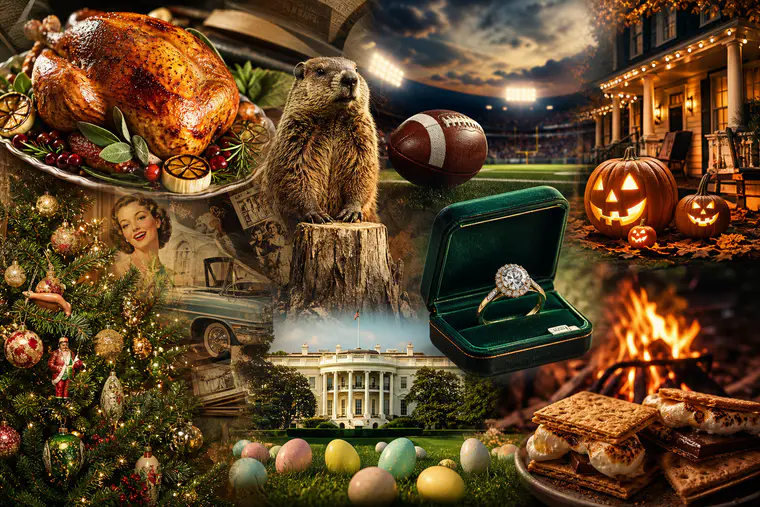
If you’ve ever wondered, “Who decided we do it this way?” you’re not alone. Many everyday U.S. traditions weren’t handed down unchanged from the distant past—they were shaped by ad agencies, immigrant communities, political moments, and a few happy accidents. This guide gives you the short, responsible origin story for 20 familiar customs so you can share them confidently at your next gathering, lesson, or trivia night.
Patterns you’ll notice as you read:
- Marketing often turned niche ideas into “must-do” traditions.
- Immigrant practices took on new life in U.S. neighborhoods and schools.
- Civic rituals grew from specific dates, decisions, or even one persuasive person.
- “Firsts” are messy; competing claims are common, so historians use careful language like “often credited.”
1. Thanksgiving turkey wasn’t a Pilgrim mandate
The origin story
The 1621 harvest feast in Plymouth did feature “fowl,” but turkey wasn’t singled out. The turkey-at-the-center tradition grew in the 1800s as writer–editor Sarah Josepha Hale championed a national Thanksgiving and domestic menus in magazines. President Abraham Lincoln proclaimed a national Thanksgiving in 1863, and by late in the century, turkey was widely promoted as the quintessential main course.
Why it stuck
Turkeys were plentiful in North America, large enough to feed a crowd, and the image fit 19th‑century ideals of home and plenty. Magazines and cookbooks did the rest.
2. The presidential “turkey pardon” is a modern flourish
The origin story
Presidents received ceremonial Thanksgiving birds for over a century, but the notion of an official “pardon” is recent. The word surfaced jokingly in the 1980s and the ritual was formalized as a lighthearted annual event in 1989. Earlier stories about presidents sparing birds exist, but the recurring, named “pardon” dates to the late 20th century.
Why it stuck
It’s camera‑friendly, nonpartisan, and perfectly timed for holiday news cycles.
3. “Black Friday” began as a traffic headache, not an accounting triumph
The origin story
Philadelphia police in the 1960s used “Black Friday” to describe the post‑Thanksgiving crush of shoppers and gridlock downtown. Retailers later reframed the term as the day stores “go into the black,” a friendlier story that helped turn a local nickname into a national shopping ritual.
Why it stuck
A long weekend, early holiday sales, and simple branding made it an unofficial kickoff to the retail season.
4. Groundhog Day swapped a hedgehog for a local rodent
The origin story
German-speaking immigrants brought a Candlemas weather belief: if a hedgehog saw its shadow, winter would linger. In Pennsylvania, the hedgehog became the native groundhog. A community in Punxsutawney began staging the event in the 1880s, and the friendly marmot became a winter celebrity.
Why it stuck
It’s playful, predictable on the calendar, and tailor‑made for news and school activities in the slow, chilly stretch of early February.
5. Trick‑or‑treating is a postwar American solution to rowdy Halloweens
The origin story
Halloween’s roots include Celtic and European customs of guising and souling. In the early 1900s U.S., pranks sometimes got destructive. Neighborhood trick‑or‑treating, seen in scattered reports by the 1930s and widely normalized after World War II, redirected youthful energy into costumes and candy.
Why it stuck
Suburbs, door‑to‑door safety campaigns, and mass‑market candy sealed the deal.
6. Super Bowl commercials became the main event thanks to a single blockbuster ad
The origin story
The Super Bowl launched in the late 1960s, but the idea that “the ads are the show” crystallized after a cinematic computer commercial in the 1980s reframed the game as a national showcase for creative advertising. Rates and hype soared, and millions now tune in as much for the spots as the score.
Why it stuck
It’s shared viewing plus Monday‑morning conversation fuel—an advertiser’s dream.
7. College homecoming was built around football
The origin story
Several universities claim the first “homecoming,” but a widely cited early instance occurred in 1911 when alumni were invited back to campus around a big football game, complete with rallies and a parade. The model spread quickly.
Why it stuck
Football season provided a fixed, festive anchor for reunions and school spirit.
8. Diamond engagement rings are mostly a 20th‑century American habit
The origin story
While rings long signified betrothal, diamonds weren’t the default in the U.S. until a coordinated mid‑century advertising push linked diamonds with enduring romance, capped by a famous four‑word slogan in 1947. The campaign nudged shoppers toward a single stone as “traditional.”
Why it stuck
Clear symbolism, durable materials, and decades of consistent messaging made the custom feel timeless.
9. Baby showers grew with the Baby Boom and department stores
The origin story
Victorian‑era women sometimes held modest pre‑birth gatherings, but the modern, gift‑heavy baby shower blossomed in the mid‑20th century alongside the Baby Boom, expanding consumer goods, and store registries.
Why it stuck
It’s a practical way to outfit new parents and gather friends before the newborn whirlwind.
10. Gender‑reveal parties began online, very recently
The origin story
The modern cake‑or‑confetti reveal is often credited to a 2008 blog post by a Chicago mom who cut a cake to show pink frosting. Social media accelerated the idea into a nationwide trend. Even the originator later urged keeping reveals low‑key.
Why it stuck
It’s photo‑friendly, inexpensive to stage, and tailor‑made for posts—though many families now opt for simpler, safer versions.
11. The Pledge of Allegiance changed during the Cold War
The origin story
A minister named Francis Bellamy wrote the Pledge in 1892 for a school program. The words “under God” were added by Congress in 1954, reflecting the era’s political and religious currents. Court decisions protect students from being forced to recite it.
Why it stuck
Daily recitation in many schools made it a familiar civic rhythm.
12. American Christmas trees blossomed after a royal portrait
The origin story
German immigrants brought the Christmas tree to the U.S., but it went mainstream after a mid‑19th‑century illustration of Britain’s Queen Victoria and Prince Albert around a decorated tree circulated in American magazines. The elegant scene sold the look.
Why it stuck
The tree is a customizable, photogenic centerpiece for family rituals, markets, and charity drives.
13. Santa’s look was refined by illustrators—and reinforced by soda ads
The origin story
American Santa blends Dutch Sinterklaas with 19th‑century literature and art. Cartoonist Thomas Nast popularized a bearded, fur‑trimmed figure in the 1860s. In the 1930s, a series of soft‑drink ads standardized the jolly red‑suited image many people picture today.
Why it stuck
Consistent winter advertising and children’s media created a single, lovable character.
14. Ugly sweater parties started as intentional irony
The origin story
Cheeky “ugly Christmas sweater” parties emerged in the early 2000s and spread rapidly across North America. The joke celebrated loud, knitted nostalgia—part thrift‑store fun, part office icebreaker.
Why it stuck
It’s low‑stakes participation: no performance skills needed, just a loud sweater and a sense of humor.
15. Black‑eyed peas on New Year’s Day carry layered histories
The origin story
In the American South, eating black‑eyed peas for luck on January 1 is linked to Civil War‑era scarcity stories and to older practices among West African and Sephardic Jewish communities that associated certain legumes with prosperity. Collard greens (paper money) and cornbread (gold) often round out the plate.
Why it stuck
It’s comforting, symbolic food when families are home and kitchens are busy.
16. The White House Easter Egg Roll started after a ban—then moved to the lawn
The origin story
After children were barred from rolling eggs on Capitol grounds in the 1870s, the tradition shifted in 1878 to the White House South Lawn with the president’s approval. It has continued with occasional pauses for weather, construction, or national emergencies.
Why it stuck
It offers rare, playful public access to the nation’s most famous backyard.
17. The Tooth Fairy is a uniquely American mash‑up
The origin story
Exchanges for baby teeth exist in many cultures, but the modern U.S. custom—placing a tooth under a pillow in hopes of a small payment—shows up in early 20th‑century newspapers and children’s theater. Radio, TV, and parenting columns helped standardize it mid‑century.
Why it stuck
It turns a slightly scary milestone into a magical mini‑economy for kids.
18. St. Patrick’s Day parades and green beer are American amplifications
The origin story
Colonial‑era New York featured Irish soldiers marching on March 17, and 19th‑century cities organized large civic parades. Green beer, however, is a U.S. bar novelty from the early 1900s—not a traditional Irish practice.
Why it stuck
Public parades let communities celebrate heritage, and bars love a theme day.
19. Tipping became embedded through custom and policy
The origin story
Tipping arrived from European practice in the late 19th century and was controversial—critics called it un‑American. Over time, restaurants and hotels normalized it. Federal law later allowed a lower base wage for many tipped workers, reinforcing the expectation that tips would make up a significant share of income. (For specifics, check your state’s current rules.)
Why it stuck
Once businesses priced assuming tips, the habit was hard to unwind.
20. S’mores owe their name to American scouting
The origin story
A printed recipe for a campfire sandwich of graham crackers, chocolate, and toasted marshmallow appeared in a 1927 Girl Scouts publication as “Some More,” later shortened to “s’mores.”
Why it stuck
It’s simple, interactive, and perfectly suited to camping trips and backyard fire pits.
What these origin stories teach us
Behind the most “traditional” American traditions you’ll often find a magazine editor, a neighborhood association, an immigrant community, a marketer, or a moment when leaders needed a unifying symbol. That doesn’t make the custom less meaningful; it just means meaning is made by people—often very recently.
If you’re using this list for trivia or classroom discussion, try grouping the traditions by what propelled them:
- Media moments: Super Bowl ads, Santa imagery, ugly sweater parties
- Civic rituals: Pledge of Allegiance, White House Egg Roll, turkey pardon
- Immigrant influence: Groundhog Day, Christmas trees, St. Patrick’s parades
- Marketing and consumer culture: diamond rings, Black Friday, baby showers, s’mores
Carry that lens, and you’ll start spotting new “traditions” as they form.
Frequently Asked Questions
Are these the only correct origin stories?
Not always. “Firsts” are hard to prove, and multiple places may claim them. Historians look for dated print references, organizational records, and contemporaneous reporting. Where claims are contested, this guide uses careful wording like “often credited” and focuses on well‑documented turning points.
Do imported customs still count as American traditions?
Yes. Many U.S. traditions began elsewhere but took on distinctly American timing, scale, or style—think groundhogs instead of hedgehogs, or parades that grew with immigrant communities in American cities.
Why do marketers show up so often in holiday history?
Because shared media can turn a local habit into a national expectation. When magazines, national retailers, and television embraced certain images or scripts, they reinforced a single “right” way to celebrate.
What’s the best way to fact‑check a tradition’s origin?
Look for dated sources: old newspaper archives, museum or university pages, and official organizational histories. Treat unsourced viral posts skeptically, and beware of tidy legends that appear only in much later retellings.
Approved member comments will appear here.