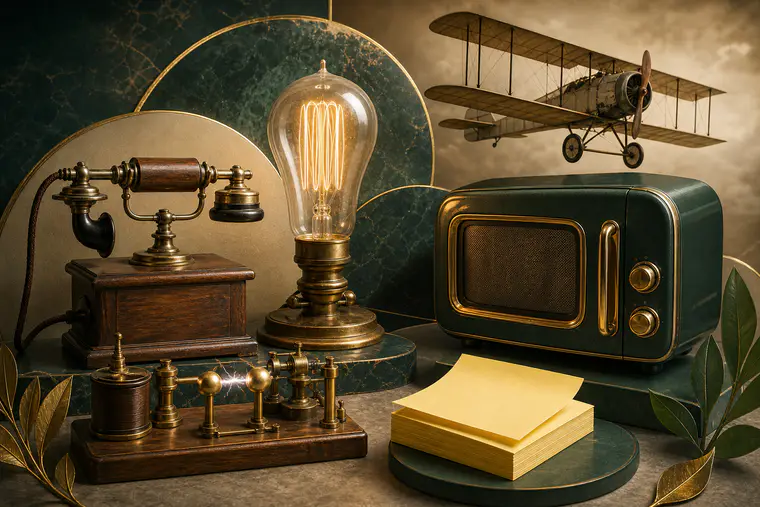
Why so many inventions are misunderstood—and who really created them
If you’ve ever heard “Edison invented the light bulb” or “Marconi invented the radio” and wondered whether that’s the whole story, here’s the short answer: rarely. Most famous “inventions” were built in layers—conceived by one person, proven by another, refined by a third, and popularized or patented by yet another. This article clears up who did what for a set of widely misunderstood breakthroughs, so you can win debates, ace trivia night, and give credit where it’s due.
To read invention stories fairly, keep this simple lens in mind: first to imagine, first to demonstrate, first to make practical, and first to scale. Those roles often belong to different people.
A quick cheat-sheet for fair credit
- The conceptor: framed the core idea or early principle.
- The demonstrator: achieved the first working proof or public demo.
- The system-builder: solved practical hurdles so it worked reliably.
- The scaler or popularizer: manufactured, marketed, or standardized it.
- The patentee: secured legal protection (not always the first or best idea).
With that in mind, let’s set the record straight on some famously fuzzy attributions.
The light bulb: not just Edison
The myth in one line
Thomas Edison single‑handedly invented the light bulb.
What really happened
- Early sparks: In 1802, Humphry Davy created an electric arc lamp. Throughout the 19th century others tried incandescent filaments, notably Warren de la Rue (1840) and many lesser‑known tinkerers.
- Near‑simultaneous success: In the late 1870s Joseph Swan in Britain and Thomas Edison in the United States each produced practical carbon‑filament lamps.
- Why Edison matters: Edison’s key contributions were durable high‑resistance filaments, the full electrical system (generators, wiring, sockets), and business execution. He received U.S. Patent No. 223,898 for an electric lamp on January 27, 1880, and—critically—built the infrastructure so homes could actually use it.
- Don’t forget: Engineer Lewis Latimer patented improved processes for making carbon filaments in the early 1880s, helping bulbs last longer and cost less.
Takeaway
Edison did not invent light itself or the idea of a glowing wire; he made electric lighting practical at scale.
The telephone: Bell, Gray, and Meucci
The myth in one line
Alexander Graham Bell invented the telephone, full stop.
What really happened
- The patent: Bell received U.S. Patent No. 174,465 on March 7, 1876, and made the first successful intelligible call later that year.
- Parallel paths: Elisha Gray filed a patent caveat the same year; Antonio Meucci had filed a caveat in 1871 for a voice‑transmission device but could not maintain it. In 2002, a U.S. House resolution acknowledged Meucci’s contributions but did not overturn Bell’s patent.
Takeaway
Bell’s patent and demonstrations won the legal and commercial race, but important groundwork came from others.
Radio: Marconi, Tesla, and a courtroom footnote
The myth in one line
Guglielmo Marconi invented radio.
What really happened
- Pioneers: Nikola Tesla, Heinrich Hertz, Alexander Popov, and Jagadish Chandra Bose all advanced wireless theory and apparatus in the 1890s.
- Breakthroughs: Marconi excelled at long‑distance signaling and achieved headline‑making transmissions, including across the Atlantic in 1901.
- The twist: In 1943, the U.S. Supreme Court invalidated some Marconi patents, noting earlier work by others (including Tesla). That didn’t erase Marconi’s practical triumphs, but it complicates the single‑inventor narrative.
Takeaway
Marconi popularized radio telegraphy and built companies around it; radio’s underlying ideas and circuits were a team effort across continents.
The airplane: the Wrights—and Santos‑Dumont
The myth in one line
The Wright brothers were the only first flyers.
What really happened
- Kitty Hawk, 1903: Orville and Wilbur Wright achieved the first controlled, sustained, powered airplane flights with effective roll, pitch, and yaw control.
- Public proof, 1906: In Europe and Brazil, Alberto Santos‑Dumont is credited with the first widely public, self‑propelled flight from level ground (the 14‑bis) in 1906, which mattered to observers who hadn’t seen the Wrights.
Takeaway
The Wrights led in control and repeatable flight; Santos‑Dumont led in public demonstration and European acceptance. Both chapters shaped aviation’s birth story.
The automobile: not Henry Ford
The myth in one line
Henry Ford invented the car.
What really happened
- First modern car: Karl Benz patented a gasoline‑powered “Motorwagen” in 1886 and produced early automobiles.
- Ford’s genius: Starting in 1908 with the Model T and, famously, the moving assembly line by 1913, Ford revolutionized mass production and affordability, not the car’s original invention.
Takeaway
Benz gave us the car; Ford put the world on wheels.
The printing press: Europe’s breakthrough, earlier Asian milestones
The myth in one line
Gutenberg invented printing.
What really happened
- Before Gutenberg: East Asia had centuries of printing. Woodblock printing flourished in China by the Tang and Song eras; Bi Sheng developed movable type around the 11th century; Korea produced metal movable‑type books by the 13th–14th centuries (notably the Jikji in 1377).
- Gutenberg’s leap: Around the 1450s, Johannes Gutenberg introduced metal movable type, oil‑based inks, and press mechanics suited to Europe’s languages and markets, seeding a communications revolution there.
Takeaway
Printing didn’t start with Gutenberg, but his European system transformed literacy and publishing in the West.
Television: Farnsworth’s electron beam vs. mechanical TV
The myth in one line
One person invented television.
What really happened
- Mechanical era: John Logie Baird and others demonstrated mechanically scanned images in the mid‑1920s.
- Electronic TV: In 1927, Philo T. Farnsworth produced the first transmitted image using an all‑electronic system (no spinning disks). Vladimir Zworykin and teams at RCA later refined key components and drove commercialization.
Takeaway
Mechanical systems proved the concept; Farnsworth’s electronic TV became the technology foundation, later industrialized by large teams.
Computers: from Babbage to Atanasoff to ENIAC
The myth in one line
The computer has a single inventor.
What really happened
- Early vision: In the 1830s, Charles Babbage designed programmable mechanical engines; Ada Lovelace outlined algorithms and insights about their potential.
- Electronic age: The Atanasoff–Berry Computer (1939–1942) implemented electronic digital computing ideas. ENIAC (unveiled in 1945) was a powerful general‑purpose electronic machine.
- Legal note: In 1973, a U.S. federal court (Honeywell v. Sperry Rand) invalidated the ENIAC patent and credited prior concepts to John Atanasoff. The history recognizes conceptual roots (Babbage/Lovelace), prototypes (Atanasoff–Berry), and landmark systems (ENIAC and successors).
Takeaway
“Who invented the computer?” depends on whether you’re crediting the idea, the first electronic prototypes, or the first broadly useful machines.
The microwave oven: a sweet accident
The myth in one line
Microwave cooking was carefully planned in a kitchen lab.
What really happened
- The spark: In 1945, engineer Percy Spencer noticed a candy bar melting in his pocket while testing a magnetron (a radar component). He investigated, then designed a safe cooking enclosure.
- From lab to lunch: Raytheon introduced the first commercial “Radarange” ovens in 1947 for restaurants and ships. Home models shrank and spread in the decades that followed.
Takeaway
Serendipity met engineering: an accidental observation turned into a new way to cook.
Post‑it Notes: an adhesive looking for a job
The myth in one line
Sticky notes were created by a single eureka moment.
What really happened
- Two‑step invention: In 1968, 3M scientist Spencer Silver developed a low‑tack, pressure‑sensitive adhesive that didn’t have an obvious use. Years later, colleague Art Fry applied it to bookmarks that would stick without tearing paper.
- Market debut: After internal trials and refinements, 3M launched Post‑it Notes in 1980, turning a “weak” glue into a must‑have office tool.
Takeaway
Innovation often means finding the right job for the tool you already have.
Blue jeans: the rivet story
The myth in one line
Levi Strauss invented jeans.
What really happened
- The problem: Work pants tore at stress points.
- The fix: Tailor Jacob Davis began reinforcing pockets with copper rivets. In 1873, he and Levi Strauss jointly obtained a U.S. patent for riveted clothing and built a business around it.
Takeaway
Jeans are a co‑invention: Davis brought the rivet; Strauss brought capital, manufacturing, and distribution.
Why these myths stick—and how to spot them fast
Stories collapse complexity. Textbooks, plaques, and headlines prefer one tidy name over a web of contributors. Patents, press coverage, and market success also bias credit toward whoever was most visible or best resourced at the decisive moment.
Use this quick filter the next time someone claims a lone inventor:
- Ask “first what?” First idea, first working demo, first mass‑market version, or first patent?
- Look for infrastructure. Big wins often come from building the system (power, manufacturing, standards), not just the gadget.
- Check for parallel invention. Many breakthroughs happen in clusters—different teams solving adjacent pieces.
- Mind the market. The person who made it affordable or usable often becomes “the inventor” in the public mind.
- Separate law from lore. A court or patent can settle rights without settling historical priority in every sense.
Practical examples you can use at trivia night
- Light bulb: credit Edison for systems and commercialization; mention Swan and Latimer for practical filaments and manufacturing.
- Radio: say Marconi built the networks; add that Tesla and others laid essential groundwork and that later court decisions acknowledged prior art.
- Airplane: Wrights for controlled, sustained flight; Santos‑Dumont for early public flights in Europe.
- Automobile: Benz for the car; Ford for mass production.
- Computer: Babbage/Lovelace for ideas; Atanasoff–Berry for early electronic logic; ENIAC for a historic, programmable machine.
Bring that framing to any other device—from cameras to smartphones—and you’ll sound both accurate and fair.
The strong takeaway
Invention is a relay, not a sprint. The handoff from concept to demo to system to scale is what turns a bright idea into a world‑changing tool. When you credit the right contributor for the right role, you don’t just win arguments—you learn how progress actually happens.
Frequently Asked Questions
Who decides who “really” invented something?
No single authority does. Historians weigh documented experiments, patents, publications, and reliable eyewitness accounts. Courts decide legal rights, which may or may not align with historical firsts.
If multiple people worked on an invention, is it wrong to name one?
It’s fine if you add context: “Edison popularized practical electric lighting,” or “Marconi commercialized radio telegraphy.” Name the role you’re crediting.
Do patents prove who invented first?
Patents prove what was claimed and granted at a moment in time. They’re strong legal evidence but don’t always capture global or earlier work, especially if others didn’t file or couldn’t maintain filings.
What’s the quickest way to sanity‑check an invention myth?
Ask four questions: who conceived it, who first demonstrated it, who made it practical, and who scaled it. If the same name answers all four, great; if not, the story is more layered than the myth suggests.
Approved member comments will appear here.