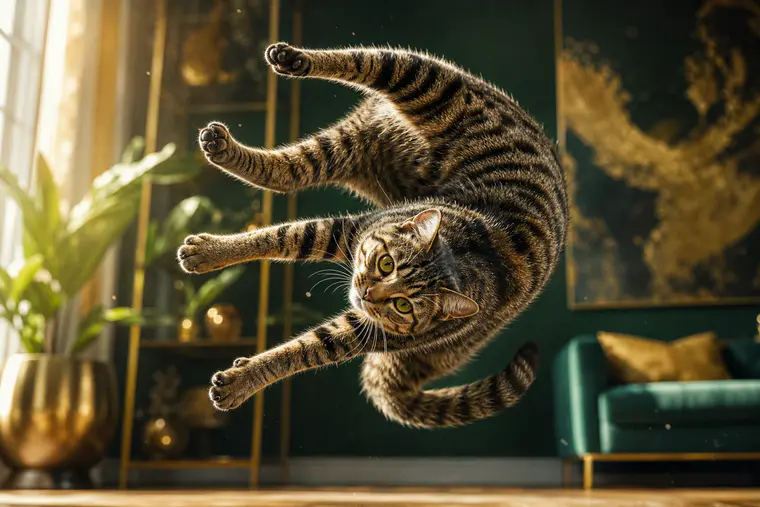
The Curious Physics of a Cat’s Midair Twist
If you’ve ever knocked a notebook off a desk and watched your cat leap—and somehow rotate—fast enough to stick the landing, you’ve witnessed one of nature’s neatest tricks. The feline “righting reflex” lets most cats reorient their bodies during a fall so their feet meet the ground first. It looks like magic, but it’s really a blend of lightning-fast sensory processing, a uniquely flexible skeleton, and some elegant physics.
Before we dive in, one important caveat: cats do not always land on their feet. The reflex has limits, and falls are dangerous. Understanding the science can help you appreciate their agility—and keep them safer at home.
What Is the Righting Reflex?
The righting reflex is a cat’s built-in ability to sense which way is “up” and twist the body midair to face the ground. Most healthy cats can do this from surprisingly short drops, often within a fraction of a second.
The Inner-Ear Balance System
Cats detect orientation using the vestibular system in their inner ears. Tiny fluid-filled canals and sensors register gravity and head motion. When a fall begins, the head snaps to a level position first—think of it as setting the reference frame. Once the head is oriented, the body follows.
A Spine Built for Acrobatics
Unlike many animals, cats have extremely flexible spines and loosely connected shoulder blades. This lets the front and back halves of the body rotate somewhat independently. That independence is the key to reorientation without any external surface to push against.
The Tail: Helpful, Not Essential
A cat’s tail can assist with balance and fine-tuning in midair, acting like a dynamic counterbalance. But it isn’t required. Tailless cats (like many Manx) can right themselves, proving the tail is more of a stabilizer than a steering wheel.
How Cats Turn Without “Pushing” on Anything
At first glance, the cat’s twist seems to break the laws of physics. How can a body rotate in empty space without pushing off a surface? The trick lies in the conservation of angular momentum and changing moment of inertia—essentially, redistributing mass to rotate different parts in opposite directions.
- When a cat tucks its front legs and extends the hind legs, the front half becomes easier to spin (lower moment of inertia), while the back half becomes harder to spin (higher moment of inertia). The front rotates more; the back rotates less.
- Then the cat reverses: extends the front legs and tucks the hind legs. Now the back half does the larger share of rotation.
- Because the halves counter-rotate, the total angular momentum stays essentially zero. Net effect: the cat’s overall orientation changes yet it hasn’t “pushed” on anything external.
This elegant solution is known in physics as the “falling cat problem,” which inspired decades of research in mechanics and even robotics. The same principles appear in space when astronauts change orientation by moving arms and legs.
A Step-by-Step Look at the Midair Maneuver
Though the entire sequence can finish in less than a second, it often follows a recognizable pattern:
- Detection: The vestibular system senses the fall; the head orients with the nose facing down.
- Front-half rotation: The cat tucks forelegs, hunches slightly, and rotates the front of the body toward the ground.
- Back-half counter-rotation: Simultaneously, the rear extends, rotating less but counterbalancing the front.
- Reversal and alignment: The cat adjusts, sometimes repeating a mini-cycle to fine-tune, ensuring the spine and limbs align underneath.
- Bracing for impact: Legs extend just before landing; shoulder and hip joints cushion the impact like natural shock absorbers.
Air Resistance and Terminal Velocity
Air matters too. As a cat spreads its body—legs out, belly slightly broadened—air resistance increases. This posture can reduce terminal velocity (the maximum falling speed) compared with a tightly tucked position. Estimates suggest a sprawled cat may reach a terminal velocity lower than a human’s, sometimes cited around 60 mph versus ~120 mph for a belly-down human. The exact number depends on posture, size, and conditions.
When falls are long enough, many cats switch from a tense twist phase to a more relaxed, spread posture. That can increase drag and give extra time to position the limbs for landing. But “slower” does not mean “safe”—serious injuries are common after any significant fall.
Development: When Do Kittens Learn This?
Kittens begin to show the righting reflex around 3–4 weeks of age as their nervous systems and balance organs mature. By 6–7 weeks, most are proficient, though coordination keeps improving with practice. Very young kittens, seniors with arthritis, and cats with neurological or inner-ear issues may have delayed or imperfect righting.
Limits and Myths: They Don’t Always Stick the Landing
Despite the name, the righting reflex is not a guarantee. Real-world limits matter:
- Too little time: In very short falls—off a couch, for example—there may not be enough time to complete the rotation. That’s why even small drops can cause awkward landings.
- Slippery or uneven surfaces: A perfect reorientation can still end in a skid on slick tile or polished wood.
- Health and body condition: Obesity, arthritis, inner-ear problems, or sedation slow reactions and reduce flexibility.
- Tail not required: As noted, tailless cats can right themselves. The tail helps with fine control but doesn’t drive the main rotation.
- High-rise syndrome: Falls from windows and balconies are a common veterinary emergency. Injuries range from broken teeth and limbs to chest trauma, even when cats “land on their feet.” Always treat heights with caution.
Practical Ways to Keep Your Cat Safer
You can’t change physics, but you can reduce risk in a cat’s vertical world. Try these home-friendly safeguards:
- Window and balcony safety: Install sturdy screens and pet-proof netting; keep tilt-and-turn windows locked or fitted with guards.
- Stable climbing zones: Provide a tall, heavy-base cat tree with wide platforms and non-slip surfaces. Anchor wall shelves into studs and use textured coverings.
- Soft landing zones: Place rugs or foam mats under favorite jump routes (window perch to bookcase, sofa to sill) to soften inevitable missteps.
- Manage motivation: Avoid luring jumps to risky spots with toys or lasers. Direct play sessions toward safe zones, using wand toys near the cat tree or a play mat.
- Clear the runway: Keep clutter off sills and shelves so a foot or claw won’t snag mid-leap.
- Trim, don’t declaw: Regular nail trims help with traction on fabric and sisal surfaces. Offer multiple scratchers to maintain grip strength.
- Harness training: For balcony lounging or open windows, a well-fitted harness and supervised “catio” time is far safer than free access.
What to Do If Your Cat Falls
Even if your cat seems fine, internal injuries can hide. After any significant fall, especially from more than one story:
- Keep the cat calm and confined to prevent further injury.
- Look for labored breathing, bleeding, limping, swollen abdomen, or lethargy.
- Minimize handling if you suspect pain; gently place the cat in a carrier on a flat towel.
- Contact your veterinarian or an emergency clinic for advice and evaluation.
Prompt care improves outcomes, and a professional exam is the safest call.
Cool Facts to Share
- Early science in motion: In the late 19th century, chronophotography (a kind of early high-speed photography) captured cats twisting midair, helping scientists map the righting sequence frame by frame.
- Math meets meow: The falling cat problem influenced modern ideas in mechanics and control theory—how objects can change orientation without external torque.
- Whisker wisdom: While whiskers don’t drive the righting reflex, they offer close-range spatial information that can improve landing awareness on tight ledges.
How This Helps You Be a Better Cat Guardian
Understanding why cats land on their feet explains both their grace and their vulnerabilities. They’re built to twist, reorient, and absorb impact better than most animals—but that talent has limits. With smart home design and a bit of training, you can channel your cat’s acrobatics into safer, happier play.
A Simple Safety Makeover in One Afternoon
- Pick the two tallest jump routes your cat uses. Add a grippy runner rug at the launch and landing points.
- Anchor a wall-mounted shelf at a comfortable intermediate height to shorten the leap.
- Move a beloved perch at least one body-length away from open windows unless screened.
- Store toys in a basket near the safe play zone so you naturally direct action there.
Small changes like these cut risk without dampening your cat’s joy in climbing and exploring.
Frequently Asked Questions
Do cats always land on their feet?
No. The righting reflex is impressive but limited by height, surface, health, and time. Short drops may not allow full rotation, and high falls can still cause serious injuries.
At what age do kittens develop the righting reflex?
It begins around 3–4 weeks and is usually reliable by 6–7 weeks, improving with coordination and practice as the kitten grows.
Does a cat need its tail to land on its feet?
No. The tail helps with balance and fine control, but tailless cats can right themselves using spine flexibility and front/back body rotation.
Can cats survive high falls because of this reflex?
Sometimes—but it’s risky. The reflex and a spread posture may reduce impact speed, yet high-rise falls frequently cause injuries. Treat any fall seriously and call your vet.
Approved member comments will appear here.