Curiosity is a powerful shortcut to learning. The world is packed with truths so counterintuitive they feel like pranks until you see the evidence. Here are 25 facts that sound fake at first blush—but check out the explanations and tips, and they click into place.
Jaw-Dropping Nature and Animal Facts
1. Bananas are berries, but strawberries aren’t
Botanically, a “berry” is a fleshy fruit produced from a single ovary with seeds embedded in the flesh. Bananas fit; strawberries don’t—strawberries are “aggregate accessory fruits,” where the tiny “seeds” on the surface (achenes) are the true fruits.
Tip: If the “seeds” are inside, it may be a berry. Tomatoes, kiwis, and grapes are berries too.
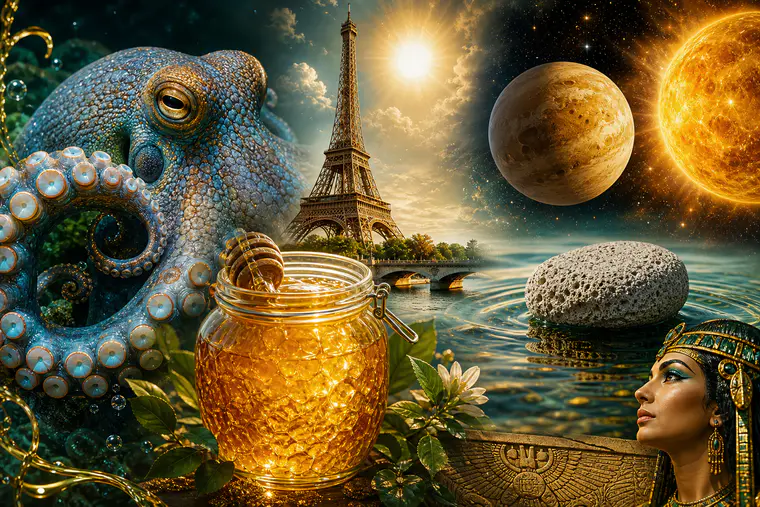
2. Octopuses have three hearts and blue blood
Two hearts push blood through the gills; one circulates it to the rest of the body. Their blood is blue because it uses copper-based hemocyanin to carry oxygen—more efficient than iron-based hemoglobin in cold, low-oxygen water.
Example: An octopus’s systemic heart actually stops when it swims, which is why they prefer crawling.
3. Honey basically never spoils
Low water content and acidity keep microbes out. Archaeologists have found edible honey in ancient tombs. If your honey crystallizes, warm the jar gently in a hot-water bath and it’ll reliquefy.
Storage tip: Keep honey sealed at room temperature; no need to refrigerate.
4. Wombat poop is cube-shaped
Specialized intestinal walls dry and shape feces into cubes, which helps the pellets stay put on rocks—useful for scent-based communication.
Fun angle: This is a rare example of a biological process creating geometric shapes.
5. Sharks are older than trees
Sharks appeared roughly 400 million years ago. The earliest trees evolved about 360 million years ago. That makes sharks veteran survivors of five mass extinctions.
Perspective: Great whites are modern; the shark lineage itself is the real ancient story.
6. The smell of rain has a name: petrichor
That earthy scent comes from oils released by plants and a compound called geosmin, produced by soil bacteria. Raindrops aerosolize it so you can smell the storm coming.
Try it: After a dry spell, notice how the first light rain has the strongest petrichor.
7. Some rocks float: pumice can bob on water
Pumice forms from gas-rich volcanic lava, filled with air pockets that reduce its density below water’s. Eventually it waterlogs and sinks.
Safety note: Don’t try to walk on pumice rafts at sea; they can be unstable and sharp.
8. A jellyfish can “age in reverse”
Turritopsis dohrnii, the so-called immortal jellyfish, can revert from its adult form back to a juvenile polyp under stress, a process called transdifferentiation. It’s not truly immortal in the wild but it’s biologically remarkable.
Research tie-in: This species is a model for studying cellular regeneration.
9. Tardigrades can survive space exposure
When dehydrated into a “tun” state, tardigrades endure vacuum, extreme temperatures, and radiation. They’re not invincible, just extraordinarily tolerant for short periods.
Takeaway: Survival is about dormancy and repair, not superpowers.
Mind-Bending Space and Physics Facts
10. A day on Venus is longer than its year
Venus takes about 243 Earth days to rotate once but only about 225 Earth days to orbit the Sun. It also spins retrograde—the Sun appears to rise in the west there.
Context: Dense clouds and slow spin contribute to Venus’s extreme conditions.
11. A teaspoon of neutron star matter would weigh about a billion tons on Earth
Neutron stars crush mass so densely that a sugar-cube volume could outweigh mountains. It’s a thought experiment—scooping any would be impossible due to gravity and heat—but the density math is solid.
Analogy: Pack the mass of the Sun into a city-sized sphere.
12. There are more trees on Earth than stars in the Milky Way
Estimates suggest roughly 3 trillion trees on Earth, versus 100–400 billion stars in our galaxy. Still, there are vastly more stars in the entire observable universe than trees on Earth.
Caveat: Both counts are estimates with margins of error, but the order-of-magnitude comparison holds.
13. A typical cloud can weigh over a million pounds
A puffy cumulus cloud can contain hundreds of tons of water. It floats because the surrounding air supports the load through updrafts and buoyancy—like a hot-air balloon with mist inside.
DIY demo: Steam rising from a kettle is denser than air but lifted by heat until it cools and condenses.
14. Hot water can freeze faster than cold water (sometimes)
Known as the Mpemba effect, under certain conditions—like specific containers, evaporation rates, and impurities—hot water may freeze before cooler water. It’s not guaranteed; it’s a tricky, fascinating edge case.
Home test: Use equal amounts of water in identical metal trays. Record freezer times and repeat. Your mileage may vary.
Time-Twisting History and Culture Facts
15. Cleopatra lived closer to the Moon landing than to the Great Pyramid
Cleopatra VII died in 30 BCE. The Great Pyramid was completed around 2560 BCE—over 2,500 years earlier. The Apollo 11 landing in 1969 CE is about 2,000 years after Cleopatra.
Lesson: Ancient Egypt spans millennia; “ancient” covers a lot of time.
16. Oxford University is older than the Aztec Empire
Scholars taught at Oxford by 1096 CE. The Aztec capital Tenochtitlan was founded in 1325 CE. Timelines often defy intuition when cultures are compared across continents.
Tip: Always check founding dates rather than relying on “ancient vs. modern” vibes.
17. The shortest war in recorded history lasted under an hour
The Anglo-Zanzibar War of 1896 ended roughly 38–45 minutes after it began. A swift bombardment led to a surrender.
Takeaway: Not all wars drag on for years; some end almost as soon as they start.
18. Scotland’s national animal is the unicorn
A symbol of purity and power in Celtic mythology, the unicorn appears in Scottish heraldry. It’s mythical, yes—but officially designated.
Fun link: You’ll spot unicorns on the Royal Coat of Arms of the United Kingdom (Scottish version).
Weird but Useful Everyday Science
19. The Great Wall of China isn’t visible from the Moon to the naked eye
From low Earth orbit, many human structures can be seen under ideal conditions, but from the Moon (about 384,400 km away) the Wall is far too narrow. The myth persists because it’s very long.
Reasoning tip: Visibility depends on width, contrast, and distance—not just length.
20. Glass isn’t a supercooled liquid that flows over centuries
Windowpanes in old buildings are thicker at the bottom due to manufacturing methods, not flow. Glass is an amorphous solid; it doesn’t noticeably “sag” at room temperature on human timescales.
Practical check: Modern float glass stays uniform for decades without thickening at the bottom.
21. Your stomach lining renews itself every few days
Stomach cells face acid strong enough to dissolve metal shavings. Rapid cell turnover—typically a few days—protects you from self-digestion.
Well-being tip: NSAIDs and certain habits can irritate this lining—follow dosage guidance and talk to a clinician if you have persistent discomfort.
22. Birds are living dinosaurs
Cladistics places modern birds as avian dinosaurs, descended from theropods like Velociraptor. Feathers likely began as insulation or display before enabling flight.
Observation: Watch a chicken’s legs and movement—you’re seeing dinosaur anatomy in action.
23. You can start a fire with ice shaped into a lens (in theory)
Clear ice carved into a smooth convex lens can focus sunlight onto tinder, just like magnifying glass fire-starting. It’s difficult: the ice must be very clear and well-polished.
Safety tips: Try with a real magnifying lens first. Never attempt in dry, fire-prone areas.
24. A day at the Eiffel Tower is longer—by centimeters
Steel expands with heat. On a hot day, thermal expansion can add about 10–15 cm to the Eiffel Tower’s height. Rails, bridges, and buildings include expansion joints for this very reason.
Try this: Warm a metal jar lid under hot water to loosen it—the metal expansion makes opening easier.
25. The DNA in your body could stretch to Pluto and back—several times
Each cell contains about 2 meters of DNA. With an estimated tens of trillions of cells, your total DNA could reach from the Sun to Pluto and back multiple times if laid end to end.
Mental picture: Microscopic strands adding up to interplanetary distances.
How to Tell If a “Fake-Sounding” Fact Is Actually True
Surprising claims spread fast. Here’s a quick playbook for gut-checking them:
- Look for original sources: scientific papers, textbooks, museum or university sites, government agencies (e.g., NASA, NOAA, WHO). Avoid single-screenshot “proof.”
- Check definitions: Many paradoxes vanish with precise terms (e.g., “berry” in botany vs grocery slang).
- Watch the conditions: Claims like the Mpemba effect are true under specific setups, not all the time.
- Compare orders of magnitude: Back-of-the-envelope math (like DNA length or cloud mass) often reveals plausibility.
- Seek consensus: If multiple independent experts agree, the claim is likely solid.
- Beware outdated stats: Health and population facts change; check publication dates.
Pro tip: Use a stargazing app, a reputable science encyclopedia, and a unit converter to test space, biology, and physics claims yourself.
Frequently Asked Questions
Are these facts really verified?
Yes. Each item reflects mainstream scientific understanding or well-documented historical records. When details have caveats (like the Mpemba effect), we note the conditions.
Which of these can I try at home?
Safe, simple options include honey crystallization and rewarming, magnifying-glass fire starting (with caution), noticing petrichor after a dry spell, and timing freezer experiments with hot vs cold water.
Why do so many myths (like the Great Wall being visible from the Moon) persist?
They’re catchy, repeated in classrooms and media, and hard to test personally. Precision (distance, contrast, definitions) often flips the conclusion.
Is the “trees vs Milky Way stars” comparison settled?
Estimates vary, but current best numbers support more trees on Earth than stars in our galaxy. That doesn’t apply to the whole universe, which contains vastly more stars overall.
Approved member comments will appear here.