Why “weird” facts are worth your time
Strange-but-true science stories aren’t just party trivia. They’re shortcuts to understanding how nature really works. When something seems odd—blue sunsets on Mars, cube-shaped poop from wombats, bananas that are technically radioactive—there’s usually a beautiful, testable explanation behind it. Below, you’ll find handpicked head-scratchers scientists can explain clearly, plus quick tips and simple ways to witness some of the weirdness yourself.
Space and sky oddities you can actually explain
A day on Venus is longer than a year
Venus rotates so slowly on its axis that one full spin takes about 243 Earth days, while its trip around the Sun takes only about 225 Earth days. Translation: the planet’s “day” is longer than its “year.” The cause is a combination of Venus’s sluggish retrograde rotation (it spins in the opposite direction of most planets) and the way tidal forces and atmospheric dynamics slowed it over eons.
Practical tip: If you enjoy skywatching, use a free planetarium app like Stellarium or SkySafari to track Venus’s brilliant evening or morning appearances. You can’t see the long day directly, but you’ll appreciate how quickly its phase changes as it races around the Sun.
Mars has blue sunsets
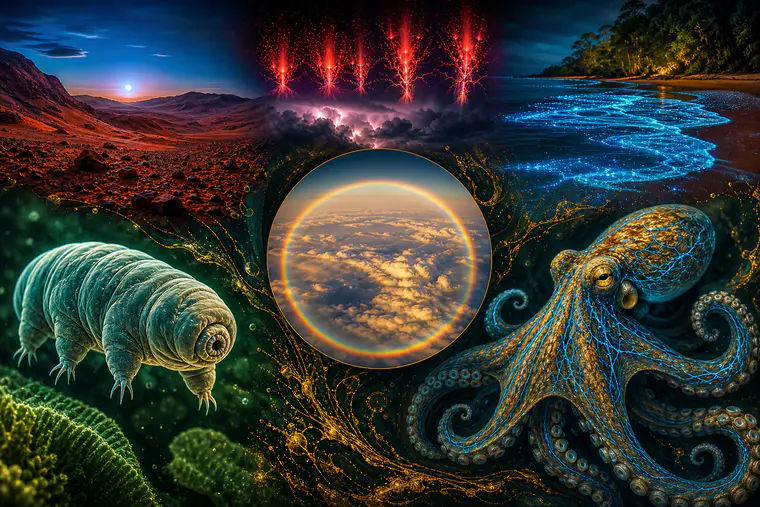
On Earth, the sky is blue and sunsets are red because tiny air molecules scatter shorter blue wavelengths (Rayleigh scattering), leaving the reds and oranges to dominate when the Sun is low. Mars flips the script. Fine red dust in its thin atmosphere scatters red light away from the line of sight while letting blue light pass through more directly near the Sun. Result: sunsets that glow an eerie blue.
Rainbows are full circles—you usually see only an arc
A rainbow is actually a 360-degree circle created by sunlight refracting and reflecting inside billions of raindrops. On the ground, the horizon blocks the bottom half, so you see just an arc. From a plane with the Sun behind you and rain ahead, you can sometimes witness the full circle, and even a dimmer, larger secondary rainbow from a second reflection within the drops.
Tip: Polaroid sunglasses can deepen rainbow colors by cutting glare, making the main and secondary bows easier to spot.
Sprites: lightning that leaps up instead of down
Sprites are towering, reddish flashes that burst 50–90 kilometers above thunderclouds. They’re not your standard lightning bolt but a related electrical discharge in the mesosphere, triggered by strong positive lightning strikes between clouds and the ground. High-speed cameras and aircraft observations now document sprites frequently, turning a once-mythical phenomenon into a well-understood (but still magical-looking) event.
Animals that seem impossible—but make sense
The octopus has three hearts and blue blood
Two branchial hearts push blood through the gills; one systemic heart circulates it through the rest of the body. Their blood uses hemocyanin (copper-based) instead of our hemoglobin (iron-based), which turns it blue and works better in the cold, low-oxygen waters many octopuses inhabit. Fun twist: the systemic heart stops beating when an octopus swims, which is one reason these animals prefer to crawl—it’s energetically cheaper.
Tardigrades can survive space by turning into glass-like “bears”
Tardigrades—aka water bears—enter a state called cryptobiosis when dehydrated. They replace much of their body water with sugars like trehalose, stabilize proteins with special damage-suppressing molecules, and essentially vitrify (form a glass-like matrix) that shields cellular machinery from radiation and vacuum. They’re not indestructible, but they can endure extremes that would kill most life.
Wombats produce cube-shaped poop
It’s not a joke. Wombats’ intestines have regions with different elastic properties that shape feces into soft cubes as water is absorbed. Final drying and the animals’ gentle tumbling motions finish the corners. The cubes don’t roll away, helping wombats stack “scent markers” on rocks and logs to communicate territory.
Migratory birds sense Earth’s magnetic field
Many birds navigate using an internal compass based on cryptochrome proteins in their eyes. When blue light hits these molecules, it creates “radical pairs” of electrons whose quantum spins are influenced by Earth’s magnetic field. The birds likely perceive this as a faint visual pattern overlaying their normal vision, giving them a reliable north–south cue. Lab experiments disrupting radical-pair chemistry impair the birds’ compass, backing up the mechanism.
Bioluminescent oceans are living light shows
Glowing waves aren’t magic; they’re plankton (often dinoflagellates) releasing light through a chemical reaction—luciferin oxidized by luciferase—when they’re disturbed by motion. Stirring by waves, fish, or even your footsteps in wet sand can trigger the glow.
Tip: Check local reports and go on a new-moon night to reduce light pollution. Move gently in the water to see trails of blue sparks.
Everyday chemistry with wonderfully odd outcomes
Bananas are radioactive (and that’s okay)
Potassium-40, a naturally occurring isotope in potassium, makes bananas slightly radioactive. A single banana gives you about 0.1 microsieverts of radiation—roughly equivalent to eating a few Brazil nuts or spending a few hours at sea level versus high altitude. Your body tightly regulates potassium, and the dose is trivial compared to everyday background radiation.
Honey never spoils
Archaeologists have found ancient Egyptian honey still edible after millennia. Its staying power comes from low water activity (not enough available water for microbes), acidity (pH ~3–4), and natural hydrogen peroxide produced by enzymes from bees. Seal it well, and it can last indefinitely. Crystallization doesn’t mean it’s gone bad—gently warm the jar to re-liquefy.
Onions make you cry for a clever chemical reason
Cutting an onion breaks cells, mixing enzymes with sulfur-containing compounds to form syn-propanethial-S-oxide, a volatile “lachrymatory factor.” It wafts into your eyes, reacts with tears to make a mild acid, and triggers more tearing to flush it out.
Tip: Chill onions for 15 minutes before cutting and use a sharp knife to rupture fewer cells. Chopping under a vent or fan also helps blow vapors away.
Pineapple “eats” you back
The tingle you feel after eating fresh pineapple comes from bromelain, a blend of protease enzymes that snip proteins—including some on your tongue’s surface. Don’t worry: your saliva and stomach acid quickly denature the enzymes, and your mouth repairs itself fast. Cooking or canning pineapple deactivates bromelain.
Ice floats—because water breaks the density rules
Most substances get denser as they freeze. Water makes an open, hexagonal crystal lattice when it forms ice, spacing molecules farther apart than in liquid water. That extra space lowers ice’s density, making it float. If ice sank, lakes would freeze from the bottom up and many aquatic ecosystems would collapse each winter.
Physics that bends your brain (and is completely real)
You are mostly empty space
Atoms are tiny nuclei surrounded by electron clouds. If a nucleus were a marble in a stadium, electrons would be faint probability smears near the rafters—and everything in between would be “empty” space. You don’t fall through your chair because electromagnetic forces and quantum rules prevent electron clouds from overlapping freely, creating the everyday solidity you rely on.
You’re literally stardust
Hydrogen in your body came from the Big Bang, while most other elements—carbon, nitrogen, oxygen, calcium, iron—were forged by stars. Some were made in the intense heat and pressure of stellar cores; others were blasted into space during supernovae or created in neutron-star mergers. Planetary chemistry recycled those atoms into rocks, oceans, and eventually you.
Magenta isn’t in the rainbow
There’s no single wavelength for “magenta.” It’s a non-spectral color your brain invents when your red- and blue-sensitive cones are stimulated strongly with little green in between. Because the visible spectrum runs from red through green to blue, there’s no “bridge” back to red—your visual system blends red and blue into magenta to make sense of it.
Hot peppers don’t taste hot—they hurt hot
Capsaicin in chili peppers binds to TRPV1 receptors, the same pain sensors that signal heat. Your brain interprets the chemical activation as burning, which is why cold milk (fat + casein proteins) helps better than water: it dissolves and carries away capsaicin.
Planet-scale connections that feel like science fiction
Sahara dust fertilizes the Amazon
Each year, roughly 180 million tons of Sahara dust blow across the Atlantic; about 22,000 tons of phosphorus settle over the Amazon Basin, replenishing nutrients washed away by heavy rains. Much of the dust comes from the Bodélé Depression in Chad, an ancient lake bed rich in mineral powder. Satellite data and ground measurements trace this intercontinental nutrient highway.
Practical angle: Want to visualize global dust and aerosols? Check interactive weather maps like Windy or Earth Nullschool and toggle the “dust” or “Aerosol Optical Depth” layer.
There are more trees on Earth than stars in the Milky Way
Astronomers estimate 100–400 billion stars in our galaxy. Ecologists tally roughly 3 trillion trees on Earth. Surprising? Yes. A reason to relax? Not quite—humans have cut nearly half of the planet’s trees since the dawn of agriculture. Still, it’s a clarifying comparison that reframes our sense of scale.
Forests “talk” through fungal networks
Tree roots partner with mycorrhizal fungi that trade nutrients for sugars and form sprawling underground networks. Through these connections, trees can share carbon, warn neighbors of pest attacks via chemical cues, and influence seedling growth. It’s not language, but it is sophisticated ecology—an internet of life powered by chemistry and symbiosis.
Weird things you can try, test, or spot this week
- See a full-circle rainbow: If you’re flying on a rainy day with the Sun behind the plane, watch below the aircraft’s shadow. You may catch a complete circular bow—and sometimes a glory, a compact rainbow-like halo around the shadow.
- Chase bioluminescence: Look for recent local sightings near sheltered bays during warm months. Use a red flashlight to preserve night vision and move slowly to stir the glow.
- Decode petrichor: Before a storm after a dry spell, step outside. The earthy smell comes from oils released by plants and compounds from soil bacteria (geosmin). Lightning also creates a hint of sharp ozone.
- Tame onion tears: Chill, sharpen, and ventilate. A small desk fan by your cutting board works wonders.
- Explore the night sky smartly: Free apps like Stellarium help you spot Venus, identify constellations, and understand why twilight colors change.
- Join a citizen-science project: Apps like iNaturalist or Seek can help you document organisms (including glowing plankton) and share verified observations with scientists.
Quick-hit oddities with solid science
Moon illusion: bigger near the horizon
The Moon looks huge when it’s low not because of magnification by the atmosphere, but because your brain compares it to objects on the horizon and interprets it as farther away—so it “scales up” the perceived size. Photograph the Moon at the horizon and overhead with the same focal length to see they’re the same size in pixels.
Lightning can and does strike the same place twice
Tall towers and mountain peaks are frequent targets because they alter electric fields and offer a conductive path. The Empire State Building gets hit dozens of times a year.
Glass isn’t a liquid at room temperature
You may have heard that old windowpanes are thicker at the bottom because glass “flowed.” In reality, historical glassmaking produced uneven panes. At room temperature, glass is an amorphous solid—its atoms are arranged like a liquid’s but locked in place.
Saturn could float (in theory)
Saturn’s average density is lower than water’s, so if you had an ocean big enough—and physics that ignored tidal shredding—it would float. In real space, there’s no cosmic bathtub, but the fact highlights how much of Saturn is puffy hydrogen and helium.
Smart tools to explore the weirdness
- Stellarium (desktop/mobile): Simulate the night sky, track planets, and visualize atmospheric optics.
- Windy (web/mobile): Toggle dust and aerosol maps to watch Sahara plumes drift across the Atlantic.
- iNaturalist or Seek (mobile): Identify organisms, including glowing plankton and strange fungi, and contribute to real research.
- A simple pocket loupe or clip-on macro lens: Turn your phone into a field microscope to examine sand grains, pollen, or leaf stomata.
Frequently Asked Questions
Are bananas too radioactive to eat every day?
No. A banana’s radiation dose is tiny—about 0.1 microsieverts—negligible compared with daily background exposure from the ground, air, and even cosmic rays.
Can I see a full-circle rainbow without flying?
Sometimes. Stand on a high ridge or tall building with rain or mist below you and the Sun behind you. The higher your vantage point, the more of the circle you’ll see.
Do birds really “see” magnetism?
Evidence suggests yes. Cryptochrome-based radical pairs in the eye appear to create a magnetic-field–dependent visual pattern. Disrupting this chemistry in labs scrambles the birds’ compass.
Is honey still safe if it crystallizes?
Yes. Crystallization is natural and reversible. Warm the jar gently in hot water to re-liquefy. Keep honey sealed and dry to preserve it for years.
Approved member comments will appear here.