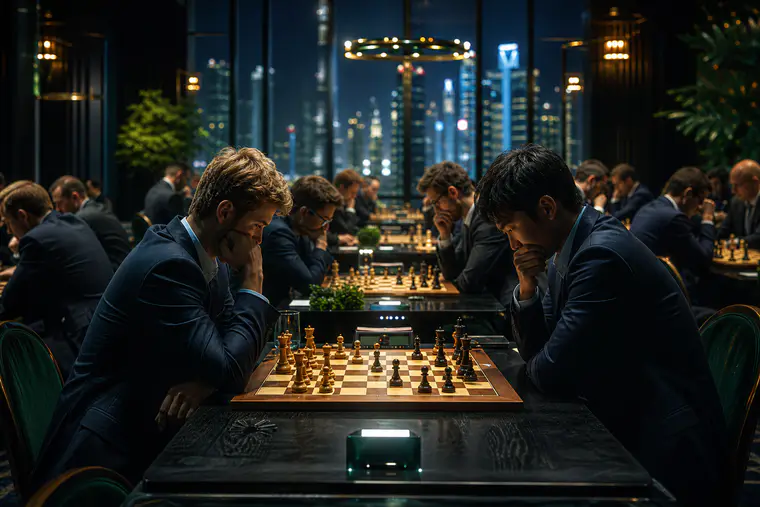
The 2750+ Elo Club: Why This Number Means “World Elite”
In chess, ratings tell a story—but the number 2750 tells a legend. Crossing 2750 Elo in classical chess puts a grandmaster among a tiny group that routinely battles for super‑tournament titles, Candidates berths, and the World Championship conversation. Only a few dozen players in history have ever touched 2750, and the margin for error at this level is razor thin: one off day can erase months of gains.
This guide gives you a fan‑friendly tour of the 2750+ “super‑GM” club: what the number really means, who the biggest names are (past and present), how ratings move at the top, and how to track the next big leap on the live lists.
Elo 101: What Does 2750 Really Mean?
Elo is a statistical system that predicts expected scores between players. A 200‑point rating gap translates to a big favorite; a 400‑point gap is almost decisive. At 2750, a player is:
- Almost always top‑15 in the world, often top‑10.
- Strong enough to be a favorite against nearly all grandmasters outside the top 100.
- Expected to score about 60–65% against a 2650–2680 opponent—if they avoid mistakes.
At this altitude, K‑factors (the multiplier that determines how much ratings move per game) are small, so gains are incremental and consistency rules. One win against a peer might yield only a couple of points; a single loss against a lower‑rated GM can cost more than that.
The All‑Time Highs: The 2800+ Legends
A subset of the 2750+ club ascends even further: the 2800+ titans. Peaks matter because they condense years of dominance into a single crest.
- Magnus Carlsen – Peak 2882: The highest official rating ever recorded. Carlsen’s run from 2010s onward set a modern benchmark for endgame mastery, practical defense, and relentless squeezing.
- Garry Kasparov – Peak 2851: The standard bearer of the late 80s and 90s. Opening preparation, deep calculation, and dynamic chess defined his era.
- Fabiano Caruana – Peak 2844: His 2014 Sinquefield Cup (+7 in 10 rounds!) remains a gold standard for tournament dominance in the engine age.
- Levon Aronian – Peak ≈2830: A creative virtuoso who paired deep preparation with resourceful middlegame play.
- Vladimir Kramnik – Peak ≈2817: The positional architect who dethroned Kasparov and shaped modern Berlin and Catalan theory.
- Viswanathan Anand – Peak ≈2817: The “Tiger of Madras,” lightning‑fast calculation and universal style, with five World Championship titles.
- Veselin Topalov – Peak ≈2816: A dynamic spearhead of 2000s top chess; fearless complications and initiative.
- Shakhriyar Mamedyarov – Peak ≈2820: Explosive tactics and uncompromising play.
- Wesley So – Peak ≈2822: A paragon of solidity and technique; very hard to beat.
- Maxime Vachier‑Lagrave – Peak ≈2819: The Najdorf and Grünfeld trailblazer.
- Ding Liren – Peak ≈2816: Metronomic consistency, precise technique; World Champion in 2023.
- Hikaru Nakamura – Peak ≈2816: Elite classical results and arguably the most successful blitz/rapid specialist of his generation.
- Alireza Firouzja – Peak ≈2804: The first teenager since Carlsen to break 2800, signaling a generational shift.
These peaks show that while 2750 is elite, the 2800 barrier separates an all‑time tier of sustained dominance.
Notable Members of the 2750+ Club (Selected)
Below are highlights of grandmasters with peak classical ratings at or above 2750. Each has a distinctive signature—opening choices, psychological approach, or tournament specialty—that propelled them into the stratosphere.
- Ian Nepomniachtchi – Upper 2700s: Blistering initiative, two‑time Candidates winner (2020–21, 2022–23 cycle). Dangerous in dynamic positions.
- Anish Giri – High 2700s: Theory connoisseur, deeply prepared in nearly every opening; world‑class drawing resistance with selective aggression.
- Alexander Grischuk – ≈2810 peak: Legendary time‑scrambler and three‑time World Blitz Champion with rich strategic understanding.
- Teimour Radjabov – ≈2793 peak: Rock‑solid repertoire, high‑stakes match player, and Kings Indian pioneer.
- Sergey Karjakin – Upper 2700s: Defensive resilience; known for resourceful holds under pressure.
- Richard Rapport – Upper 2700s: Unorthodox openings and creative complications.
- Jan‑Krzysztof Duda – Mid/upper 2700s: Fearless counterattacker, classical and rapid threat.
- Peter Svidler – ≈2769 peak: Grünfeld authority with decades of elite‑level longevity.
- Boris Gelfand – ≈2777 peak: Classical style and endgame sophistication; World Championship challenger (2012).
- Veselin Topalov – Listed above among 2800+: His 2750+ years stretched across multiple cycles.
- Peter Leko – ≈2763 peak: Endgame technician and World Championship match challenger (2004).
- Shirov, Alexei – ≈2755 peak: “Fire on Board” tactics; attacking play that thrilled a generation.
- Michael Adams – ≈2761 peak: Pragmatic, resource‑efficient style; extremely hard to crack.
- Baadur Jobava – Flirted with mid‑2700s: Flashy ideas and practical chances against anyone at his best.
- Wang Yue, Wang Hao, Wei Yi, Yu Yangyi – All have recorded 2750+ or close peaks in modern Chinese chess’s rise, blending rock‑solid technique with tactical precision.
- Pentala Harikrishna, Vidit Gujrathi, and India’s young guard – India’s surge has produced multiple players who reached, approached, or hovered around the 2750 mark in recent years; depth keeps growing.
Important note: Live ratings change by the game, and official ratings update monthly. For the latest exact numbers and current members over 2750, check the official FIDE rating lists and reputable live trackers.
The Modern 2750+ Landscape: Events That Make (or Break) Ratings
To reach or maintain 2750, you need consistent plus scores in the toughest events on Earth—usually round‑robins or select Swiss tournaments featuring only super‑GMs. A typical 14‑player super‑tournament might have 10 or more players rated 2700+. Score +2 or +3 there and your rating gently climbs; dip below 50% and it can dip sharply.
Key arenas where 2750+ reputations are forged:
- Candidates Tournament: The gate to the World Championship. Even a 50% score here carries enormous prestige.
- Super‑tournaments: Tata Steel (Wijk aan Zee), Norway Chess, Sinquefield Cup, Grand Chess Tour events, and elite round‑robins like Grenke or Bucharest.
- National team events: Olympiad and World Teams, where leaders often meet other top boards.
Strategic scheduling matters. Many 2750‑caliber players mix classical events with rapid/blitz tours to balance form, confidence, and practical preparation—even though rapid/blitz ratings don’t directly affect classical Elo.
How Ratings Move at 2750: A Quick Feel for the Math
While exact formulas use expected score tables and K‑factors, a rule of thumb at the top is:
- Draw with peers: Often near zero change.
- Beat a lower‑rated 2650–2680 GM: +1 to +2 points, depending on the gap and K.
- Lose to a lower‑rated GM: −3 or worse.
That’s why risk management is pivotal. Super‑GMs choose openings that maximize winning chances with minimal exposure, and tailor their white/black strategies to the opponent’s style.
Practical Tips: How to Track the 2750+ Club Like a Pro
- Bookmark official and live lists: Use the monthly FIDE ratings for archival accuracy and trusted live trackers for day‑to‑day movement.
- Follow event pages: Many top events provide daily PGN files, pairings, and live commentary that explain rating implications.
- Build a watchlist: Note who’s within a few points of 2750 or 2800. Their next event might push them over the line.
- Compare classical vs rapid/blitz: A player hot in rapid may be riding form that spills into classical—useful when predicting surges.
Helpful Digital Tools for Fans and Improvers
- Opening trainers and courses: Structured repertoires help you see why top players choose specific lines (and how they steer games into “two‑result” positions). Look for spaced‑repetition features and model‑game collections.
- Cloud databases and engines: Search recent elite games, then test ideas with engines like Stockfish. Emphasize understanding plans over memorizing evals.
- Training planners: Apps that schedule tactics, endgames, and review sessions keep you consistent—the same virtue that sustains 2750‑level play.
What You Can Learn from 2750+ Grandmasters
You don’t need 2750 strength to borrow elite habits. Try these principles:
- Prioritize quality over quantity: Study 2–3 recent model games in your openings each week and annotate them in your own words.
- Master a few “get to a game” systems: With Black, favor sturdy lines that yield playable middlegames against almost anything (e.g., solid Queen’s Gambit declines or reliable Sicilian/Spanish setups you understand well).
- Value the endgame: At 2750, many points are scored by converting small edges. Learn a handful of critical rook and bishop endgames cold.
- Manage time like a pro: Avoid time trouble by pre‑assigning thinking budgets to phases of the game. Top GMs rarely burn minutes on trivial recaptures.
- Build resilience: Even super‑GMs blunder. What separates them is the speed of psychological recovery.
Fun Facts and Milestones
- First to 2800: Garry Kasparov in 1990—an Everest moment for chess ratings.
- Highest official rating ever: Magnus Carlsen’s 2882, a record that towers over the field.
- Teenager at 2800: Alireza Firouzja crossed 2800 as a teenager, a feat that signaled the acceleration of young talent in the engine era.
- National waves: The USSR/Russia once dominated this echelon; today the USA, India, and China all field multiple players flirting with or surpassing 2750.
How the Club Evolves: Generational Shifts and Style Trends
Every few years, the composition of the 2750+ club refreshes. Engines and databases spread best practices quickly; openings that were once niche become mainstream. The current trends include:
- Universal style: Players cultivate both dynamic and positional arsenals, swapping gears by opponent.
- Practical engineship: Elite prep is not about memorizing evals but identifying human‑practical lines that pose real problems at the board.
- Endgame precision: Squeezing tiny advantages with near‑flawless technique remains a timeless separator.
Build Your “2750 Watch” Routine
- Pick three players on the cusp: a proven star, a rising junior, and a creative maverick.
- Track their next super‑tournament, noting round‑by‑round form and opening choices.
- After each game, summarize in one sentence what tipped the scales—opening surprise, endgame grind, time pressure, or a tactical shot.
- Revisit your notes monthly. You’ll quickly develop an eye for who’s about to surge.
Frequently Asked Questions
Who has the highest classical rating of all time?
Magnus Carlsen holds the record with an official peak of 2882, the highest in chess history.
Why is 2750 Elo such a big deal?
Because it marks a level where only a handful of humans operate. At 2750, you’re competitive for super‑tournament wins and serious World Championship contention.
How often do classical ratings update?
Official FIDE classical ratings update monthly. Live lists track changes game‑by‑game during ongoing events, but the official list is the permanent record.
How can a top grandmaster gain 10 rating points quickly?
By scoring a strong plus score against near‑peers in a single elite event—think +3 or better in a tough round‑robin. At 2750+, gains are hard‑earned and usually incremental.
Approved member comments will appear here.