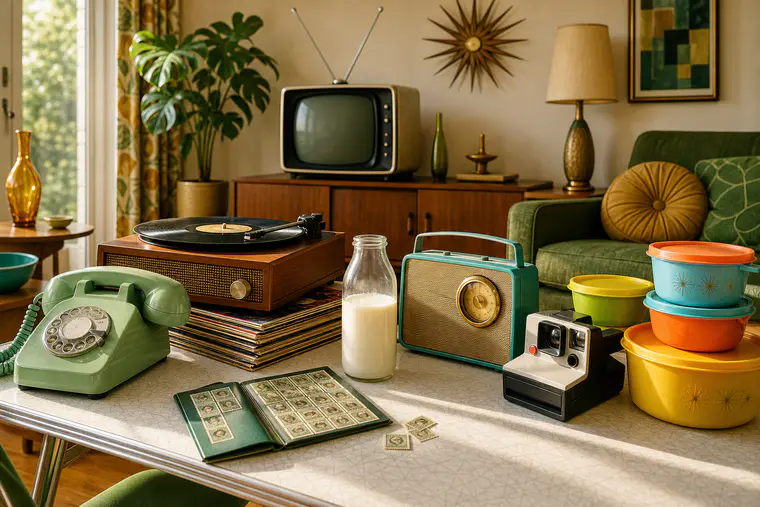
If the 1960s were part of your life—or part of your family’s stories—you probably remember a world of simple gadgets, bold colors, and shared rituals. From rotary phones to S&H Green Stamps and TV dinners in aluminum trays, the everyday things of the ’60s tell the tale of how people worked, cooked, played, and stayed in touch. Ready for a memory tour (with practical tips to preserve those memories)? Let’s time-travel through the small stuff that made daily life tick.
Ring, Click, and “Operator, Please”: How We Communicated
Rotary phones and party lines
A home phone wasn’t an app—it was a piece of furniture. The rotary dial’s clicks were a soundtrack all their own. Many households had a wall-mounted phone with a long, coiled cord; others set a heavy desktop handset on a doily-covered table. In rural areas, party lines meant multiple homes shared a single line (and, occasionally, a bit of gossip).
- Tip: You can still use many vintage rotary phones with modern VoIP adapters. Look for units that support pulse-to-tone conversion, and have an electrician inspect old cords for safety.
Exchange names and phone booths
Before all-numeric dialing fully took over, exchange names like KLondike-5 or TUxedo-3 appeared on dials and in directories. Outside the home, glass phone booths and payphones were lifelines—10 cents for a local call, with a tiny instruction card bolted above the coin slot.
- Interesting fact: The Bell System phased out lettered exchanges through the early ’60s. You can still decode them: KL5, famously, became 555.
The Heart of the Home: Kitchens and Daily Chores
TV dinners, percolators, and Jell-O molds
Fast, futuristic, and fun—TV dinners came in compartmentalized aluminum trays, perfect for an episode of Bonanza. Coffee bubbled in metal percolators, filling kitchens with a toasty aroma. And Jell-O molds? They were culinary showpieces, often starring fruit cocktail or—even more daring—shredded carrots.
- Tip: If you cook a retro menu for a themed family night, line aluminum-style trays (or oven-safe divided dishes) with parchment for easy cleanup, and balance sweetness with crisp salads.
Tupperware parties and metal ice cube trays
Social shopping was an event. Tupperware parties brought neighbors together to “burp” airtight lids. Meanwhile, ice came from a clattering metal tray with a lever to free stubborn cubes.
- Safety note: Some vintage plastics may not meet modern food-safety standards. Use them for dry goods, crafts, or decor rather than hot, oily, or acidic foods.
Milk delivery, bread men, and Green Stamps
Glass milk bottles clinked on porches in the morning, and bread trucks sold fresh loaves door-to-door. At supermarkets and gas stations, S&H Green Stamps piled up in booklets. Families carefully pasted and saved them for toasters, lamps, and even furniture from a catalog.
- Interesting fact: S&H Green Stamps were one of the largest loyalty programs of the era, peaking in the mid-1960s.
Screens, Sounds, and Snapshots: Entertainment at Home
Black-and-white sets, rabbit ears, and the nightly sign-off
Many families gathered around black-and-white televisions. “Rabbit ears” antennas were a must, and switching to a UHF channel sometimes meant fine-tuning with a separate dial. Stations signed off late at night—often with the national anthem—before a test pattern took over.
- Fun fact: The All-Channel Receiver Act (1962) required TVs manufactured after 1964 to include UHF tuners, expanding viewing options.
Vinyl records, 45 adapters, and console stereos
Records ruled. LPs (33⅓ rpm) delivered albums; 45s brought hit singles with big center holes. A little plastic “spider” adapter made 45s playable on a standard spindle. Many homes had handsome, furniture-style console stereos that sounded as warm as they looked. Transistor radios tucked into pockets for Motown, the British Invasion, or the ballgame.
- Practical care: Store records vertically, in inner sleeves, away from heat and sunlight. Use a carbon fiber brush before each play and replace stylus needles as recommended.
Polaroids, Kodaks, and slide shows
Photography flipped from “wait and see” to “see it now.” Polaroid peel-apart film produced prints in a minute. The Kodak Instamatic (introduced in 1963) simplified loading with 126 cartridges. Families projected vacation slides on living-room walls, the projector fan humming gently.
- Tip: To digitize slides and negatives, use a dedicated film scanner or a high-resolution camera with a light panel. Archive originals in acid-free sleeves.
School and Work: Paper, Ink, and Purple “Ditto” Sheets
Typewriters, carbon paper, and the IBM Selectric
Before word processors, typewriters clicked and chimed. Copying meant carbon paper stacked between sheets. In 1961, IBM launched the Selectric with its iconic “golf ball” element—fast, precise, and changeable for different typefaces.
- Quick fix: To revive a manual typewriter, gently clean type slugs with a soft brush and isopropyl alcohol. New ribbons are still widely available.
Mimeographs, slide rules, and card catalogs
Students remember the sweet, solvent scent of freshly run “ditto” sheets from spirit duplicators. Math classes leaned on slide rules, and research meant thumbing through library card catalogs instead of typing into a search bar.
- Useful swap: Explore slide-rule simulator apps to learn the logic of analog calculation—great for STEM history lessons.
Letters, stamps, and the birth of ZIP codes
Mail was personal and plentiful. In 1963, the USPS introduced five-digit ZIP codes with a cheerful mascot, Mr. ZIP, to speed delivery.
- Tip: When scanning old letters, add filenames with dates and sender names (e.g., 1966-08-14_Grandma_Rose_to_Mark.jpg) for easy digital sorting.
Hitting the Road: Cars, Gas Stations, and Nights Out
Full-service gas and trading stamps
Pull into a station and an attendant pumped gas, checked oil, cleaned the windshield, and sometimes handed you Green Stamps. Prices hovered under 40 cents a gallon in the early part of the decade.
- Collecting tip: Vintage gas station road maps are inexpensive starter collectibles. Flatten and frame them for nostalgic wall art.
Bench seats, vent windows, and the floor dimmer switch
Cars sported wide bench seats, chrome trim, and triangular “wing” vent windows. Many vehicles placed the headlight high-beam switch on the floor, left of the brake. Crank windows, ashtrays, and cigarette lighters were standard.
- Safety snapshot: Federal regulations in 1968 required seat belts in new cars, but widespread use grew later. Today’s restorations often add modern retractable belts discreetly for safety.
Drive-in theaters, soda fountains, and jukeboxes
Summer evenings meant drive-in movies with a window-hung speaker (later, audio via AM radio). Teen hangouts glowed with neon, soda fountains served cherry Cokes, and jukeboxes stacked 45s for a nickel or a dime.
- How to find one today: Search for “drive-in theater near me” or consult preservation groups’ maps—many family-run drive-ins still operate seasonally.
Toys, Games, and What We Wore
The toy box of dreams
The 1960s introduced a parade of classics: Etch A Sketch (1960), Easy-Bake Oven (1963), G.I. Joe (1964), Spirograph (1966), Twister (1966), Lite-Brite (1967), and Hot Wheels (1968). Barbie, launched in 1959, came into her own with new wardrobes and friends.
- Care tip: If you inherit old toys, dust gently with a soft brush. Keep plastics away from direct sun to prevent brittleness and color fade. Boxed sets with instructions are especially prized by collectors.
Neighborhood fun and the banana-seat bike
Sidewalks echoed with clattering metal roller skates tightened by a skate key. Kids bounced on pogo sticks or flew down the street on Schwinn Sting-Ray bikes with banana seats and high-rise handlebars.
Fashion flair
Go-go boots, mini skirts, horn-rimmed glasses, paisley prints, and beehive hair—by decade’s end, tie-dye and long hair pointed to new cultural currents. Kitchens and appliances followed suit with avocado green and harvest gold.
Name That Thing: Quick Memory Challenge
How many of these can you picture instantly?
- The metal lever that freed ice cubes from a rigid tray
- A plastic “spider” adapter snapped into a 45 rpm record
- The paper booklets you filled with S&H Green Stamps
- A TV’s UHF dial that didn’t quite “click” like VHF
- A glass milk bottle with a cardboard cap
- A telephone book with lettered exchange names on the cover
- A slide projector carousel that jammed at the best part
- The floor-mounted button for high beams
- A wall-mounted pencil sharpener in the school hallway
- A Polaroid print you waved while it developed
Keep the Past Alive: Simple Ways to Preserve 1960s Memories
Make a digitizing weekend
Gather albums, slides, and home movies. Use a phone scanning app for prints, a film scanner for slides/negatives, and a USB capture device for 8mm projectors or camcorders that can play the film-to-video transfer. Store files in two places (external drive + cloud) and share a highlights folder with family.
Build a story box
Place a few lightweight originals—an S&H booklet, a school badge, a concert stub—into an acid-free box. Add a short note card for each item telling who, where, and why it mattered. Future you (and future kids) will thank you.
Create a playable corner
If you have a working record player or typewriter, set it up for light use. Keep cleaning supplies handy and display a small rotation of records or ribbons. Label what’s okay to touch and what’s display-only.
Record the voices
Open your phone’s voice recorder, sit with a parent or grandparent, and ask about their routine in, say, 1966: What time did your school start? How much was a bus fare? What song played on your transistor radio? Five minutes becomes a priceless time capsule.
Handy Identification and Value Tips
- Condition rules. Original packaging, instructions, and clean surfaces can double or triple value.
- Verify era-correct details. For example, a true ’60s transistor radio will often list a country of origin like Japan or Hong Kong and use a 9V battery compartment; early-’70s versions may look similar but differ in logos or materials.
- Research sold prices. Check completed listings on reputable marketplaces to see what items actually sold for (not just asking prices).
- Be cautious with restorations. Gentle cleaning is welcome; heavy repainting or parts swaps can reduce collector interest. Photograph “before” and “after.”
Why This Decade Still Feels Close
The 1960s were a hinge between analog tradition and modern convenience. You could still order milk to your door, but you might snap an instant Polaroid of it. You might dial an operator for long distance, then listen to a spacecraft launch on a portable radio. Remembering these everyday things isn’t just nostalgia—it’s a way to see how families adapted, improvised, and stayed connected.
Share this article with someone who remembers the clink of a glass bottle or the hum of a slide projector. Then, pull out a keepsake and tell the story that goes with it.
Frequently Asked Questions
When did color TV become common in U.S. homes?
Color broadcasts expanded through the mid-1960s, and by the late ’60s many primetime shows were in color. Household adoption accelerated after 1966 as sets became more affordable.
What’s the difference between 8-track tapes and cassettes?
Both launched in the 1960s (8-tracks mid-decade, compact cassettes in 1963). 8-tracks were larger, looped, and popular in cars; cassettes were smaller, rewound easily, and eventually dominated by the late ’70s and ’80s.
Are vintage Tupperware and plastics safe to use with food?
It depends on the item and condition. For peace of mind, reserve older plastics for dry goods or display. Use modern, food-safe containers for hot or oily foods.
How can I tell if a record is from the 1960s?
Check the label design, catalog number, and dead-wax inscriptions near the center. Reference label discography guides online. Original ’60s pressings often have specific fonts, logos, and matrix codes that reissues don’t.
Approved member comments will appear here.